


Syllabus: GS1/Geography/GS3/Environment
In News
- Recent research indicates that the Atlantic Meridional Overturning Circulation (AMOC) is at its weakest in 1,600 years and is more likely to experience a severe shutdown or collapse than previously estimated.
Atlantic Meridional Overturning Circulation (AMOC)
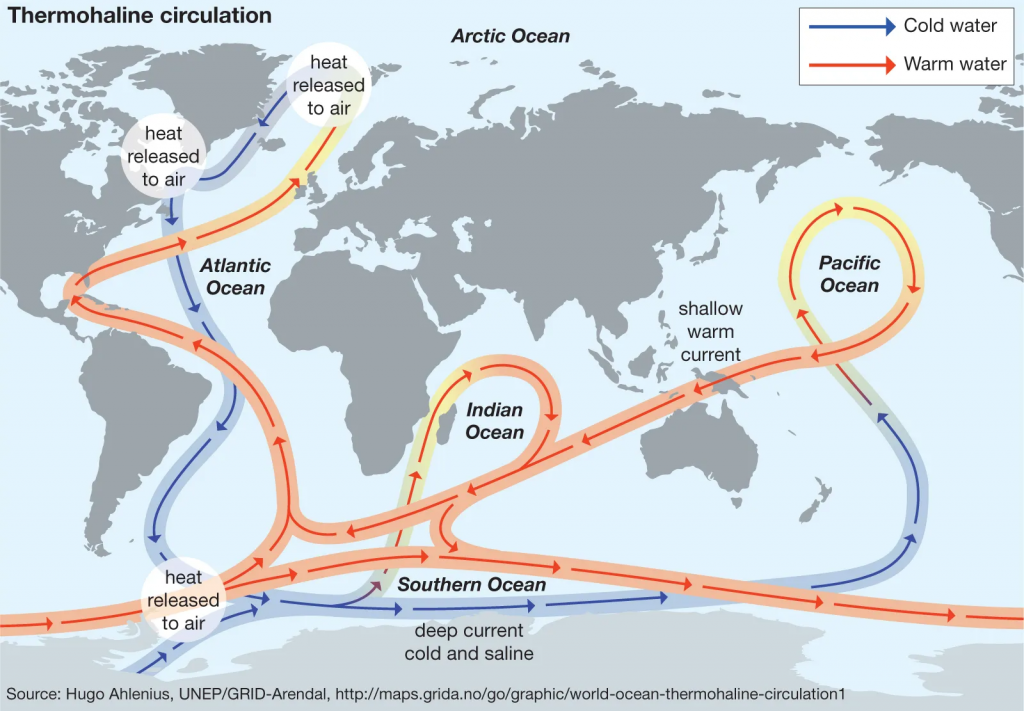
- It is a large ocean current system in the Atlantic that moves warm water northward and cold, dense water southward in a continuous cycle.
- It is a major part of the global ocean conveyor belt that distributes heat and nutrients across the world’s oceans.
- It transports warm surface water from the tropics to the Northern Hemisphere, where it cools and sinks, before flowing back southward as a deep current.
- From the South Atlantic, this water spreads into other oceans through the Antarctic Circumpolar Current.
Reasons for Weakening
- Global Warming: Rising temperatures reduce density contrasts, slowing down sinking currents.
- Freshwater Inflows: Melting of Greenland ice sheet and increased rainfall dilute salinity, weakening deep-water formation.
- Natural Variability vs Human Impact: Studies show weakening since the 1980s, with pauses due to natural oscillations, but anthropogenic drivers dominate long-term decline.
- Deep Ocean Changes: Antarctic Bottom Water inflows have reduced by ~12% (2000–2020), warming the deep Atlantic and raising sea levels.
Impacts of Weakening
- Regional Climate:North America & Europe: Colder winters, disrupted rainfall.
- Africa & South Asia: Monsoon weakening, drought risks.
- Sea-Level Rise: Slower circulation raises sea levels along the U.S. East Coast and globally.
- Marine Ecosystems: Alters nutrient flows, threatening fisheries.
- Carbon Cycle: Reduced carbon uptake by oceans, worsening atmospheric CO₂ levels.
- Extreme Events: Greater risk of hurricanes and heatwaves due to altered ocean-atmosphere dynamics.
Suggestions
- The AMOC is a key part of Earth’s climate system that regulates temperature, rainfall, and ocean health.
- Evidence shows it is weakening due to global warming and freshwater inflow, raising concerns about a possible collapse with severe global climate impacts.
- Hence, urgent emission reduction, better monitoring, and international cooperation are needed to avoid a climate tipping point.
Source :TH
Previous article
Virli Khandar Excavation
Next article
Delhi’s TOD Policy
