


US Sanction Waiver Expires on Chahbahar Port
Syllabus: GS2/IR
Context
- As US sanctions waiver expires, India is recalibrating its strategy at Iran’s Chabahar port, weighing options that could include a temporary exit without abandoning its long-term ambitions.
Background
- India and Iran signed an MoU in 2015 to jointly develop the Shahid Beheshti Port at Chabahar.
- Aim: To develop a major commercial hub helping India access the markets of Afghanistan, the Central Asian states, and Russia.
- Sanctions: The port’s prospects came under a cloud due to Western sanctions against Iran but in 2018, the US administration gave a waiver to Indian operations.
Chabahar Port
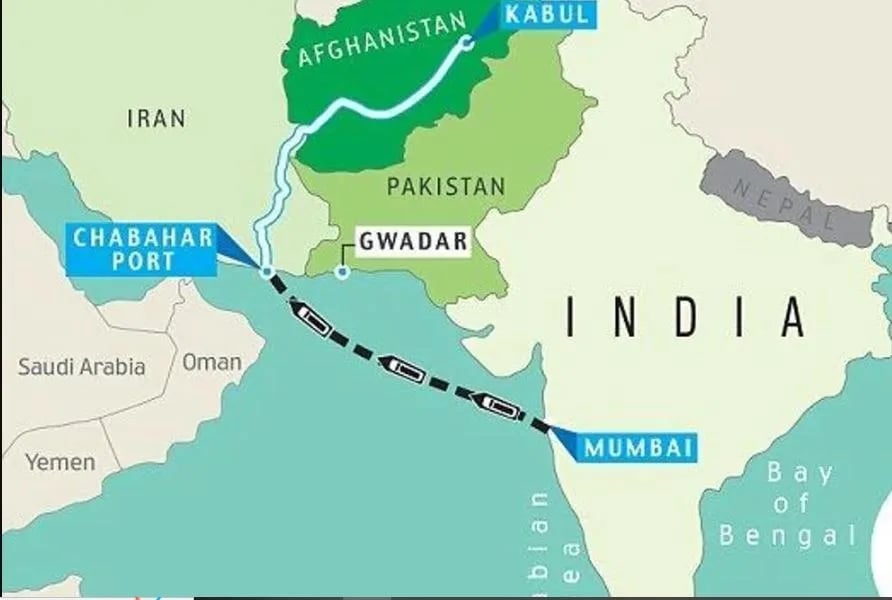
- Iran’s Chabahar port is located on the Gulf of Oman and is the only oceanic port of the country.
- It is situated in the city of Chabahar in Sistan and Baluchestan Province.
- The port gives access to the energy-rich Persian Gulf nations’ southern coast and bypasses Pakistan.
- Kandla port in Gujarat is the closest port at 550 nautical miles, while the distance between Chabahar and Mumbai is 786 nautical miles.
Significance of Chabahar Port for India
- Geopolitical Significance: It is strategically located at the crossroads of South Asia, Central Asia, and the Middle East. It provides India with direct sea access to Afghanistan and Central Asia, bypassing Pakistan.
- The port also offers an alternative route from the Strait of Hormuz for cargo traffic between Central Asian countries and Afghanistan. This diversification strengthens India’s strategic position in the region.
- Gateway to INSTC: Chabahar port will boost India’s access to Iran, the key gateway to the International North-South Transport Corridor (INSTC) that has sea, rail and road routes between India, Russia, Iran, Europe and Central Asia.
- Countering China: Chabahar port is beneficial to India in countering Chinese presence in the Arabian Sea which China is trying to ensure by helping Pakistan develop the Gwadar port.
- Trade Benefit: With Chabahar port becoming functional, there will be a significant boost in the import of iron ore, sugar and rice to India.
- The import cost of oil to India will also see a considerable decline.
Source: TH
Sahyog Portal
Syllabus: GS2/ Governance
Context
- India has joined a limited group of nations where platforms like Meta (Facebook and Instagram) automatically restrict flagged online content at scale.
What is the Sahyog Portal?
- It is a centralized digital interface launched in 2024 by the Ministry of Home Affairs (MHA) and operated by the Indian Cyber Crime Coordination Centre (I4C).
- The Portal serves as a single-window platform for authorized law enforcement agencies (LEAs) to issue speedy, coordinated notices for the removal or blocking of unlawful online content.
- Originally, it was conceived as an emergency tool during the pandemic. Later, it was repurposed in late 2024 into a primary mechanism for content regulation.
Legal Basis
- Section 79(3)(b) of the IT Act, 2000: The portal operates under this provision, which dictates that an intermediary loses its “safe harbour” (immunity from user-generated content liability) if it fails to “expeditiously” remove unlawful information upon being notified by the government.
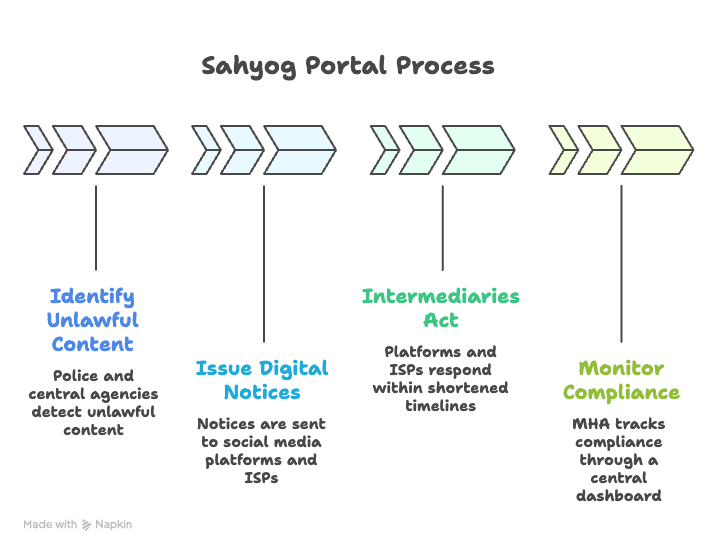
- Section 69A vs. Section 79: While Section 69A provides a formal blocking process with procedural safeguards (like written reasons), the government utilizes Section 79(3)(b) through Sahyog as a faster, parallel route for content takedowns.
Source: TH
Project AI4WaterPolicy
Syllabus: GS2/AI in Governance
Context
- Project AI4WaterPolicy helped community-led development in Rajasthan.
About
- The AI4WaterPolicy pilot project was designed in the water-stressed Sirohi and Pali districts of Rajasthan.
- Working with a field partner, an AI model conducted 352 interviews across 50 villages in six months.
- AI enabled real-time thematic analysis revealed issues like gender burden, funding delays, and lack of awareness of Panchayat processes.
- Significance: Insights led to mid-course policy correction (training redesign, govt interface), improving community engagement and demonstrating that AI can enable participatory, responsive governance rather than just automate services.
- The approach strengthened and complemented existing government efforts by enhancing feedback loops and improving last-mile responsiveness.
Source: TH
Small Hydro Power Development Scheme
Syllabus: GS3/Environment
In News
- Recently, the Union Cabinet has approved the Small Hydro Power (SHP) Development Scheme.
Did You Know?
- Hydropower is a well-established renewable energy source that uses flowing water to generate electricity.
- In India, the primary distinction between large and small hydropower projects lies in their installed capacity and the respective ministerial jurisdiction.
- Small Hydropower Projects (SHP) are defined as those with an installed capacity of up to 25 MW and are administered by the Ministry of New and Renewable Energy (MNRE).
- Large hydropower projects, with capacity exceeding 25 MW, fall under the purview of the Ministry of Power.
Small Hydro Power Development Scheme
- It promotes small hydropower as a long-lasting, eco-friendly energy source with minimal environmental impact.
- It aims to support inclusive growth by generating jobs, encouraging local investment, and strengthening regional economies, contributing to India’s self-reliant energy future
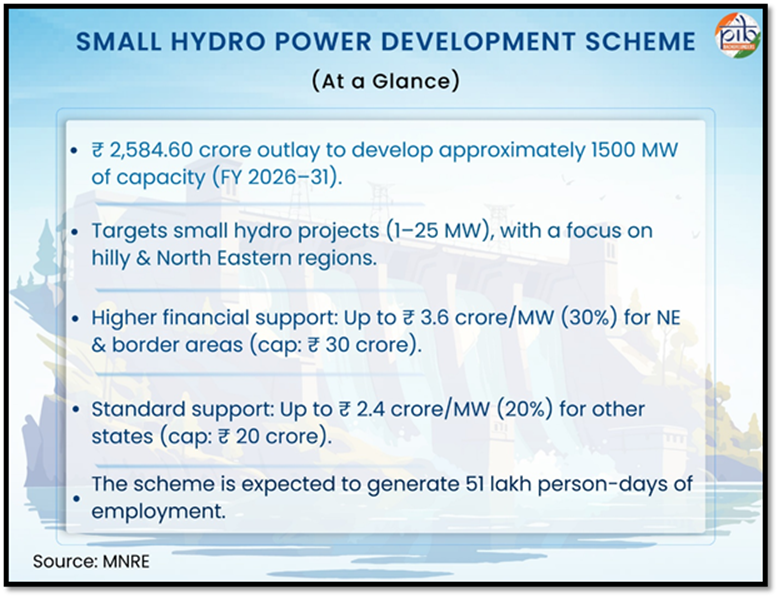
- It will support small hydro projects (between 1-25 MW capacity) to come up in different states.
- The scheme targets developing about 1,500 MW of small hydropower capacity, especially in hilly and North Eastern regions with untapped potential and limited energy access.
Importance
- Small hydropower (SHP) is an important source of clean, decentralised energy in India, especially suitable for remote and hilly regions.
- It generates electricity close to where it is used, reducing transmission losses and improving reliability.
- It is a clean and cost-effective energy option with no fuel use or emissions, and it supports rural development by improving electricity access and boosting local economies.
Small Hydro Power Potential and Prospects in India
- Small hydropower (SHP) is an important part of India’s clean energy transition, especially useful in remote and hilly areas where it supports decentralised power, better energy access, and local development.
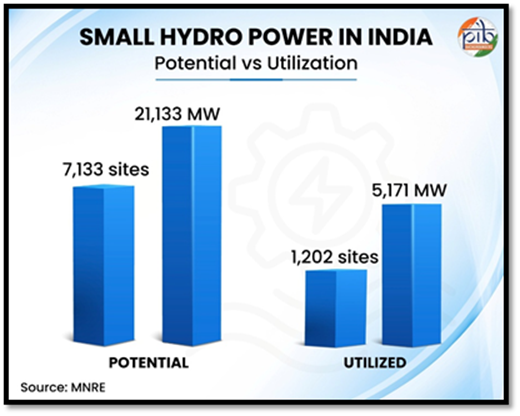
- India has a total SHP potential of 21,133 MW across 7,133 sites, of which about 5,171 MW (24.5%) has already been developed, leaving a large untapped capacity. This potential is spread across regions: North (38%) and North-East (15%) have major untapped resources, while the South (26%) and West (14%) have better infrastructure for faster development, and the East (7%) has scope in rural and tribal areas.
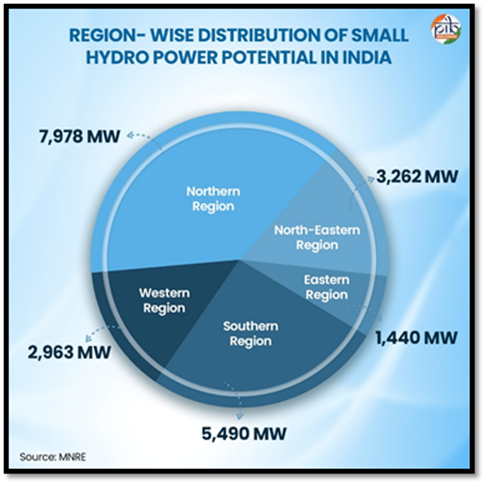
Source :PIB
Nilgiri Tahr Survey
Syllabus:GS3/Environment
In News
- Recently, The Tamil Nadu Forest Department has commenced the third synchronised survey of the Nilgiri Tahr (TN’s State Animal) under the flagship Project Nilgiri Tahr.
Nilgiri Tahr
- It is the only mountain ungulate in southern India among the country’s 12 such species and is the state animal of Tamil Nadu.
- Historical linkages : There are multiple references to Nilgiri Tahr in the Sangam Tamil literature.
- Two epics — Silappathikaram and Sivakasindamani — mention descriptions of the Nilgiri Tahr and its habitat.
- Habitat and Distribution: The Nilgiri tahr is found at high elevations on cliffs, grass-covered hills, and open terrain.
- Nilgiri Tahr is now largely confined to isolated patches of suitable habitat in the states of Kerala and Tamil Nadu.
- The Eravikulam National Park in Anamalai hills, Kerala, is home to the largest population of the Nilgiri tahr
- Threats : Its numbers have declined significantly due to habitat loss and hunting.
- Protection status : It is classified as Endangered on the IUCN Red List and is protected under Schedule I of India’s Wildlife (Protection) Act, 1972.
- Steps :
- Project Nilgiri Tahr was launched in 2023 and focuses on comprehensive conservation strategies, including habitat management, population monitoring, and the use of advanced scientific methods with support from global experts.
Source:TH
Skyroot’s Vikram-1
Syllabus: GS3/Science & Technology
Context
- Skyroot Aerospace has dispatched its first orbital rocket, Vikram-1, to the Satish Dhawan Space Centre for final integration and launch preparations, marking a key step toward India’s first private orbital launch.
About Vikram-1 Launcher
- Vikram-1 is a multi-stage launch vehicle using both solid and liquid fuel-based propulsion systems.
- It is designed to launch satellites up to 350 kg into Low Earth Orbit (LEO).
- LEO lies between 160–2,000 km above Earth and has seen a surge in satellite launches in recent years, with many being the Starlink communication satellites.
- The rocket is made of carbon composite instead of metals, and houses a 3D-printed indigenously made engine making its manufacturing and assembly easier, quicker and cheaper.
- The launch vehicle has been named to honour Dr Vikram Sarabhai, considered to be the father of the Indian space programme, and its propulsion systems honour several other scientific greats — the solid propulsion system is called Kalam, the liquid Raman, and the cryogenic Dhawan.
Do you know?
- Skyroot, founded by Pawan Chandana and Bharath Dhaka, was also the first private company to carry out a single-stage sub-orbital flight in 2022, followed by another company, Agnikul.
- A sub-orbital flight is launched at a slower speed than the orbital velocity, so it reaches outer space but cannot get into an orbit around Earth.
Source: IE
Ashok Kumar Lahiri Appointed NITI Aayog Vice Chairperson
Syllabus: GS2/Polity and Governance
Context
- The Prime Minister, Narendra Modi, has reconstituted NITI Aayog, appointing noted economist Ashok Lahiri as Vice-Chairperson and replacing four of its five full-time members.
About NITI Aayog
- Established: NITI (National Institution for Transforming India) Aayog is a government think tank established in 2015.
- Aim: It replaced the Planning Commission, aiming to focus on more contemporary challenges like sustainable development, policy innovation, and governance reforms.
- Composition: It is led by the Prime Minister as the Chairperson, with the Vice-Chairperson and CEO leading the executive functions.
- Governing Council: The Prime Minister of India,
- It comprises the Chief Ministers of states and Union Territories,
- The Lieutenant Governors of Union Territories, except Delhi and Puducherry,
- The Vice Chairman of NITI Aayog,
- Full-time members of NITI Aayog.
The key differences between the Planning Commission and NITI Aayog are:
| Aspect | Planning Commission | NITI Aayog |
| Purpose | Centralized five-year planning and resource allocation. | Focus on cooperative federalism, long-term development, and policy research. |
| Structure | Led by the Prime Minister with a Deputy Chairman and full-time members. | Led by the Prime Minister with a Vice-Chairperson, CEO, and Governing Council. |
| Approach | Top-down, centralized planning. | Bottom-up, encouraging state participation and cooperation. |
| Role in Governance | Executive authority over policy implementation. | Advisory body, without direct enforcement power. |
| Five-Year Plans | Formulated and implemented Five-Year Plans. | Does not formulate Five-Year Plans, focuses on long-term policy. |
Source: PIB
B’nei Menashe
Syllabus: Miscellaneous
In News
- About 250 members of the B’nei Menashe community from Manipur and Mizoram arrived in Tel Aviv, claiming descent from one of the Ten Lost Tribes of Israel.
B’nei Menashe
- The B’nei Menashe belong to the Mizo and Kuki tribal communities across Manipur and Mizoram.
- The B’nei Menashe believe they descend from the biblical tribe of Tribe of Manasseh, which is said in Jewish tradition to have been exiled after the Assyrian conquest of Israel around 722 BCE.
- Their migration story traces a long journey through Persia and Afghanistan to Northeast India, though historical proof is uncertain.
- Their belief developed through a mix of 19th–20th century Christian missionary influence, local revival movements, and later contact with Jewish organisations such as Amishav, which encouraged identification with ancient Israel.
- From the 1980s, many adopted Judaism, migrated to Israel in small groups, and were later partially recognised by Israeli religious authorities, though scientific evidence remains inconclusive and their status has been debated.
- Today, thousands have moved to Israel with government support, though some face social discrimination there.
- Other similar claims of “lost tribe” descent exist in India and nearby regions, including the B’nei Ephraim and some Pashtun groups in Afghanistan and Pakistan.
Source :IE
Right to Safe Travel on National Highways
Syllabus: Miscellaneous
Context
- The Supreme Court of India has held that the right to safe travel on National Highways (NHs) is part of the right to life under Article 21.
Constitutional Interpretation
- The Court clarified that Article 21 imposes a positive obligation on the State to ensure a safe environment for commuters.
- Deaths caused by avoidable hazards such as illegal parking, potholes, or unsafe infrastructure amount to a failure of this duty.
Key Directions by the Court
- The Court imposed an immediate ban on construction or operation of new dhabas, eateries, or commercial structures within the right-of-way of NHs.
- It prohibited parking or stopping of heavy and commercial vehicles on highways, carriageways, or paved shoulders, except at designated lay-bys or wayside amenities, to prevent accidents in blind spots.
- District Magistrates have been directed to remove or demolish all unauthorised structures within 60 days.
- No authority can grant licenses or approvals within highway safety zones without prior clearance from NHAI or PWD.
- A District Highway Safety Task Force must be established in every district to monitor and enforce safety norms.
Significance
- The ruling expands Article 21 to include road safety, making the State accountable for preventing avoidable highway deaths.
Source: TH
Previous article
“Moving Towards Effective City Government – A Framework for Million-Plus Cities” Report
Next article
India and New Zealand Signed FTA
