

Syllabus: GS3/Biotechnology
Context
- With the agriculture industry projected to grow 2.5 times by 2033, biotech experts underscored the growing importance of agri-biotechnology in the coming years.
- Scientists have warned that with every one degree Celsius increase in temperature, India’s wheat yield could decline by 6% to 10%.
What is Climate-resilient Agriculture (CRA)?
- Climate-resilient agriculture uses a range of biotechnology and complementary technologies to guide farming practices and reduce dependence on chemical inputs, while maintaining or improving productivity.
- Tools include: Biofertilizers and biopesticides, and soil-microbiome analyses.
- Genome-edited crops can be developed to withstand drought, heat, salinity, or pest pressures.
- AI-driven analytics can integrate multiple environmental and agronomic variables to generate locally tailored farming strategies.
India’s Bioeconomy
- India is among the Top 12 destinations for biotechnology worldwide and 3rd largest destination for biotechnology in Asia Pacific.
- India’s bioeconomy has grown sixteen-fold from $10 billion in 2014 to an impressive $165.7 billion in 2024.
- Contributing 4.25% to the national GDP, the sector has demonstrated a robust compound annual growth rate (CAGR) of 17.9% over the past four years.
- India’s Biotechnology sector is categorised into Biopharmaceuticals, Bio agriculture, Bio IT and Bio Services.
- Future Goals: Target of achieving a $300 billion bioeconomy by 2030.
- India also seeks to lead globally in bio-pharma, including vaccines, diagnostics, and therapeutics.
Why does India need CRA?
- Agricultural Economy: India is an agricultural nation with a rapidly growing population, which places increasing pressure on the need for higher and more reliable farm productivity.
- Around 51% of India’s net sown area is rainfed, and produces nearly 40% of the country’s food, making it especially vulnerable to climate variability.
- Conventional Farming Methods are not enough: These methods alone may not withstand the rising stresses of climate change.
- Recent modelling suggests that by the end of the century, yields of staple crops like rice could fall by 3-22%, and in worst-case scenarios by more than 30%.
- Enhanced Productivity: Climate-resilient agriculture offers a suite of technologies that can enhance productivity while protecting environmental health.
- It can also reduce India’s reliance on food imports and strengthen the country’s strategic autonomy in the food sector.
Global Scenario
- The U.S. integrates CRA into federal policy through the USDA Climate-Smart Agriculture and Forestry (CSAF) initiative, investing billions in climate-smart practices.
- CRA is embedded in the EU Green Deal and Farm to Fork Strategy, both aiming to reduce chemical inputs and enhance sustainability.
- China’s CRA strategy centres on climate-tolerant crop breeding, large-scale water-saving irrigation, and agricultural digitalisation.
- Brazil leads in tropical climate-resilient crop development, driven by EMBRAPA’s biotechnology research.
Challenges
- Low Adoption: CRA techniques adoption is low among small and marginal farmers due to limited access, awareness, and affordability, and quality inconsistencies in biofertilizers and biopesticides that undermine trust in biological alternatives.
- Uneven Distribution: The rollout of climate-resilient seeds remains slow, with the adoption of new tools such as gene editing still emerging and uneven distribution across States.
- The digital divide limits the reach of precision agriculture and AI-based decision tools.
- These challenges are compounded by ongoing soil degradation, water scarcity, and accelerating climate volatility, which may outpace current adaptation efforts.
- Fragmented policy coordination further risks slowing progress.
Use of Biotechnology in Agriculture
- The Department of Biotechnology’s Agriculture Biotechnology programme supports innovative biotechnological research for achieving sustainable agriculture by leveraging the latest advances in technologies.
- The main achievements include:
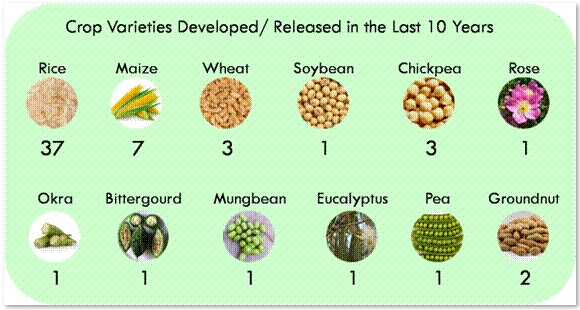
- Climate-Smart Crops: A New Superior Climate Smart Drought Tolerant High-Yielding Chickpea Variety “SAATVIK (NC 9)” with enhanced yield under drought stress was notified recently.
- Genome-Edited Crops: Genome editing was employed to generate loss of function mutations in several rice genes that negatively regulate crop productivity.
- Amaranth Genetic Resources: The department of biotechnology has developed an Amaranth Genomic Resource Database, Near Infrared Spectroscopy (NIRS) techniques for screening nutritional qualities of amaranth grain, and a 64K SNP chip.
- Amaranth accessions screened using the above resources have been shown to counteract high fat diet induced obesity.
- Fungal Biocontrol: A stable fungal enzyme nano-formulation from Myrothecium verrucaria has been developed for eco-friendly biocontrol of powdery mildew in tomato and grape.
Government Initiatives
- National Innovations in Climate Resilient Agriculture: In 2011, the Indian Council of Agricultural Research (ICAR) launched a flagship network project ‘National Innovations in Climate Resilient Agriculture’.
- The National Mission for Sustainable Agriculture has been formulated to enhance agricultural productivity, especially in rainfed areas, focusing on integrated farming, water use efficiency, soil health management, and synergising resource conservation.
- The BioE3 policy also positioned CRA as a key thematic area for the development of biotechnology-led solutions.
- Leading companies such as Biostadt, IFFCO, GSFC, NFL, and IPL Biologicals supply bio-inputs that improve soil health and reduce chemical dependence.
- India also has an expanding digital agriculture sector, with agritech startups offering AI-enabled advisories, precision irrigation, crop-health monitoring, and yield prediction tools.
Way Forward
- There is a need to accelerate the development and deployment of climate-tolerant and genome-edited crops.
- Financial incentives, climate insurance, and credit access are essential to support farmers during the transition.
- India needs a coherent national CRA roadmap under the BioE3 framework, aligning biotechnology, climate adaptation, and policies to deliver resilience at scale.
Source: TH
Next article
India’s Payment Revolution
