


Syllabus: GS3/ Environment
Context
- The Government of India has directed that no new environmental clearances will be granted for hydrofluorocarbon (HFC) production projects beyond December 31, 2027.
- It is aligned with India’s commitments under the Montreal Protocol and the Kigali Amendment.
Background
- Under the Kigali Amendment, the Parties to the Montreal Protocol will phase down production and consumption of Hydrofluorocarbons, commonly known as HFCs.
- Hydrofluorocarbons were introduced as non-ozone depleting alternatives to Chlorofluorocarbons (CFCs).
- While HFCs do not deplete the stratospheric ozone layer, they have high global warming potential ranging from 12 to 14,000, which have adverse impact on climate.
- Hence Parties to the Montreal Protocol, reached agreement at their 28th Meeting of the Parties (MOP) held in in Kigali, Rwanda to add HFCs to the list of controlled substances and approved a timeline for their gradual reduction by 80-85 per cent by the late 2040s.
- India will complete its phase down of HFCs in 4 steps from 2032 onwards with cumulative reduction of 10% in 2032, 20% in 2037, 30% in 2042 and 85% in 2047.
What is an Ozone Layer?
- The ozone layer is a trace gas in the stratosphere, one of the four layers of the Earth’s atmosphere.
- It is found between 15 to 35 kilometers above Earth.
- Ozone creation: Ozone is composed of three atoms of Oxygen.The production of ozone in the stratosphere results primarily from the breaking of the chemical bonds within oxygen molecules (O2) by high-energy solar photons.
- This process, called photodissociation, results in the release of single oxygen atoms, which later join with intact oxygen molecules to form ozone.
- Good and Bad Ozone: Stratospheric ozone (Good Ozone) is formed naturally through the interaction of solar ultraviolet (UV) radiation with molecular oxygen (O2).
- Tropospheric or ground-level ozone (Bad Ozone), what humans breathe, is formed primarily from photochemical reactions between (VOC & NOX).
- Significance: It functions as a protective gas shield that absorbs ultraviolet radiation, protecting humans and ecosystems from dangerous amounts of UV radiation causing skin cancers.
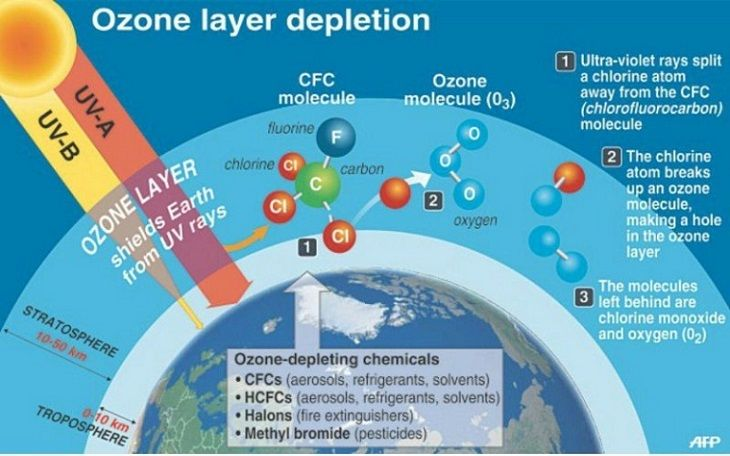
Conventions for Protection of Ozone layer
- Vienna Convention: First convention for the protection of the Ozone layer.
- To promote cooperation among nations by exchanging information on the effects of human activities.
- Montreal Protocol: It is a legally binding treaty adopted in 1987, on Substances that Deplete the Ozone Layer. It is the first United Nations treaty to achieve universal ratification, with all 198 UN member states as parties.
- India became a Party to the Montreal Protocol in 1992.
- It successfully phased out ozone-depleting substances such as chlorofluorocarbons (CFCs).
- Kigali Agreement: Around 197 countries agreed at Kigali to reduce the use of Hydrofluorocarbons (HFCs) by roughly 85% of their baselines by the late 2040s, by amending the 1987 Montreal Protocol.
- India ratified the Kigali Amendment in 2021.
Way Ahead
- The government should promote research and development in alternative refrigerants with low global warming potential.
- There must be provisions for financial incentives and policy support to industries for smooth transition.
- India should strengthen international cooperation for technology transfer and climate finance.
Source: IE
Previous article
RBI Holds Repo Rate at 5.25 per cent
Next article
Dedicated Freight Corridor (DFC)
