


Syllabus: GS3/ Economy
Context
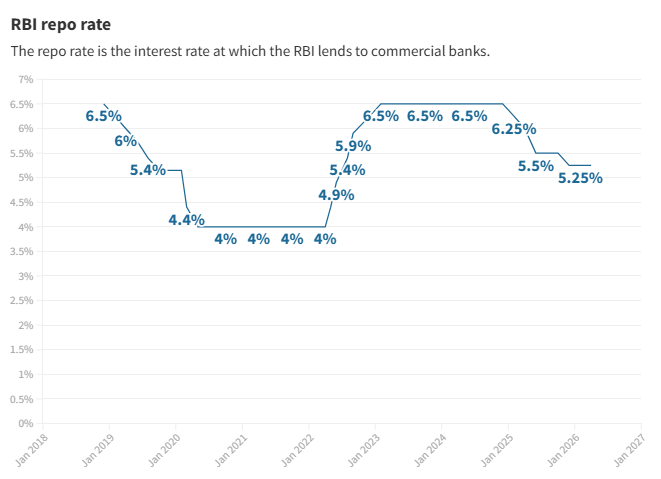
- The Monetary Policy Committee of the Reserve Bank of India decided to keep the repo rate unchanged at 5.25%.
About
- The Standing Deposit Facility (SDF) rate remains at 5 per cent and the Marginal Standing Facility (MSF) rate and the bank rate at 5.5 per cent.
- The real GDP growth for 2026-27 is projected at 6.9%, with Q1 at 6.8%; Q2 at 6.7%; Q3 at 7.0%; and Q4 at 7.2%.
- The inflation is projected for FY27 to be at 4.6 percent, with 4.0 percent in Q1, 4.4 percent in Q2, 5.2 percent in Q3, and 4.7 percent in Q4.
What is the Repo Rate?
- The repo rate is the rate at which the RBI lends short-term money to commercial banks. It is the key policy tool used by the RBI to control liquidity, inflation, and economic growth.
- A lower repo rate means banks can borrow from the RBI at cheaper rates. This encourages banks to lower lending rates, leading to:
- Easier access to credit for consumers and businesses
- Boost in investment, consumption, and economic activity
- Increased liquidity and money supply
- This can stimulate growth, especially during economic slowdowns.
| What is the Monetary Policy Committee (MPC)? – The MPC is a statutory body established under the RBI Act, 1934 (amended in 2016). – It is responsible for fixing the benchmark interest rate (repo rate) to maintain price stability while keeping growth in mind. 1. It consists of 6 members: (a). 3 from the RBI (including the Governor as Chairperson), (b). 3 external members appointed by the Government. – Functioning: It meets at least four times a year (usually bi-monthly) and the decisions are made by majority, and each member has one vote. In case of a tie, theRBI Governor has the casting vote. Flexible Inflation Targeting Framework (FITF) – India adopted a Flexible Inflation Targeting Framework (FITF) in 2016. – Under this, the government, in consultation with the RBI, sets an inflation target every five years.Under this framework, the Government sets the inflation target every five years in consultation with the RBI. The current mandate, effective until March 31, 2026, specifies a CPI inflation target of 4%, with a tolerance band of ±2%, i.e. between 2% and 6%. Monetary Policy Tools in India Various instruments used by the RBI to control the money supply can be categorized into two categories: – Quantitative Tools – Quantitative tools of monetary policy are aimed at controlling the cost and quantity of credit. – Qualitative Tools – Qualitative tools of monetary policy are aimed at controlling the use and direction of credit. 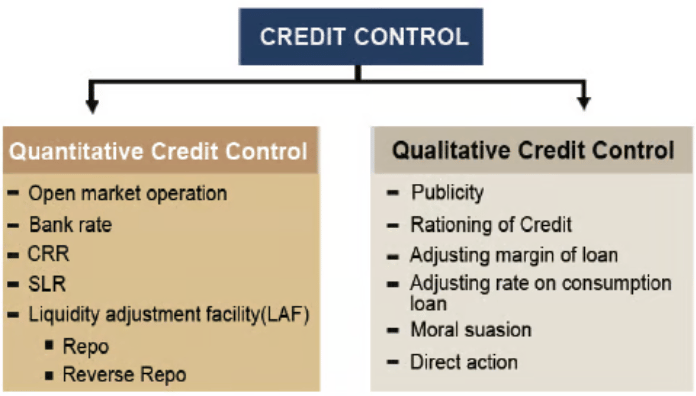 Quantitative Tools – Repo Rate: Rate at which RBI lends short-term funds to banks against collateral.Reverse Repo Rate: Rate at which RBI absorbs liquidity from banks. – Cash Reserve Ratio (CRR): Portion of deposits banks must keep with RBI in cash. – Statutory Liquidity Ratio (SLR): Portion of deposits kept in liquid assets (gold, cash, securities). – Open Market Operations (OMO): Buying/selling of government securities to control liquidity. – Marginal Standing Facility (MSF): Emergency borrowing by banks at a penal rate. – Liquidity Adjustment Facility (LAF): Framework for repo/reverse repo operations. – Market Stabilisation Scheme (MSS): Bonds issued to absorb excess liquidity. Qualitative Tools – Margin Requirement: Controls loan-to-value ratio – Consumer Credit Regulation: Regulates credit terms – Rationing of Credit: Limits sectoral lendingMoral Suasion: Persuasive guidance by RBI – Direct Action: Penal action against non-compliant banks |
Reasons Behind the recent Policy Decision
- Geopolitical Uncertainty: The MPC decided to maintain the repo rate due to heightened geopolitical tensions in West Asia, which have worsened global economic uncertainty.
- Supply-Side Shock: The MPC highlighted that the Indian economy is facing a supply-side shock, primarily due to disruptions in energy and commodity markets.
- Inflation Within the Target Range: Retail inflation remains within the 2–6% target band, and core inflation is contained limiting the need for immediate policy action.
- Impact of Trade Agreements: India recently signed trade agreements with the United States, the European Union, Oman and New Zealand.
- These agreements are expected to boost exports and investments, reduce external vulnerabilities, and support medium-term growth.
Impact on the Indian Economy
- Impact on Borrowers and Households: Stable interest rates reduce financial uncertainty for middle-class households and housing loan borrowers.
- Impact on Investment and Credit Growth: Stable interest rates, strong demand conditions, and trade agreements create a predictable environment for private investment.
- Macroeconomic Stability: The decision reinforces the credibility of India’s Flexible Inflation Targeting framework and demonstrates institutional stability in monetary policymaking.
Way Ahead
- Safeguard External Sector Stability: Active liquidity management, prudent forex reserve deployment, and monitoring of global financial conditions are necessary to cushion against external shocks.
- Enhance Fiscal-Monetary Coordination: Continued fiscal consolidation alongside targeted public spending will complement monetary policy and sustain long-term growth without triggering inflationary pressures.
Source: TH
Previous article
News In Short 09-04-2026
Next article
Phasing Down Hydrofluorocarbons (HFCs) in India
