


Vinayak Damodar Savarkar
Syllabus: GS1/ Modern History
Context
- A criminal defamation case involving remarks on Vinayak Damodar Savarkar has brought attention to the origin of the title Swatantryaveer, before a Pune court.
Vinayak Damodar Savarkar
- Vinayak Damodar Savarkar (1883–1966), popularly known as Veer Savarkar, was a prominent freedom fighter, political thinker, and writer.
- He is associated with the development of the Hindutva ideology and played a significant role in revolutionary nationalism during the freedom struggle.
- Education: Savarkar studied at Fergusson College in Pune and later travelled to London to study law.
- Role in freedom struggle: He founded the Abhinav Bharat Society in 1904, a secret organisation dedicated to armed revolution against British rule.
- While in London, he led the India House and the Free India Society, training Indian students in methods of sabotage and assassination.
- Hindu Mahasabha: He served as the president of the Hindu Mahasabha from 1937 to 1943, advocating for a “Hindu Rashtra” (Hindu Nation).
- Social Reform: Savarkar was a staunch opponent of the caste system and untouchability.
- Literary Work: He authored The Indian War of Independence, 1857, which was the first work to describe the 1857 rebellion as India’s first struggle for independence.
Source: TH
Sijimali Bauxite Mine
Syllabus: GS1/ Resources
In Context
- Recent violent clashes between tribal villagers and police in Odisha’s Rayagada district have drawn national attention to the Sijimali bauxite mine project.
About
- Sijimali is a high-grade bauxite reserve spanning 1,500 hectares across the Rayagada and Kalahandi districts of Odisha, situated within the Eastern Ghats hill ranges.
- It holds an estimated 311 million tonnes of bauxite ore and was handed over to Vedanta Limited through a government auction in 2023.
- The project has recently received conditional Stage-1 forest clearance from the Central government.
Key Facts
- The bauxite extracted from Sijimali is intended for refining into alumina, the primary raw material for aluminium production.
- Odisha dominates India’s bauxite sector, accounting for 41% of national bauxite resources and approximately 73% of total bauxite production as of 2021-22.
- Key bauxite sites include Panchpatmali (operated by NALCO, one of the world’s largest bauxite mines), Gandhamardan (Bargarh-Balangir, ecologically sensitive), Niyamgiri (where 12 Gram Sabhas rejected Vedanta’s mining bid in 2013), and Sijimali.
Source: TH
Madman Theory
Syllabus: GS2/ International Relation
In Context
- The West Asian crisis enters a “fog of ceasefire,” a fragile pause generating competing US and Iran victory claims. US President’’s “madman theory” and backchannel diplomacy brokered the uncertain truce.
About Madman Theory
- The Madman Theory is a foreign policy and strategic doctrine in which a leader deliberately cultivates an image of being unpredictable, irrational, or willing to take extreme action, with the aim of making adversaries believe that escalation including war or even nuclear confrontation is possible.
- The term is most closely associated with Richard Nixon and his National Security Adviser Henry Kissinger during the Cold War, particularly in the context of the Vietnam War.
- The theory fundamentally functions through psychological signalling, focusing on shaping the adversary’s perception rather than on immediate military action.
- In the short term, it can strengthen deterrence and crisis diplomacy if the threat is believed; however, over the long term, it risks reducing trust among allies and weakening a country’s reputation as a stable and reliable global actor.
Source: IE
Deepening of India–Denmark Economic Ties
Syllabus: GS2/ International Relations, GS3/ Economy
Context
- Denmark has announced the establishment of the first Danish Chamber of Commerce in India, to be set up in New Delhi.
About
- The chamber will facilitate business engagement between India and Denmark by providing an institutional platform for interaction.
- It will support Danish companies already operating in India as well as those planning to enter the Indian market.
India–Denmark Relations
- Diplomatic relations between India and Denmark were formally established in 1949.
- The bilateral relations were elevated to a Green Strategic Partnership in 2020.
- Economic Relations: India and Denmark share over 400 years of trade relations. More than 225 Danish subsidiaries operate in India, employing over 1 lakh people.
- The total volume of bilateral trade in goods and services between India and Denmark is around $7.8 billion in 2024.
- India exports textiles, vehicles and components, iron and steel, metal goods, and leather products to Denmark.
- Denmark exports pharmaceutical products, power-generating machinery, industrial machinery, metal waste, ores, and organic chemicals to India.
- India and Denmark signed a Migration and Mobility Partnership Agreement in February 2024 to facilitate movement of skilled professionals.
Source: IE
World Homoeopathy Day 2026
Syllabus: GS2/ Health
Context
- World Homoeopathy Day is observed every year on April 10 to commemorate the birth anniversary of Dr Samuel Hahnemann (1755–1843), a German physician and founder of Homoeopathy.
About Homoeopathy
- Homoeopathy is a system of medicine based on the principle of “like cures like”meaning substances that cause symptoms in a healthy person can help treat similar symptoms in a patient.
- The term comes from the Greek words Homois (similar) and Pathos (suffering). It was formalised in 1796 by a German physician Samuel Hahnemann, whose work Organon of Medicine continues to guide its practice.
- Homoeopathic medicines are prepared from natural sources like plants, minerals, and animals through a process of dilution and succussion. A key feature is its individualised approach, where treatment focuses on the overall physical and mental condition of the patient rather than just the disease.
- The theme for 2026 is “Homoeopathy for Sustainable Health.” It aligns with global goals such as Universal Health Coverage and the United Nations Sustainable Development Goals, especially SDG 3 (Good Health and Well-being).
Homoeopathy in India
- Homoeopathy was introduced in India in the early 19th century, around 1810, and gradually gained acceptance.
- John Martin Honigberger, a disciple of Samuel Hahnemann, played a key role in its spread, especially after successfully treating Maharaja Ranjit Singh in 1839.
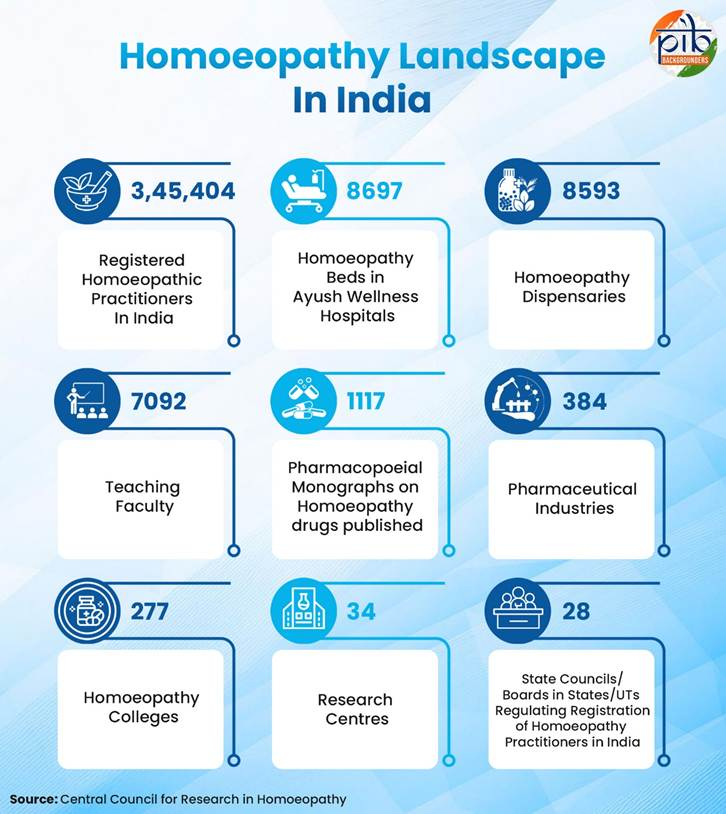
- The National Commission for Homoeopathy (NCH) was established under the National Commission for Homoeopathy Act, 2020, which came into effect on 5 July 2021, replacing the Central Council of Homoeopathy as the regulatory body.
- Homoeopathy is a part of AYUSH (Ayurveda, Yoga and Naturopathy, Unani, Siddha and Homoeopathy), which comes under the Ministry of AYUSH, established in 2014.
Source: PIB
Morchella Mushrooms
Syllabus: GS3/ Agriculture
In News
- Researchers at Sheri Kashmir University of Agricultural Sciences and Technology, have for the first time successfully cultivated Morchella (Morel mushroom).
About Morchella (Morel mushroom)
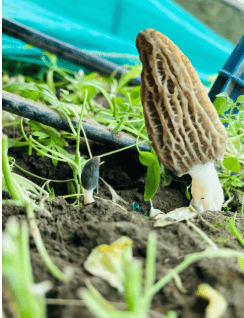
- Morchella, locally known as Kangaech in Kashmir, is a rare, high-value edible fungus that naturally grows in specific high-elevation forest ecosystems during a narrow rainy season.
- It commands a market price of ₹15,000 to ₹40,000 per kilogram.
- The mushroom is prized for its intense flavour, superior nutritional profile, and medicinal properties including antioxidant, antitumor, & antimicrobial properties.
- Cultivation of Morchella has long been a major scientific challenge due to its complex life cycle, symbiotic ecological behaviour, and highly specific environmental requirements.
- It is not commercially cultivated anywhere in India.
Source: IE
Naphthalene Diimide (NDI)
Syllabus: GS3/ S&T
In News
- Researchers have discovered that the structural and electrical properties of an organic nanomaterial called Naphthalene Diimide (NDI) can be switched using only temperature.
About
- NDI is a specialised amphiphilic molecule meaning it possesses both water-attracting (hydrophilic) and water-repelling (hydrophobic) parts which enables it to self-organise into complex structures when placed in water.
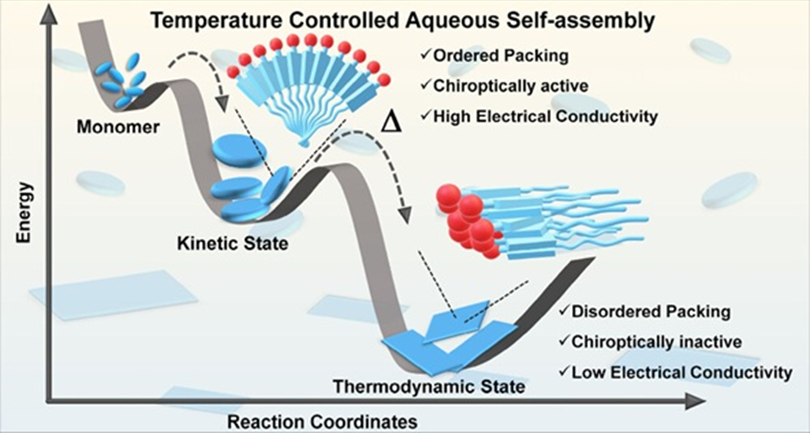
- In water at room temperature, NDI molecules assemble through noncovalent interactions to form tiny circular nanodisks that are highly electrically conductive and interact with polarised light.
- Upon heating, these nanodisks undergo structural reorganisation and transform into two-dimensional nanosheets, which lose the light-interacting properties of the original disks and experience a nearly sevenfold drop in electrical conductivity.
- This phenomenon is an example of supramolecular self-assembly, a process where molecules spontaneously organise into well-defined structures using weak noncovalent interactions rather than strong chemical bonds, with the final architecture determined by environmental conditions such as temperature or solvent.
Significance
- The discovery has significant applications in organic electronics, smart sensors, tunable optoelectronics, bioelectronic interfaces, and adaptive materials that can dynamically alter their properties in response to external stimuli.
Source: TH
Central Armed Police Forces
Syllabus: GS3/ Internal Security
In News
- The Centre has notified the Central Armed Police Forces (General Administration) Act, 2026, which creates a unified legal framework to regulate the recruitment, deputation, promotion, and conditions of service for officers.
About
- India maintains seven armed police organisations collectively known as Central Armed Police Forces, all functioning under the Ministry of Home Affairs (MHA).
- These are the Assam Rifles, Border Security Force, Central Industrial Security Force, Central Reserve Police Force, Indo-Tibetan Border Police, National Security Guard, and Seema Suraksha Bal.
- The Assam Rifles is unique because it is under dual control. While the MHA handles its administration (salary, infrastructure), its operational command rests with the Ministry of Defence.
- Each force is commanded by an officer of the Director General of Police (DGP) rank.
Source: TH
Punatsangchhu-II Hydroelectric Project (PHEP-II)
Syllabus: MIscllenous
In News
- India and Bhutan have signed the Protocol to the Agreement on the Punatsangchhu-II Hydroelectric Project (PHEP-II) Export Tariff.
About
- The Punatsangchhu Hydroelectric Projects are a set of two major run-of-the-river hydropower projects built on the Punatsangchhu River in Bhutan, developed under the India–Bhutan bilateral energy cooperation framework.
- Punatsangchhu-I has an installed capacity of 1,200 MW and is currently under construction & Punatsangchhu-II has an installed capacity of 1,020 MW, is fully operational, and has been exporting surplus electricity to India since September 2025.
Source: PIB
Previous article
Dedicated Freight Corridor (DFC)
