


Raja Ravi Varma
Syllabus: GS1/ Art and Culture
Context
- The painting Yashoda and Krishna by Raja Ravi Varma was sold for ₹167.2 crore at an auction conducted by Saffronart, setting a record for Indian art.
- The painting was created in the 1890s during the peak of Raja Ravi Varma’s artistic career.
About Raja Ravi Varma
- Raja Ravi Varma (1848–1906) was born in Kilimanoor, in present-day Kerala.
- He is regarded as a pioneer of modern Indian art for introducing European academic realism into Indian themes.
- He worked under royal patronage, particularly of the Travancore royal family.
Key Contributions & Legacy
- Humanising the Divine: He was among the first Indian artists to depict Hindu gods and goddesses in realistic human form, with anatomical accuracy and emotional expression.
- Democratization of Art: In 1894, he established the Ravi Varma Fine Arts Lithographic Press in Bombay (later shifted to Malavli near Lonavala).
- The press produced oleographs (colour lithographs) of Hindu deities like Lakshmi and Saraswati.
- Famous Artworks: Hamsa Damayanti, Shakuntala, Jatayu Vadham, Lady in the Moonlight etc.
Source: TH
Kar Saathi
Syllabus: GS3/ Economy
In Context
- An AI-enabled digital chatbot platform launched by the Income Tax Department to provide 24×7 guidance on direct tax matters under the new Income Tax Act, 2025 framework.
About
- It provides round-the-clock assistance for queries related to ITR filing, tax provisions, forms, notices, deductions, refunds, and compliance.
- It brings all direct tax-related resources such as forms, challans, e-payment, e-verification, and FAQs under one platform.
- Supports taxpayer grievance resolution and compliance queries.
Significance
- Part of India’s broader push toward AI-driven digital governance.
- Facilitates smooth transition to the Income Tax Act, 2025.
Source: TH
E20 Petrol
Syllabus: GS3/ Environment
In Context
- India has officially mandated the nationwide rollout of E20 petrol at all fuel stations from April 1, 2025.
About
- It marks a significant milestone in India’s Ethanol Blended Petrol (EBP) Programme, which originally targeted 20% blending by 2030 but was advanced to 2025 under the revised National Biofuel Policy (2022).
- The mandate is being implemented jointly by the Ministry of Petroleum and Natural Gas and the Bureau of Indian Standards (BIS).
- Ethanol used in the blend is a biofuel derived from agricultural feedstocks primarily sugarcane, maize, damaged food grains, and surplus rice. It is produced through fermentation and distillation of these crops, making it a renewable and domestically sourced energy input.
- E20 petrol carries a higher octane rating of approximately 95 RON compared to 91–92 RON of regular petrol — meaning smoother engine combustion and better anti-knock performance.
Significance
- Energy Security: Reduces crude oil import dependence, India imports over 85% of its oil needs, making it highly vulnerable to global price shocks and supply disruptions.
- Agriculture Linkage: Creates sustained demand for ethanol-producing crops, direct income support to sugarcane and maize farmers.
- Climate Commitments: Biofuel blending reduces net lifecycle carbon emissions, aligned with India’s NDC targets under the Paris Agreement.
Source: TH
India’s Push for Piped Natural Gas
Syllabus: GS3/ Energy
Context
- India is accelerating the expansion of Piped Natural Gas (PNG) connections to reduce import dependence, improve energy security, and transition towards a cleaner fuel mix.
Types of Gases
- Liquefied Petroleum Gas (LPG):
- Composition: Propane and Butane.
- State & Storage: Stored as a liquid under moderate pressure in cylinders.
- Usage: Domestic cooking, water heating, and small-scale industrial applications.
- Key Characteristic: Heavier than air; collects on the ground if leaked.
- Piped Natural Gas (PNG):
- Composition: Primarily Methane.
- State & Storage: Delivered as a gas through underground pipelines.
- Usage: Residential kitchens, commercial cooking, and industries.
- Key Characteristic: Continuous supply; no need for cylinder storage.
- Compressed Natural Gas (CNG):
- Composition: Primarily Methane.
- State & Storage: Compressed to high pressure (200-250 bar) in tanks.
- Usage: Vehicles (cars, buses, autos) and low-pressure industrial burners.
- Key Characteristic: Cleaner burning than petrol/diesel.
- Liquefied Natural Gas (LNG):
- Composition: Primarily Methane.
- State & Storage: Cooled to roughly –160°C to become a liquid for transport.
- Usage: Transporting natural gas over long distances by sea, power generation.
- Key Characteristic: Volume is reduced by 600 times, making it easy to store in bulk.
India’s Shift Towards PNG
- Reducing Import Dependence: India imports nearly 60% of its LPG requirement, with a large share coming from West Asia and supply routes like Strait of Hormuz are geopolitically vulnerable.
- In contrast, LNG can be sourced from multiple global suppliers, enhancing diversification.
- Economic Efficiency: PNG eliminates logistics costs associated with cylinder transportation and storage.
- Pricing can be more stable compared to LPG, which is sensitive to global oil prices.
- Environmental Benefits: Natural gas burns cleaner than LPG, producing fewer pollutants and greenhouse gases.
Source: TH
India’s Multi-Hazard Early Warning Decision Support System
Syllabus: GS3/Disaster Management
Context
- The India Meteorological Department (IMD) received the National Award for e-Governance 2025 for its indigenously developed Multi-Hazard Early Warning Decision Support System (MHEW-DSS).
What is MHEW-DSS?
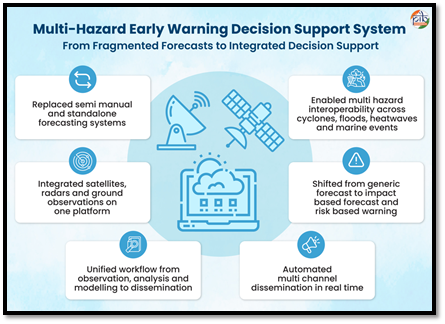
- Launched in 2024, it is a digital platform that automates decision-making in critical weather forecasting processes and provides forecast and warning services to the public, government, and non-government agencies, as well as specific stakeholders.
- Developed under Mission Mausam, the system has automated 90% of weather data processing and improved forecast accuracy by 30%, while reducing preparation time from six hours to three.
- It integrates real-time data from satellites, radars, and ground and upper air-based sensors into a centralized GIS-enabled platform, replacing outdated manual workflows.
Do you Know?
- IMD was established in 1875 and completed 150 years of service in 2025.
- IMD functions under the Ministry of Earth Sciences
- India is a Regional Specialised Meteorological Centre (RSMC) for the North Indian Ocean, responsible for cyclone tracking and naming.
- Mission Mausam is the overarching framework under which MHEW-DSS was developed
- The Sendai Framework for Disaster Risk Reduction 2015–2030 is a non-binding international agreement adopted at the Third UN World Conference on Disaster Risk Reduction, held in Sendai, Japan, on March 18, 2015.
- It is the primary global framework guiding how nations reduce disaster risk, build resilience, and protect development gains from natural and human-induced hazards over the 15-year period from 2015 to 2030.
Source: TH
Previous article
Temporary Relief Measure in Special Economic Zones (SEZs)
Next article
India–Australia ECTA Completes Four Years
