

Syllabus: GS3/ Science and Technology
Context
- India’s indigenous navigation satellite system Navigation with Indian Constellation (NavIC) has suffered a setback after the failure of the IRNSS-1F satellite due to malfunction of its last operational rubidium atomic clock.
- The IRNSS-1F satellite was launched in 2016 by the Indian Space Research Organisation and has completed its 10-year design mission life.
About Atomic clock
- An Atomic Clock is a highly precise time-keeping device that measures time based on the natural vibration frequency of atoms, usually cesium or rubidium atoms.
- It is considered the most accurate time-keeping technology, capable of maintaining accuracy to nanoseconds (billionths of a second).
- Working Principle:
- Atoms vibrate at extremely stable and predictable frequencies when they change energy states.
- The atomic clock measures this frequency and converts it into standard time signals.
Navigation with Indian Constellation (NavIC)
- Established by Indian Space Research Organisation (ISRO), NavIC is India’s autonomous regional navigation satellite system, designed to fulfill both civilian and military navigational needs. It was launched in 2013.
- NavIC was erstwhile known as Indian Regional Navigation Satellite System (IRNSS).
- It provides precise Position, Velocity, and Timing (PVT) services within India and extends up to 1,500 km beyond the country’s borders, forming its primary service area.
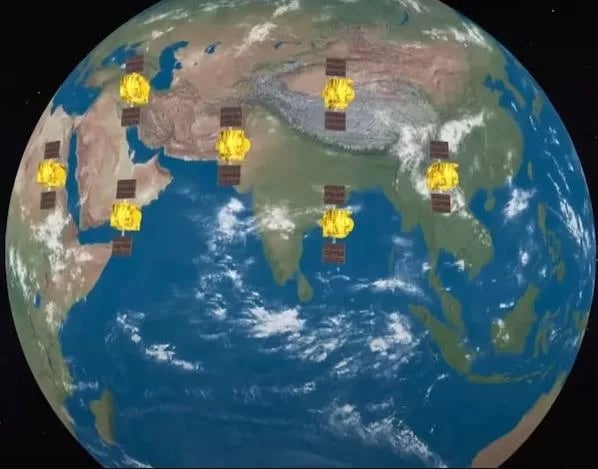
- NavIC is designed with a constellation of 7 satellites and a network of ground stations operating 24 x 7.
- Three satellites of the constellation are placed in geostationary orbit and four satellites are placed in inclined geosynchronous orbit.
- NavIC offers two services: Standard Position Service (SPS) for civilian users and Restricted Service (RS) for strategic users.
- It provides location accuracy better than 20 meters and timing accuracy better than 40 nanoseconds across the core service area.
Source: IE
Previous article
Supreme Court’s Push for Crop Diversification
Next article
Thorium can Power India’s 100 GWe by 2047 Mission
