

Syllabus: GS3/Agriculture
Context
- Recently, the Supreme Court of India directed the Union Government to revisit its agricultural policy framework and develop better incentives to encourage farmers to diversify from wheat and paddy to pulses especially in North India.
Issues Highlighted by the Court
- Lack of Adequate MSP Incentives: Farmers often prefer wheat and paddy because government procurement is strong for these crops.
- However, pulse farmers rarely receive effective MSP support, reducing their incentive to cultivate pulses.
- MSP policies historically favoured rice and wheat, discouraging diversification into pulses and oilseeds.
- Uncertainty in Procurement and Market Access: Pulses lack the robust, guaranteed procurement systems seen for cereals like rice and wheat, where agencies like FCI buy most output at MSP.
- For pulses, procurement under the Price Support Scheme (PSS) covers only a fraction, often under 30% in key states like Maharashtra—leaving most farmers exposed to private traders.
- Impact of Imports on Domestic Producers: India imports pulses such as yellow peas to stabilise prices.
- However, imports can depress domestic prices, and discourage farmers from growing pulses.
- The Court suggested fixing the import price of yellow peas to ensure it does not harm domestic producers.
Crop Diversification
- Crop diversification refers to the practice of cultivating a variety of crops instead of relying on a single crop or crop pattern in a region.
- Shifting from Rice–Wheat cropping system to pulses, oilseeds, millets, horticulture and fodder crops.
Why is Crop Diversification Necessary?
- Environmental Sustainability: The rice–wheat cropping system has caused groundwater depletion, soil degradation, and stubble burning.
- Pulses require less water and improve soil fertility through nitrogen fixation, making them environmentally beneficial.
- Nutritional Security: Pulses are a major protein source in India’s predominantly vegetarian diet.
- However, domestic production often falls short of demand, leading to imports.
- Major importing sources include Canada, Australia & Myanmar. Increasing domestic production improves food security and reduces import bills.
- Economic Benefits For Farmers: Crop diversification can reduce dependence on a few crops, improve farm resilience, and enhance farm incomes through diversified production systems.
- Importance of Pulses in Crop Diversification: Pulse crops fix atmospheric nitrogen through symbiotic bacteria (Rhizobium), improving soil fertility.
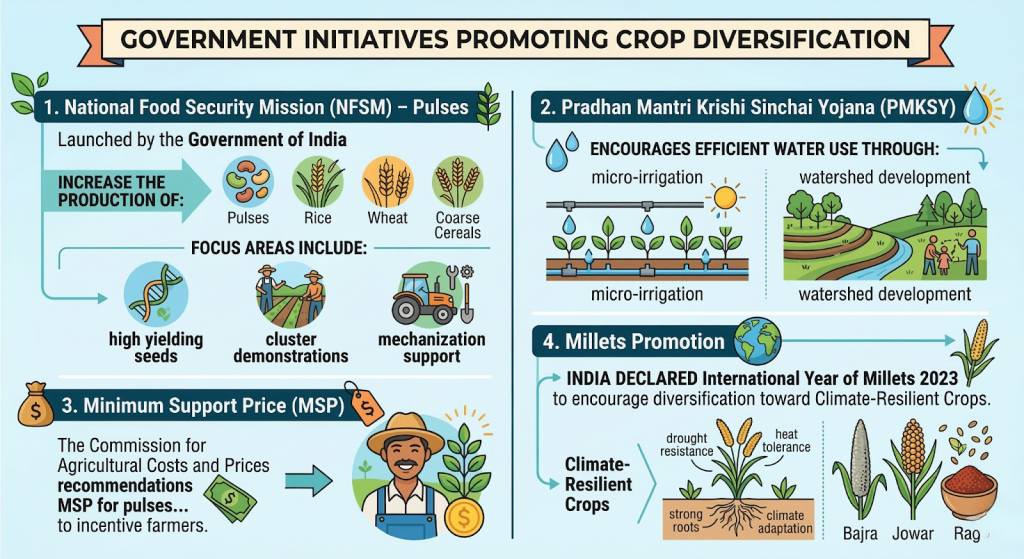
Policy Measures for Promoting Pulses
- Strengthening MSP and Procurement: Ensure effective MSP implementation, and expand procurement through NAFED and FCI.
- Price Stabilisation Mechanisms: Maintain buffer stocks, and regulate imports during domestic harvest seasons.
- Agricultural Diversification Programs: Promote pulses in rice fallow areas, and encourage intercropping systems.
- Inclusion in Public Distribution System (PDS): Adding pulses to the PDS basket could increase demand and support farmers.
Conclusion
- The Supreme Court’s intervention underscores the need for structural reforms in India’s agricultural policy.
- A coordinated effort involving MSP reforms, procurement assurance, import regulation, and scientific crop diversification strategies is essential.
Previous article
UPSC’s New Rule on Appointment of State DGPs
Next article
Failure of Atomic Clock Cripples ISRO’s NavIC
