

Syllabus: GS1/Geography; GS3/Environment
Context
- Protests against the Ken–Betwa River Linking Project (KBLP), highlighting tensions over the implementation of the river interlinking project.
About River Interlinking in India
- Historical Context: The concept of interlinking rivers dates back to the 19th century, with Sir Arthur Cotton’s designs for irrigation dams in the Godavari and Krishna river valleys.
- Over the years, this idea evolved, with notable contributions from engineers like M Visvesvaraya, KL Rao, and Captain Dinshaw J Dastur.
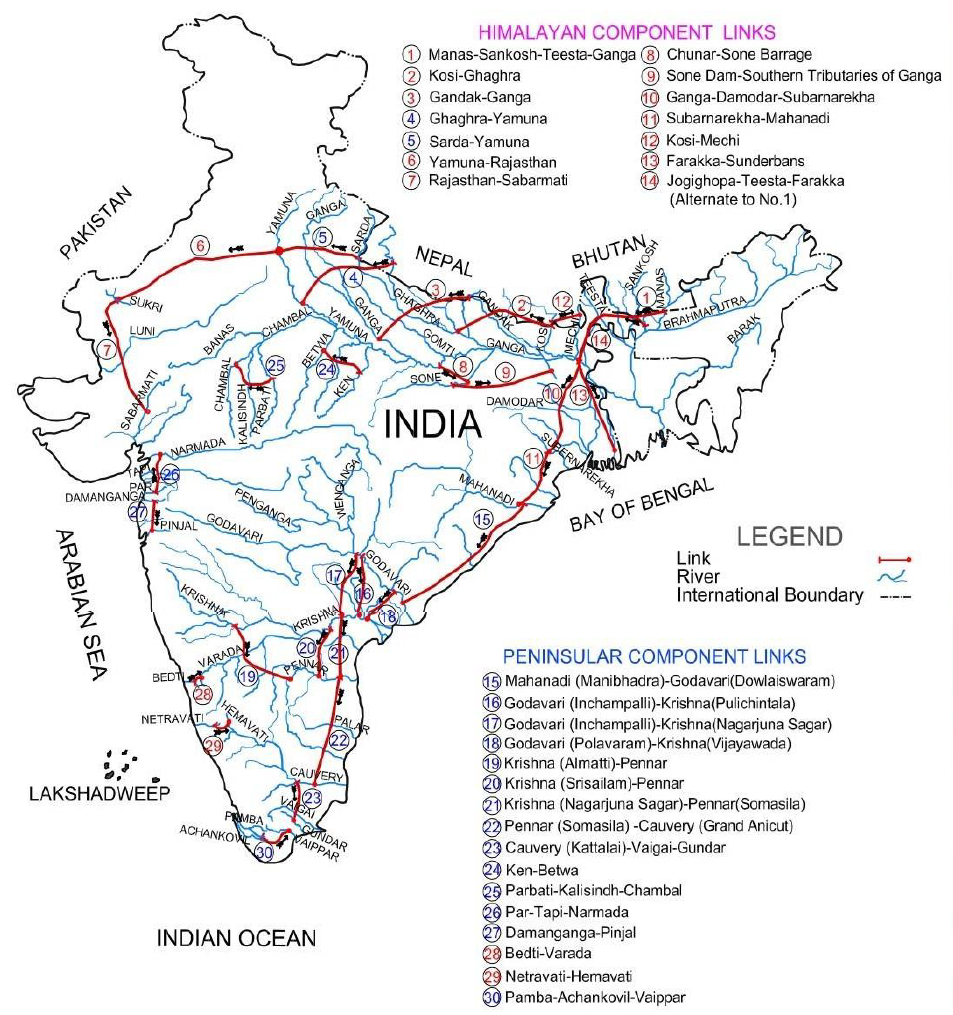
- It was conceptualized in the Interlinking of Rivers (ILR) Programme under the National Perspective Plan (1980) that aims to transfer water from surplus basins to deficit basins to address regional water imbalances, enhance irrigation, mitigate floods and droughts, and support inland navigation and hydropower.
- The National Perspective Plan (1980) proposed two components ie Himalayan Component (14 links), and the Peninsular Component (16 links).
- Recent progress includes the Ken–Betwa Link Project (the first ILR project under implementation), with others such as Parbati–Kalisindh–Chambal under appraisal.
- In 2002, the Supreme Court of India ordered the Union Government to complete the river interlinking project within the next 12–15 years.
- In response to this order, the Government of India appointed a Task Force and scientists, engineers, ecologists and others for the project related works.
Do You Know?
- Hashim Commission Report (2004-05): It highlighted which rivers and at which locations water surpluses could be transferred and to which rivers, and at what factors in these rivers the transfer water could be taken.
- National Water Policy (NWP) 2012 considered water as economic goods for promoting its conservation and efficient use.
- It was formulated to govern the planning and development of water resources and their optimum utilization.
Objectives of River Interlinking
- Irrigation Expansion: Potential irrigation to millions of hectares in water-deficit regions.
- Drinking Water Supply: Augmentation of potable water for rural and urban populations.
- Flood Control: Diverting excess monsoon flows from flood-prone basins.
- Drought Mitigation: Stabilizing agriculture in arid and semi-arid zones.
- Hydropower Generation: Harnessing elevation gradients for renewable energy.
- Inland Navigation & Fisheries: Secondary economic benefits.
Major Project: Ken–Betwa Link
- The Ken–Betwa Link Project (KBLP) is the first ILR project under the NPP to receive Cabinet approval. It aims to benefit the drought-prone Bundelkhand region of Madhya Pradesh and Uttar Pradesh.
- It aims to provide annual irrigation to 10.62 lakh hectares, drinking water to 62 lakh people, and generate 130 MW of power.
- Other priority projects include the Modified Parbati-Kalisindh-Chambal (PKC) Link and the Godavari-Cauvery Link, besides the Ken-Betwa Link Project (KBLP).
Challenges and Concerns
- Ecological Imbalance: Interlinking rivers can disrupt the natural flow of rivers, affecting aquatic ecosystems and biodiversity. The alteration of river courses can lead to the loss of habitats for various species.
- The Ken-Betwa River Link Project, for instance, involves constructing a dam within the Panna Tiger Reserve, raising concerns about submergence and loss of biodiversity.
- Financial Viability: High costs associated with the implementation and maintenance of the projects.
- The Ken-Betwa River Link Project, estimated to cost around ₹45,000 crore, has faced objections from experts and circumvented strict legal terms for hydroelectric power projects.
- Inter-State Disputes: States have the power to use water in supplies, irrigation, canals, drainage, embankments, water storage, and water power within their respective territories.
- Water is listed in List II of the Seventh Schedule of the Indian Constitution, which is the State List.
- However, the Central Government has the power to regulate and develop inter-state rivers and river valleys List I of the Seventh Schedule.
- Displacement of Communities: Large-scale projects often require the displacement of local communities, leading to social and economic challenges.
- The resettlement process can be complex and may not always be fair or adequate.
- Climate Change Impact: The alteration of river systems can exacerbate the impacts of climate change, such as increased frequency and intensity of floods and droughts.
- It can further strain the already vulnerable regions.
- Deforestation and Habitat Loss: The construction of canals and reservoirs requires large-scale deforestation, leading to habitat loss for wildlife.
- It can also contribute to soil erosion and degradation.
- Water Quality Issues: The mixing of waters from different rivers can lead to changes in water quality, affecting both human and animal populations.
- Pollutants from one river can contaminate another, leading to health hazards.
Conclusion & Path Forward
- River Interlinking in India represents one of the world’s most ambitious water engineering visions, reflecting developmental aspirations rooted in post-independence planning but faces modern scrutiny regarding ecology, climate uncertainty, financial viability, and federal governance.
- The path forward likely depends on strong environmental safeguards, transparent hydrological data, cooperative federalism, integration with decentralized water strategies, long-term climate modelling.
