


New START Treaty
Syllabus: GS2/IR
In News
- Experts caution that the expiry of the New START Treaty would eliminate the last remaining legally binding constraint on the nuclear arsenals of the world’s two largest nuclear powers.
Background
- The term START originates from the “Strategic Arms Reduction Treaty,” with the first agreement, START-I, signed between the US and the former USSR in 1991 and coming into force in 1994.
- START-I limited each side to 6,000 nuclear warheads and 1,600 intercontinental ballistic missiles (ICBMs) but expired in 2009.
- It was succeeded by the Strategic Offensive Reductions Treaty (SORT, also called the Treaty of Moscow) and later by the New START treaty (signed in 2010 & entered into force in 2011).
- The New START treaty caps the number of deployed strategic warheads at 1,550 on each side, with no more than 700 deployed ground- or submarine-launched missiles and bomber planes, and 800 launchers.
Implications of Expiration
- Without a treaty, Russia and the US could freely expand their arsenals, risking a renewed nuclear arms race amid global tensions.
- The absence of a framework heightens nuclear risks and removes the transparency and stability that arms control agreements provide.
Source :TOI
Pradhan Mantri Virasat Ka Samvardhan (PM VIKAS)
Syllabus: GS2/Governance/GS3(Economy)
In News
- PM VIKAS has allocated targets to train about 1.51 lakh beneficiaries through Project Implementing Agencies across States and UTs.
Pradhan Mantri Virasat Ka Samvardhan (PM VIKAS)
- It is a Central Sector Scheme which is being implemented by the Ministry of Minority Affairs.
- It focusing on socio-economic empowerment of six notified minority communities through the following:
- Skilling and Training (Non-traditional and traditional)
- Women Leadership and Entrepreneurship
- Education (through National Institute of Open Schooling)
- Infrastructure Development (through Pradhan Mantri Jan Vikas Karyakram)
- minority groups—Muslims, Christians, Sikhs, Buddhists, Jains, and Zoroastrians (Parsis)
| Do you know? Muslims, Sikhs, Christians, Buddhists, Jain and Zoroastrians (Parsis) have been notified as minority communities under Section 2 (c) of the National Commission for Minorities Act, 1992 |
Features
- The implementing agencies must ensure candidate placement in accordance with the scheme guidelines, as stipulated in the MoUs signed with the Ministry.
- For non-traditional (modern) skilling, Project Implementing Agencies are required to place at least 75% of trained beneficiaries in employment (wage, self-employment, or apprenticeship), with a minimum of 50% placed in the organized sector as defined under NSQF/Common Cost Norms.
Source :PIB
What is Suborbital Tourism?
Syllabus: GS3/ Economy
In News
- Blue Origin has suspended its New Shepard suborbital space tourism programme for at least two years to prioritise development of NASA’s Artemis lunar lander.
About Suborbital Tourism
- Suborbital tourism refers to short-duration spaceflights that cross the 100 km Kármán line, widely accepted as the boundary of outer space, but do not place the spacecraft into Earth orbit.
- These flights follow a parabolic trajectory, where the vehicle ascends steeply and then descends back to Earth. Unlike orbital missions, suborbital vehicles do not achieve the high horizontal velocity required to remain in orbit.
- The flight duration is brief, usually around 10–15 minutes, making suborbital tourism significantly cheaper and technologically less complex than orbital space travel.
- During the coasting phase, passengers experience microgravity (weightlessness) for a few minutes and can observe the curvature of the Earth against the blackness of space.
Source: TH
India has Entered an Elite Group of Possessing SFDR Technology
Syllabus: GS3/ Defence
In News
- DRDO successfully demonstrated Solid Fuel Ducted Ramjet (SFDR) technology from the Integrated Test Range (ITR) in Chandipur, Odisha, advancing India’s long-range air-to-air missile capabilities.
What is Solid Fuel Ducted Ramjet (SFDR)?
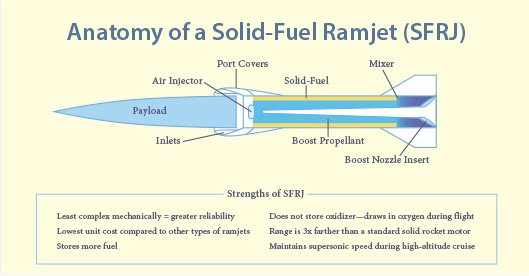
- SFDR is a missile propulsion system that uses a ramjet engine to provide sustained thrust. Unlike traditional rockets, it is an air-breathing system, meaning it does not carry an onboard oxidizer, using atmospheric oxygen instead.
- Since ramjets only function at high speeds, the missile is first launched using a nozzle-less solid booster to reach supersonic speeds (Mach 2+).
Strategic Significance for India
- Long-Range Air-to-Air Missiles (LRAAM): SFDR will power the Astra Mark-3, enabling it to intercept high-speed, maneuvering enemy aircraft at ranges exceeding 150–300 km.
- Expanded “No-Escape Zone”: Because the missile stays “powered” until the very end, it can perform high-G turns near the target, making it nearly impossible for an enemy jet to out-maneuver it.
- Surface-to-Air Application: It can be adapted for futuristic SAM systems (like the proposed SAM-X) to defend against hypersonic or highly agile cruise missiles.
Source: TH
Agriculture Infrastructure Fund
Syllabus: GS3/Economy
In News
- Agriculture Infrastructure Fund (AIF) has sanctioned ₹80,224.15 crore in loans for over 1.5 lakh projects, mobilising investments of ₹1.27 lakh crore since 2020.
Agriculture Infrastructure Fund (AIF)
- It is a central sector scheme to mobilize medium and long-term debt financing for the development of post-harvest management infrastructure and community farming assets.
- It focuses on strengthening agri-logistics, reducing post-harvest losses, promoting modern storage, processing and value-addition facilities and improving farm-gate level infrastructure for efficient supply chains.
- Under the scheme, banks and financial institutions provide loans with 3% per annum interest subvention by Government of India.
- Loan tenure is up to 7 years with a moratorium of up to 2 years.
- Credit guarantee coverage for loans up to ₹2 crore is also supported under Credit Guarantee Fund Trust for Micro and Small Enterprises (CGTMSE).
- The Components B and C of Pradhan Mantri – Kisan Urja Suraksha evam Utthaan Mahabhiyan (PM-KUSUM) for solarisation of grid-connected agriculture pumps and standalone solar pumping systems were included as eligible assets for availing AIF benefits in convergent mode in September 2020.
Source :PIB
VOPPA Order, 2025
Syllabus: GS3/ Agriculture
In News
- The Government of India has strengthened regulatory oversight of the edible oil value chain through the VOPPA Order, 2025, issued under the Essential Commodities Act, 1955.
About
- The amended Order mandates compulsory registration of all manufacturers, processors, blenders and re-packers of edible oils on the National Single Window System (NSWS) and the VOPPA portal.
- Registered entities must submit monthly returns on production, stocks, imports, sales and consumption of edible oils, including vanaspati and blended oils.
Impacts
- India imports nearly 60% of edible oil needs; VOPPA counters hoarding/pricing volatility, supporting food security amid Budget 2026 fiscal goals.
Source: PIB
Debt-to-GDP Ratio
Syllabus: GS3/ Economy
In Context
- In the Union Budget 2026–27, the Finance Minister signalled a strategic shift in fiscal policy focus from short-term fiscal deficit targets to a medium-term debt-to-GDP ratio.
- The government has set a target to bring India’s debt-to-GDP ratio down to 50% by FY 2030–31, with a flexibility band of ±1%.
About Debt-to-GDP Ratio
- It measures total public debt as a percentage of GDP.
- It indicates a country’s capacity to service and repay its debt.
- Lower ratio means better fiscal sustainability and investor confidence.
Why is this Shift Important?
- Fiscal Sustainability Perspective: High debt limits government’s ability to spend during crises, invest in infrastructure and social sectors & debt-based targeting ensures intergenerational equity.
- Post-COVID Context: India’s debt increased sharply after pandemic stimulus & higher welfare spending.
- Global Best Practice: Many countries use debt anchors instead of only fiscal deficit limits. This aligns India with international fiscal responsibility norms.
Source: PIB
Waste-pickers Enumeration Under NAMASTE Scheme
Syllabus: GS1/ Social Justice
In News
- For the first time, the Union government has released nationwide enumeration data of waste-pickers under the NAMASTE (National Action for Mechanised Sanitation Ecosystem) scheme.
- The data highlights deep caste-based social stratification in informal urban sanitation work.
About
- Over 52 lakh waste-pickers were enumerated across 35 States/UTs, with 84.5% from SC, ST, and OBC communities.
- In Delhi and Goa, the majority of waste-pickers are from the General category.
About NAMASTE Scheme
- Launched as a Central Sector initiative by the Ministry of Social Justice and Empowerment.
- The Scheme integrates waste-pickers into formal solid waste management from FY 2024-25. It provides ID cards via a mobile app, safety gear, skill training, health insurance under Ayushman Bharat-PMJAY, e-Shram registration, and capital subsidies for waste vehicles.
Source: TH
Previous article
Death Penalty in India
