


Syllabus: GS2/Polity; Judiciary
Context
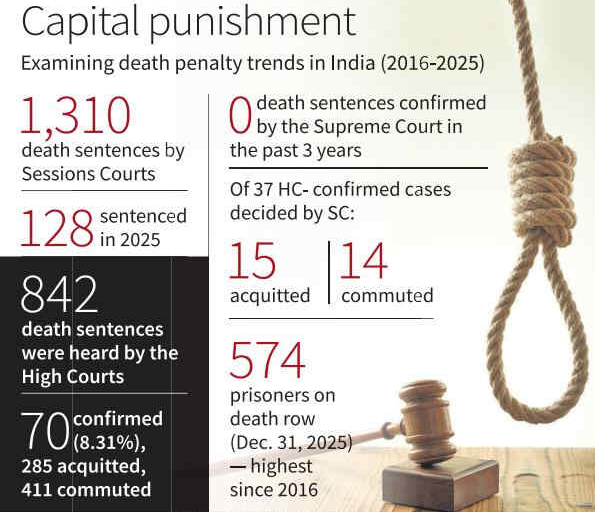
- According to an annual report on capital punishment published by Square Circle Clinic at NALSAR University of Law, the Supreme Court of India has not confirmed a single death sentence in the past three years, reflecting a highly restrictive approach toward capital punishment.
Key Findings of the Report
- Lower Courts Continue to Impose Death Sentences: Sessions Courts imposed 1,310 death sentences between 2016 and 2025, including 128 sentences in 2025 alone, despite growing skepticism at higher judicial levels.
- Low Confirmation Rates in High Courts: Of the 1,310 death sentences, 842 cases reached the High Courts. Only 70 sentences (just 8.31%) were confirmed.
- Supreme Court Overturns Confirmed Sentences: Even where High Courts confirmed death sentences, the Supreme Court has not upheld a single one in the past three years.
- Of 37 such cases decided, most ended in acquittal or commutation.
- Record Acquittals in 2025: In 2025, the Supreme Court acquitted 10 death row prisoners, the highest number of such acquittals in a decade.
- Large Death Row Population: India had 574 prisoners on death row, including 24 women (as of December 31, 2025).
- Prolonged Time On Death Row: Prisoners spent an average of over five years on death row before acquittal, with some waiting nearly ten years for exoneration.
- Widespread Procedural Violations: Nearly 95% of death sentences in 2025 were imposed without following mandatory Supreme Court guidelines on mitigation and sentencing procedures.
- Shift Toward Alternatives: Courts are increasingly opting for life imprisonment without remission as an alternative to the death penalty.
What is Capital Punishment?
- It is the most severe form of criminal punishment, commonly known as the death penalty, in which the State legally executes a person convicted of the gravest offences.
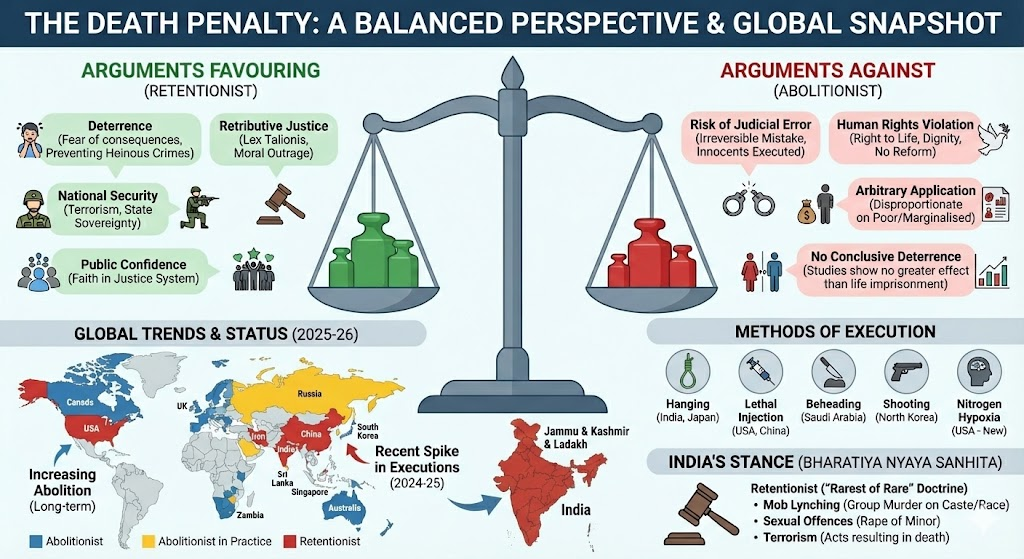
- In India, capital punishment is permitted only in the ‘rarest of rare cases’, a doctrine evolved by the Supreme Court to ensure that death sentences are imposed only when life imprisonment is deemed wholly inadequate.
Legal Basis in India
- Capital punishment is constitutionally valid under Article 21 (Right to Life and Personal Liberty), provided it is imposed through a fair, just and reasonable procedure.
- It is prescribed for certain offences under laws such as the Bharatiya Nyaya Sanhita (BNS), Unlawful Activities (Prevention) Act (UAPA), and other special statutes.
- Execution is carried out only after exhaustion of all judicial remedies and the decision on a mercy petition by the President or Governor.
Role of Lower Courts (Sessions Courts) in Capital Punishment Cases
- Primary Trial & Sentencing Authority: Sessions Courts conduct the trial for serious offences punishable with death. They examine evidence, hear witnesses, and determine guilt or innocence.
- Sentencing Function: If the accused is convicted, the Sessions Court conducts a separate sentencing hearing.
- The court must weigh aggravating circumstances (nature of crime) against mitigating circumstances (background, mental health, possibility of reform).
- Under Supreme Court guidelines (2022), the court must consider psychological evaluation, probation officer’s report, and prison conduct and social background.
- Reference to High Court: A death sentence passed by a Sessions Court does not take effect automatically.
- It must be confirmed by the High Court under the Bharatiya Nagarik Suraksha Sanhita, 2023 (BNSS).
- High Courts act as the first appellate safeguard. Every death sentence must be confirmed, commuted, or set aside by the High Court.
- High Courts reassess facts, evidence, and law, not merely procedural correctness. They also examine whether the ‘rarest of rare’ test has been correctly applied.
Role of the Supreme Court of India
- Final Judicial Authority: The Supreme Court is the ultimate appellate court in death penalty cases.
- Appeals reach the Court through Special Leave Petitions (SLPs) or criminal appeals.
- Constitutional and Due Process Oversight: The Court ensures compliance with Articles 14 and 21, fair investigation and trial, and proper sentencing hearings and consideration of mitigation.
- Sentencing Jurisprudence: The Supreme Court has shaped death penalty law by developing the ‘rarest of rare’ doctrine, mandating individualised sentencing, and requiring strict procedural safeguards.
- Review and Curative Jurisdiction: Even after dismissal of appeals, the Court can hear review petitions, and curative petitions (in exceptional cases).
- Mercy Petition Interface: The Court may review delays, arbitrariness, or procedural violations in mercy petition decisions, after judicial remedies are exhausted.
Role of the Governor and the President in Capital Punishment
- President of India (Article 72): The President has the power to grant pardon, reprieve, respite, remission, and commutation of sentence. It applies in cases where:
- punishment is a death sentence;
- offence is under Union law;
- sentence is by a court-martial;
- Governor of a State (Article 161): The Governor has similar powers for offences under State law, except, it cannot pardon a death sentence, but can commute it to life imprisonment or a lesser sentence.
Key Issues and Challenges in Capital Punishment in India
- High Rate of Erroneous Convictions: A large proportion of death sentences imposed by trial courts are overturned by High Courts and the Supreme Court.
- It indicates systemic flaws in investigation, prosecution, and trial-level adjudication, especially in cases involving poor and marginalised accused.
- Inadequate Sentencing Hearings and Mitigation: Trial courts frequently conduct rushed or perfunctory sentencing hearings.
- Mitigating factors such as mental illness, socio-economic background, and possibility of reform are often ignored or insufficiently examined.
- Non-Compliance with Due Process Safeguards: Despite Supreme Court guidelines (2022), trial courts regularly fail to obtain psychological evaluation reports, probation officer reports, and prison conduct records.
- It weakens the fairness of sentencing and increases the risk of wrongful punishment.
- Socio-Economic and Caste Bias: Death row prisoners disproportionately belong to economically weaker and socially marginalised groups.
- Lack of effective legal representation at the trial stage worsens outcomes
- Prolonged Delays and Mental Trauma: Long delays between conviction, appeal, and execution result in severe psychological suffering, often referred to as ‘death row phenomenon’.
- Delays in deciding mercy petitions aggravate this problem.
Previous article
Solid Waste Management (SWM) Rules, 2026
Next article
News In Short 04-02-2026
