


Syllabus: GS3/Economy
Context
- Union Budget 2026–27 proposed the Biopharma SHAKTI with an outlay of Rs. 10,000 crores over five years, aimed at strengthening India’s ecosystem for production of biologics and biosimilars.
Biopharma
- Biopharma, or biopharmaceuticals, refers to the part of the pharmaceutical industry that focuses on developing and manufacturing medicines using living biological systems, rather than relying solely on chemical synthesis.
- Biopharma medicines are produced through biological organisms, such as human cells, fungi, or microbes.
- Some examples of biopharmaceuticals include vaccines, antibody treatments, gene therapies, cell implants, modern insulin, and recombinant protein drugs.
- Government’s Aim: Transforming India into a leading global biopharma industry and capturing 5% of the global biopharmaceutical market share.
Key Budget Announcements for Biopharma
- Biopharma SHAKTI: The initiative is designed to support domestic development and manufacturing of high-value biopharmaceutical products and enhance India’s competitiveness in global biologics supply chains.
- Establishment of National Institutes: Establishment of three new National Institutes of Pharmaceutical Education and Research (NIPERs) and the upgradation of seven existing NIPERs.
- This measure seeks to address the growing requirement for highly specialised human resources in biopharma research, development, manufacturing and regulation.
- Strengthening of Research Ecosystem: Creation of a large-scale clinical research ecosystem, with a proposal to develop over 1,000 accredited clinical trial sites across the country.
- This is expected to significantly improve India’s capacity to conduct advanced clinical trials for biologics and biosimilars.
- Regulatory Framework: Enhancing the capacity of the Central Drugs Standard Control Organisation (CDSCO) through the induction of specialised scientific and technical personnel.
- The focus is on improving regulatory efficiency, aligning approval timeframes with global standards.
India’s Pharmaceutical Sector
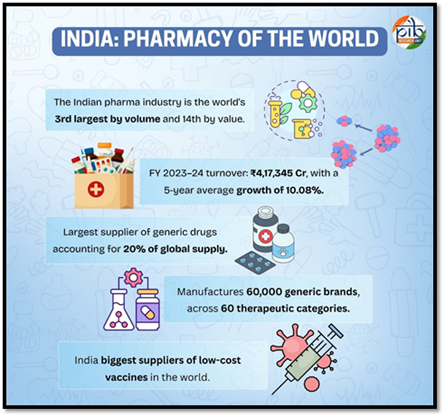
Government Initiatives to Strengthen India’s Biopharma Sector
- National Biopharma Mission (NBM): The NBM – Innovate in India (i3) was launched in 2017 with an aim of transforming India into a $100 billion leading global biotech industry by 2025.
- It is co-funded by the World Bank and implemented by the Biotechnology Industry Research Assistance Council (BIRAC).
- The mission focuses on the development of new vaccines, bio-therapeutics, diagnostics and medical devices.
- The mission also aims to make drugs more affordable and accessible.
- BIRAC-led Biotech Innovation Support: BIRAC was established in 2012 under the Department of Biotechnology (DBT), supports innovation through funding schemes, incubation infrastructure and mentorship.
- Manufacturing and Industrial Strengthening Measures: Government has implemented schemes such as the Production Linked Incentive (PLI) Scheme for Pharmaceuticals, Strengthening of Pharmaceutical Industry (SPI) scheme and the Bulk Drug Parks Scheme.
- Promotion of Research and Innovation in Pharma-MedTech (PRIP): The PRIP scheme, launched in 2023 seeks to transform India into an innovation-driven and globally competitive Pharma-MedTech sector.
- BioE3 Policy: The BioE3 (Biotechnology for Economy, Environment and Employment) Policy was approved in 2024.
- The scheme aims to establish biomanufacturing, Bio-AI hubs and Biofoundry for a sustainable Viksit Bharat.
- Bio-RIDE Scheme: The Bio-RIDE scheme launched in 2024 merged two umbrella schemes of the DBT under one scheme: ‘Biotechnology Research Innovation and Entrepreneurship Development (Bio-RIDE)’ with a new component namely Biomanufacturing and Biofoundry.
- The scheme has three broad components: Biotechnology Research and Development (R&D), Industrial & Entrepreneurship Development (I&ED), and Biomanufacturing and Biofoundry.
Conclusion
- All these measures signal a deliberate and coordinated policy approach by the government to build a resilient biopharma ecosystem in India, spanning research, innovation, manufacturing and entrepreneurship.
- The Biopharma SHAKTI scheme announced in the Union Budget 2026–27 therefore represents a key policy intervention in this direction.
Source: PIB
Previous article
News In Short 02-02-2026
Next article
India–US Signed Trade Agreement
