


Syllabus: GS3/Economy
Context
- Recently, the Finance Minister Nirmala Sitharaman presented the Union Budget 2026-2027 in Parliament.
Constitutional Basis of the Union Budget of India
- The preparation, presentation, and approval of the Union Budget derive authority from the Constitution of India.
- Annual Financial Statement (Article 112): It is the core constitutional provision for the Union Budget. It legally requires the government to present a budget every year.
- It mandates that the President shall lay before both Houses of Parliament an Annual Financial Statement. It shows:
- Estimated receipts and expenditure;
- For the financial year (1 April – 31 March);
- It mandates that the President shall lay before both Houses of Parliament an Annual Financial Statement. It shows:
- Voting on Demands for Grants (Article 113): No money can be withdrawn from the Consolidated Fund of India without Parliament’s approval.
- Demands for Grants are:
- Discussed and voted only in the Lok Sabha;
- Rajya Sabha can discuss but not vote;
- It ensures parliamentary control over public expenditure.
- Demands for Grants are:
- Appropriation Bill (Article 114): After Demands for Grants are approved, an Appropriation Bill is introduced. It authorizes the government to:
- Withdraw money from the Consolidated Fund;
- Spend it for approved purposes;
- Government spending is unconstitutional without this Bill.
- No Tax Without Authority of Law (Article 265): States that no tax shall be levied or collected except by authority of law.
- All tax proposals in the Budget must be backed by legislation; and approved by Parliament;
- It prevents arbitrary taxation.
- Consolidated Fund, Contingency Fund, Public Account (Article 266): It defines the three funds of India:
- Consolidated Fund of India: Main government account;
- Contingency Fund of India: For emergencies;
- Public Account of India: Money held in trust (PF, savings, etc.);
- Most budget transactions relate to the Consolidated Fund.
- Money Bill (Article 110): The Finance Bill (part of the Budget) is a Money Bill. It can be introduced only in the Lok Sabha.
- Rajya Sabha cannot reject or amend it, and can only make recommendations.
- It gives primacy to the Lok Sabha in financial matters.
Key Highlights of Union Budget 2026–27
- It is the first Union Budget prepared in Kartavya Bhawan, and the Finance Minister underscored it is guided by three kartavya (duties) to accelerate growth, build people’s capacity, and ensure inclusive development.

First Kartavya: Accelerating and Sustaining Economic Growth
- It focuses on productivity, competitiveness and resilience amid global volatility.
- Key interventions include manufacturing push in seven strategic and frontier sectors; rejuvenation of legacy industries; creation of Champion MSMEs; continued thrust on infrastructure; long-term energy security; and development of City Economic Regions (CERs);
- Key Sectoral Announcements:
- Biopharma SHAKTI: ₹10,000 crore over five years to position India as a global biopharma hub, including new and upgraded NIPERs, over 1,000 clinical trial sites, and faster drug approvals.
- Textiles: An integrated programme covering fibre self-reliance, cluster modernisation, handloom and handicrafts, sustainable textiles, and skilling through Samarth 2.0.
- MSMEs: A ₹10,000 crore SME Growth Fund to nurture future champions.
- Infrastructure: Public capex to rise to ₹12.2 lakh crore in FY 2026–27, sustaining the investment momentum.
- Green Logistics: New Dedicated Freight Corridors, 20 National Waterways, and training centres for logistics manpower.
- Urban Growth: ₹5,000 crore per CER over five years through a reform-linked challenge mode.
- High-Speed Rail: Seven corridors to act as inter-city growth connectors.
Second Kartavya: Fulfilling Aspirations and Building Capacity
- It aims to empower citizens as partners in growth. The Budget deepens investments in human capital noting that 25 crore people have exited multidimensional poverty.
- Major Initiatives:
- Medical Tourism: Five Regional Medical Hubs combining healthcare, education and research.
- Veterinary Education: Support to add over 20,000 professionals via private-sector capacity creation.
- AVGC Sector: Content Creator Labs in 15,000 schools and 500 colleges to meet future talent needs.
- Education & Gender: One girls’ hostel in every district for STEM institutions.
- Tourism & Hospitality: National Institute of Hospitality and upskilling of 10,000 tourist guides.
- Sports: Launch of a Khelo India Mission to systematically develop talent, infrastructure and sports science.
Third Kartavya: Sabka Sath, Sabka Vikas
- It aligns with inclusive development across regions and communities.
- Agriculture: Bharat-VISTAAR, an AI-powered multilingual advisory platform integrating AgriStack and ICAR systems.
- Women Empowerment: SHE Marts to strengthen self-help entrepreneurs.
- Mental Health: Establishment of NIMHANS-2 and upgradation of institutes in Ranchi and Tezpur.
- Regional Development: East Coast Industrial Corridor, tourism destinations in Purvodaya states, e-buses, and a Buddhist Circuit Scheme in the North-East.
Tax Reforms: Simpler & Growth-Oriented
- Direct Taxes: New Income Tax Act, 2025 effective April 2026;
- Lower TCS rates for overseas tours, education and medical purposes;
- Simplified TDS, automated lower-deduction certificates, extended timelines for return revisions;
- Rationalised penalty and prosecution, decriminalisation of minor offences;
- Targeted reliefs for cooperatives and IT services;
- Incentives to attract global cloud, data centre and manufacturing investments;
- Indirect Taxes: Customs duty rationalisation to support manufacturing, energy transition, aviation and critical minerals;
- Lower tariffs for personal imports and exemptions for essential drugs;
- Faster, tech-driven customs processes and expanded AEO benefits;
- Boost to exports via courier, fisheries, and SEZ reforms;
Fiscal Consolidation and Stability
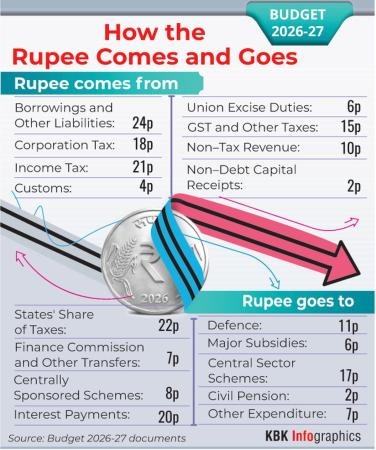
- The Budget maintains fiscal discipline while supporting growth:
- Fiscal deficit: 4.3% of GDP in BE 2026–27;
- Debt-to-GDP ratio: Declining to 55.6%;
- Capex (RE 2025–26): ~₹11 lakh crore;
- Non-debt receipts (BE 2026–27): ₹36.5 lakh crore;
Conclusion
- The Union Budget 2026–27 presents a duty-driven, reform-oriented, and inclusive roadmap for India’s next phase of growth.
- It combines fiscal discipline with bold investments in people, productivity, and infrastructure, laying a strong foundation for a resilient, competitive, and equitable Viksit Bharat anchored in the three kartavya.
Previous article
News In Short 31-01-2026
Next article
AI-powered Toys
