

Syllabus: GS2/ Health
In News
- The World Anti-Doping Agency (WADA) Report 2024 has ranked India as the worst doping offender globally for the third consecutive year, recording 260 Adverse Analytical Findings (AAFs) with a positivity rate of 3.6%.
About
- In contrast, countries such as China (0.2%), France (0.8%), Russia (0.7%) and the US (1.1%) recorded far lower positivity rates despite wider testing programs.
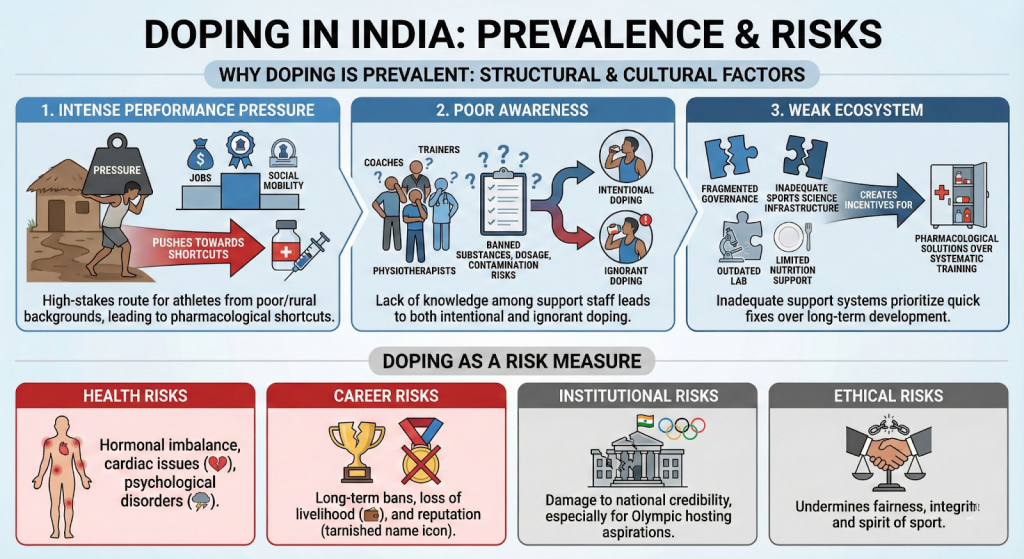
- This comes at a crucial time when India is preparing to host the 2030 Commonwealth Games and bidding for the 2036 Olympic and Paralympic Games. The International Olympic Committee (IOC) has expressed concerns over India’s doping record, flagging it as a reputational and governance risk.
What is Doping?
- The World Anti-Doping Code defines a range of anti‑doping rule violations, including presence or use of a prohibited substance, refusal to submit to sample collection, tampering with the testing process, trafficking, administration, and complicity by support personnel.
- These substances include anabolic steroids, stimulants, blood-doping agents like EPO, and various hormone modulators that can increase strength, endurance, or recovery capacity.
India’s Efforts to Tackle Doping
- National Anti-Doping Act, 2022: This landmark legislation gave the National Anti-Doping Agency (NADA) and the National Dope Testing Laboratory (NDTL) statutory status.
- National Anti-Doping (Amendment) Bill, 2025 recently introduced to strengthen institutional autonomy.
- India is a signatory to the UNESCO International Convention Against Doping in Sport.
- Athlete Passport Management Unit (APMU): A dedicated unit at NDTL was inaugurated in 2025 to monitor the Biological Passport of athletes.
- NIDAMS Portal: The NADA India Data Administration and Management System was launched in 2025. It digitalizes the entire process—from planning tests and generating mission orders for Doping Control Officers (DCOs).
- “Know Your Medicine” (KYM) App: A mobile tool that allows athletes to scan or search medicines to check if they contain substances prohibited by WADA.
| About the World Anti-Doping Agency (WADA) – The World Anti-Doping Agency (WADA) coordinates the global fight against doping in sports through unified rules and oversight. – Founded in 1999 as a Swiss private law foundation following the Lausanne Declaration, it is headquartered in Montreal, Canada, with regional offices in Lausanne (Europe), Cape Town (Africa), and Montevideo (Latin America). – The agency publishes the World Anti-Doping Code and the annual prohibited list. |
Source:TOI
