


Pamir Mountains/ Pamir-Karakoram Anomaly
Syllabus: GS1/ Geography
Context
- Ice cores from the Pamir Mountains are being studied to understand why its glaciers have resisted melting despite global warming.
What is the Pamir–Karakoram Anomaly?
- It refers to the unusual behaviour of glaciers in parts of the Pamir and Karakoram ranges.
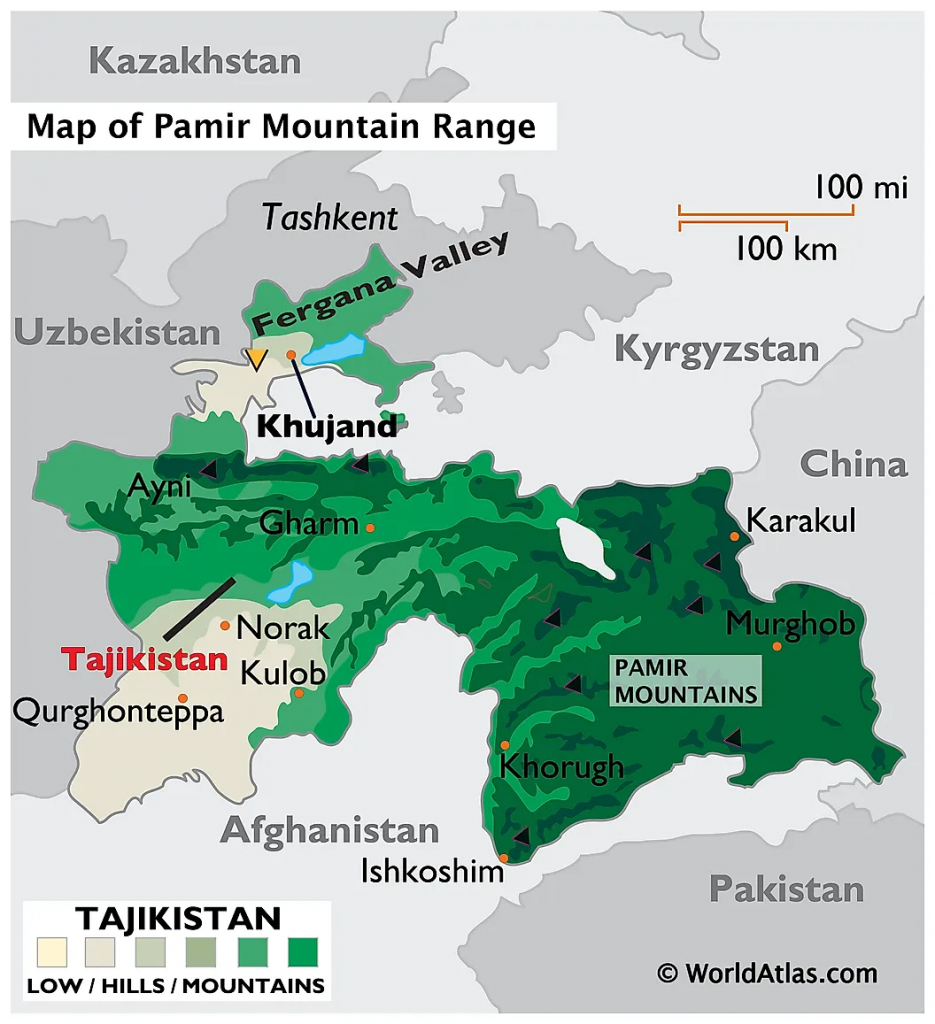
- Unlike most glaciers worldwide, these glaciers have:
- Shown resistance to melting, and
- Experienced slight mass gain in recent decades.
- This makes the region scientifically significant for understanding glacier–climate interactions.
About Pamir Mountains
- Geology: Formed by the collision of the Indian and Eurasian tectonic plates, making it a seismically active zone.
- Location: Spans parts of Tajikistan, Afghanistan, China, and Kyrgyzstan.
- The Pamir Mountains, also known as the “Roof of the World,” form a massive convergence zone (Pamir Knot) with the Himalayas, Karakoram, Hindu Kush, Kunlun, and Tian Shan ranges.
- Ancient Routes: Historically part of the Silk Road, with Marco Polo referencing the area.
- Major Peaks & Features: Ismoil Somoni Peak (Tajikistan), Kongur Tagh (China), Muztagh Ata (China) etc.
- Tajik National Park: A large protected area encompassing much of the Pamirs, a UNESCO World Heritage site.
- Drainage System: The Pamirs are heavily glaciated, with the Fedchenko Glacier being the largest glacier in Central Asia.
- Meltwater from glaciers feeds major rivers such as, Panj River and Vakhsh River. These rivers are part of the Amu Darya river system, crucial for Central Asia.
Source: TH
Dark Matter
Syllabus: GS3/Space
Context
- A study published recently in the Journal of Cosmology and Astroparticle Physics, claims to have finally detected the elusive ‘dark matter’.
About
- The Universe is composed of three major components: normal (baryonic) matter, dark matter, and dark energy. Observations show that dark energy forms about 68%, dark matter about 27%, and ordinary matter less than 5% of the total cosmic content.
- Dark matter does not interact with electromagnetic radiation, meaning it neither emits, absorbs, nor reflects light, making it invisible to direct observation. Its existence is inferred from its gravitational effects on stars, galaxies, and galaxy clusters.
- Dark matter provides the gravitational framework for the universe by holding galaxies together and enabling large-scale structure formation. Evidence includes galaxy rotation curves, gravitational lensing, and cluster dynamics.
- Dark energy is responsible for the accelerated expansion of the universe, discovered through observations of distant Type-Ia supernovae. It behaves as a repulsive effect at cosmological scales, often linked to the cosmological constant.
- While dark matter dominates galactic and cluster-level dynamics, dark energy dominates the universe at the largest scales, shaping its long-term expansion and future evolution.
- Both dark matter and dark energy are known indirectly, highlighting major unresolved questions in modern cosmology and fundamental physics.
Source: TH
China Tests World-First Wireless Rail Convoy
Syllabus: GS3/ Science and Technology
Context
- China has successfully tested a wireless rail convoy system by operating seven heavy freight trains (each carrying around 5,000 tonnes) as a single coordinated unit without any physical coupling.
- The trial was conducted on the Baoshen Railway in the Inner Mongolia Autonomous Region.
Significance
- In conventional rail operations, heavier and faster trains must maintain longer distances to ensure safe braking.
- This innovation enables;
- Higher freight throughput on existing tracks.
- Reduced need for building new railway infrastructure.
- Better utilisation of existing rail corridors.
How Does the Wireless Rail Convoy System Work?
- The technology uses continuous train-to-train and train-to-ground wireless communication. Acceleration, cruising speed, and braking of all trains are synchronised in real time.
- The system employs a two-dimensional control mechanism that integrates relative speed between trains maintaining absolute distance between them.
- The technology is conceptually similar to ADAS (Advanced Driver Assistance Systems) used in automobiles.
- Like adaptive cruise control in cars, the trains can dynamically adjust speed and braking based on the movement of the lead train.
Source: IE
Exercise Desert Cyclone 2025
Syllabus: GS3 Defence
Context
- India-UAE Joint Military Exercise Desert Cyclone is going to begin in UAE.
About the exercise
- The first edition of Exercise Desert Cyclone was held in 2024 in Rajasthan, India.
- The aim of the exercise is to enhance interoperability and foster defence cooperation between the Indian Army and the UAE Land Forces through joint training in an urban environment, with a focus on sub-conventional operations under a United Nations mandate.
Source: PIB
Navy Inducts Second Seahawks Squadron
Syllabus: GS3/Defence
Context
- The Indian Navy commissioned its second MH 60R helicopter squadron, INAS 335, at INS Hansa in Goa.
About
- Twenty-four of these submarine-hunting helicopters have been acquired by India from the US.
- These are US-origin Seahawks, maritime versions of the Black Hawk.
- The squadron has been nicknamed ‘Ospreys’ after the fish-hunting bird of prey.
- The helicopter is designed for a wide range of operations: anti-submarine warfare (ASW), anti-surface warfare (ASuW), search and rescue (SAR) missions, and medical evacuation (MEDEVAC).
- These helicopters are replacing the ageing British-origin Sea King helicopters, which have been in service for long.
Source: IE
Param Vir Chakra (PVC)
Syllabus: Miscellaneous
Context
- Portraits of all 21 Param Vir Chakra (PVC) awardees have been installed at Rashtrapati Bhavan, replacing the portraits of 96 British Aide-de-Camps (ADCs).
- This move is part of the government’s broader effort to dismantle colonial legacies.
About the Param Vir Chakra
- It was instituted on 26 January 1950 (Republic Day) by Dr. Rajendra Prasad, the first President of India, with retrospective effect from 15 August 1947.
- The name Param Vir Chakra translates to “Wheel of the Ultimate Brave.”
- The medal was designed by Savitri Khanolkar, who drew inspiration from Sage Dadhichi, the Vedic rishi who sacrificed his body so that the gods could forge the Vajra (thunderbolt) from his spine.
- The medal is cast in bronze. In the centre, on a raised circle, is the state emblem, surrounded by four replicas of Indra’s Vajra, flanked by the sword of Shivaji. It is suspended from a swivelling bar and worn with a 32 mm purple ribbon.

Do You Know?
- An Aide-de-Camp (ADC) is a senior military or police officer appointed as a personal assistant to high constitutional or military authorities such as the President, Governors, or Service Chiefs, handling protocol, logistics, and official coordination.
Source: PIB
Previous article
How India’s Science and Technology Ecosystem Strengthened in 2025
Next article
Goa Liberation Day
