Viksit Bharat Shiksha Adhikshan Bill

Syllabus: GS2/Governance

Context

  • The Union Cabinet has approved the Viksit Bharat Shiksha Adhikshan Bill.

About

  • The bill proposes a unified regulator for higher education, replacing existing statutory bodies such as the University Grants Commission (UGC), the All India Council for Technical Education (AICTE) and the National Council for Teacher Education (NCTE).
    • UGC oversees non-technical higher education, the AICTE oversees technical education and the NCTE is the regulatory body for teachers’ education.
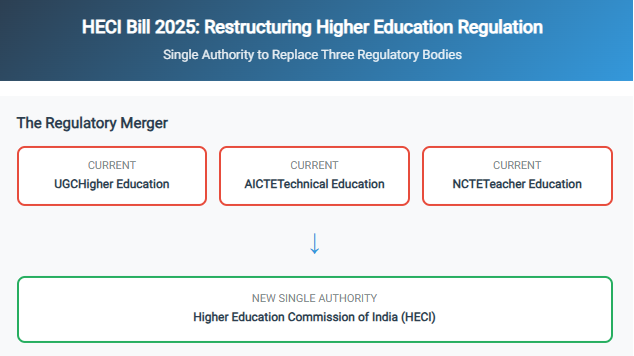
  • It follows recommendations in the National Education Policy (NEP) 2020 for a single regulatory authority to streamline governance and oversight in India’s higher education sector.
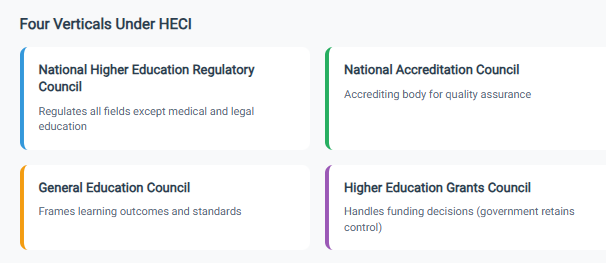
  • The new regulator will have three major roles: regulation, accreditation and setting professional standards. 
  • It proposed four verticals of HECI: 
  • The body will not have any role to play in funding. 
    • The autonomy for funding is proposed to be with the administrative ministry. 
  • The new regulator body will not supervise medical and law colleges.
    • Medical and legal education will continue to be regulated by their respective councils, remaining outside HECI’s regulatory purview.

Significance

  • The present bill represents a renewed effort to implement the NEP 2020 vision, incorporating a more comprehensive framework that includes technical and teacher education oversight under the new authority.
  • Under NEP 2020, the concept of a single regulator was highlighted as part of a broader repositioning of higher education governance
  • The policy recommended separating regulatory functions to reduce duplication and improve efficiency while maintaining accountability.

Source: IE


Other News of the Day

Syllabus: GS2/Governance; GS3/Economy Context The Union Cabinet approved the Sabka Bima Sabki Raksha (Amendment of Insurance Laws) Bill, 2025. About The Bill seeks to revamp India’s insurance framework, proposing changes to the: Insurance Act, 1938, the Life Insurance Corporation Act, 1956, and the IRDAI Act, 1999. Aim: Modernisation, wider coverage and stronger regulatory oversight. Major...
Read More

Syllabus: GS2/Governance Context The Information and Broadcasting Minister said that the government has strengthened the framework to combat fake news and deep fakes across media platforms. About Fake news is known as information that is false or misleading and presented as news.  Deep Fakes are digital media — video, audio, and images, edited and manipulated...
Read More

Syllabus: GS2/Health Context The Demow Model from eastern Assam’s Sivasagar has been chosen as one of the successful systems of snakebite prevention and management under a project sanctioned by the Indian Council of Medical Research (ICMR). The project, called the Zero Snakebite Death Initiative: Community Empowerment and Engagement for Mitigation of Snakebite Envenoming. Snakebite Envenoming ...
Read More

Syllabus: GS3/ Economy Context The Union Budget 2026–27 is expected to unveil a policy direction on the next phase of public sector bank (PSB) reforms based on two parallel tracks—Consolidation 2.0 and calibrated dilution of government ownership. What are the Reforms? Consolidation 2.0: The government is considering merging the five smallest PSBs with mid-sized banks...
Read More

Sardar Vallabhbhai Patel Syllabus: GS1/Personalities Context Prime Minister Narendra Modi paid tributes to Sardar Vallabhbhai Patel, the Iron Man of India, on his 75th death anniversary (15 December 1950).  About Born on October 31, 1875, Sardar Vallabhbhai Patel served as independent India’s first Deputy Prime Minister and Home Minister.  He is widely regarded as the...
Read More
scroll to top