

Syllabus: GS3/ Science & Technology
Context
- The NITI Aayog’s Frontier Tech Hub, in partnership with International Business Machines-IBM, has released a national roadmap to transform India into one of the world’s top-three quantum economies by 2047.
About
- Quantum technology is a rapidly advancing field that leverages the principles of quantum mechanics to develop new technologies with unprecedented capabilities.
- By 2035, quantum technologies are projected to unlock USD 1–2 trillion in new global value across industries.
- India entered the global quantum race by launching the National Quantum Mission (NQM) in 2023, from 2023-24 to 2030-31.
- Aim: To seed, nurture and scale up scientific and industrial R&D and create a vibrant & innovative ecosystem in Quantum Technology (QT).
Key pillars of quantum technologies
- Quantum Computing: Uses qubits and quantum information to perform computations exponentially faster than classical systems.
- Quantum Communication: Utilises quantum key distribution (QKD) and entanglement to enable ultra-secure communication that cannot be intercepted without detection.
- Quantum Sensing & Metrology: Uses quantum mechanical effects to achieve extremely high-precision measurements, such as in atomic clocks, magnetometers, and navigation sensors.
- Quantum Materials: Develops novel materials by exploiting quantum properties such as superconductivity, topological states, and quantum coherence.
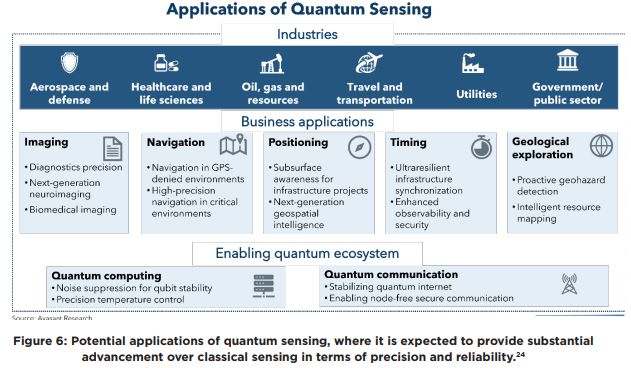
India’s Vision for 2035
- Incubating at least 10 globally competitive quantum startups, each surpassing USD 100 million in revenue,
- Capturing over 50% of the value in the global quantum software and services market by harnessing our software and engineering strength,
- Achieving meaningful, scaled deployment of quantum technologies, home-grown and global, in strategic sectors across India,
- Commanding critical positions in the global quantum supply chain for both hardware and software, creating strategic dependencies and value,
- Becoming a source of foundational scientific breakthroughs, with world class research and intellectual property creation in quantum science and engineering.
SWOT analysis of Indian ecosystem in quantum technologies
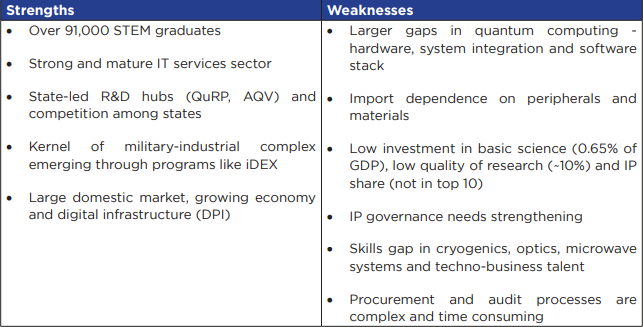
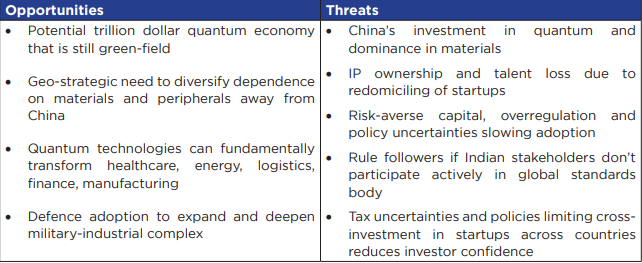
Steps Needed to Become Quantum Economy
- Expand the Quantum Workforce: Grow the scientific, deep engineering and professional workforce that is deployment-ready by an order of magnitude in 2-3 years.
- Accelerate Lab-to-Market Transition: Significantly improve ease of doing research, of technology validation and of taking technology from lab-to-market, within 2 years.
- Make Indian domicile attractive for Indian startups so that >90% deep tech Indian startups choose to stay domiciled in India.
- Lead in Global Standard Setting: Engage actively with global standards bodies and take leadership in international standard setting to ensure Indian products access in global markets.
- Strengthen trade: Ensure strong trade relations and ease of technology export and import, especially in quantum related technology areas.
| NITI Frontier Tech Hub – The NITI Frontier Tech Hub is an action tank for Viksit Bharat. – In collaboration with over 100 experts from government, industry, and academia, it is shaping a 10-year roadmap across 20+ key sectors to harness frontier technologies for transformative growth and societal development. |
Source: AIR
Previous article
National Intelligence Grid (NATGRID): Strengthening India’s Internal Security Architecture
Next article
News In Short 08-12-2025
