

11th India International Science Festival (IISF)
Syllabus: GS3/Science and Tech; Economy
In News
- The 11th India International Science Festival (IISF) commenced in Panchkula, Haryana.
India International Science Festival (IISF)
- It was launched in 2015 and has established itself as a major platform for scientific exchange, innovation, outreach, and public engagement, consistently expanding its scale through diverse programmes, wide participation, and landmark initiatives across each edition.
- Theme : The theme of IISF 2025 is Vigyan Se Samruddhi: for Aatmanirbhar Bharat.
- IISF 2025 focus on five broad themes:
- Science, Technology and Ecology of North-West India and the Himalayan Region;
- Science for Society and Education;
- Atmanirbhar Bharat through Science and Technology;
- Biotechnology and Bio-economy; and
- Integration of Traditional Knowledge with Modern Science.
Source :DD
Saras Food Festival 2025
Syllabus: Miscellaneous
In News
- The Saras Food Festival 2025 at Delhi’s Sunder Nursery became a vibrant showcase of women’s empowerment through Self-Help Groups (SHGs) under the National Rural Livelihood Mission (NRLM).
Saras Food Festival 2025
- It features over 500 traditional dishes served across 62 stalls, representing states from Haryana, Arunachal Pradesh, Maharashtra, Kerala, Assam, Uttar Pradesh, Uttarakhand, Goa, Gujarat, and many more.
- It showcases women’s entrepreneurship and self-reliance, with around 300 “Lakhpati Didis” from SHGs across India presenting food and rural products.
| Do you know? – SARAS Aajeevika Mela is organised by the Ministry of Rural Development under Deen Dayal Antyodaya Yojana-National Rural Livelihood Mission. – It provides rural women and self-help groups a national platform to sell their products directly, eliminate middlemen, and gain vital market exposure. – It equips them with skills to upgrade their products, increase incomes, and connect with buyers from across the country and beyond through workshops on packaging, design, communication, and marketing, the Melas |
Source :PIB
Shyok Tunnel
Syllabus: GS3/Infrastructure
In News
- The Defence Minister inaugurated Shyok Tunnel in eastern Ladakh and 124 other strategic border infra projects.
Shyok Tunnel
- It is the 920-metre cut-and-cover tunnel.
- It is of key strategic significance as it would provide all-weather connectivity to areas close to the LAC in eastern Ladakh, where India and China were locked in a military standoff between 2020-2024 before both sides decided to disengage from all friction points along the border.
- It will also likely reduce dependence on air maintenance and resolve logistical challenges in the difficult terrains.
- It is built in one of the world’s toughest and most challenging terrain.
Source :IE
Hindu Rate of Growth
Syllabus: GS3/ Economy
In News
- Prime Minister Narendra Modi recently stated that the expression “Hindu rate of growth” reflected a colonial mindset that unfairly associated India’s slow economic performance in earlier decades with the identity of its people.
What is the ‘Hindu Rate of Growth’?
- The term refers to India’s low and stagnant economic growth rate (around 3–3.5% per year) during the first three decades after Independence (1950s to 1970s).
- The phrase was coined by economist Raj Krishna (University of Delhi) in the late 1970s.
- As noted in paper “The New Oxford Companion to Economics in India”, Raj Krishna used it as “a polemical device” to draw attention to India’s persistently meagre growth, which appeared culturally “embedded” due to its stability across decades.
- Importantly, the word “Hindu” does not imply a religious or communal meaning.
Why Was India’s Early Growth Labeled So Low?
- Growth hovered around 3–3.5%, while population growth averaged 2% in these decades.
- India followed a state-controlled, import-substitution, license-permit-quota model, which limited private enterprise and productivity gains.
- Later, Post 1980s reforms reduced licensing, import easing, and technology upgrading escaped the “Hindu rate of growth”.
Source: IE
Border Roads Organisation (BRO)
Syllabus: GS3/ Defence
In News
- Defence Minister unveils ₹5,000 crore BRO roads, bridges and key assets across Ladakh, Jammu and Kashmir and seven states in major border infrastructure push.
About Border Roads Organisation (BRO)
- Established: 1960
- Parent Ministry: Ministry of Defence (MoD)
- Motto: Shramena Sarvam Sadhyam (Everything is achievable through hard work)
- Nature: A premier road construction executive force that develops and maintains road networks in India’s border areas and friendly neighbouring countries.
- Structure: Led by a Director General Border Roads (DGBR) — a senior officer of the rank of Lt. General (Army).
- Works through Border Road Tasks Forces (BRTFs) and Projects (e.g., Project Himank, Project Vijayak, Project Dantak, Project Vartak, Project Udayak, etc.).
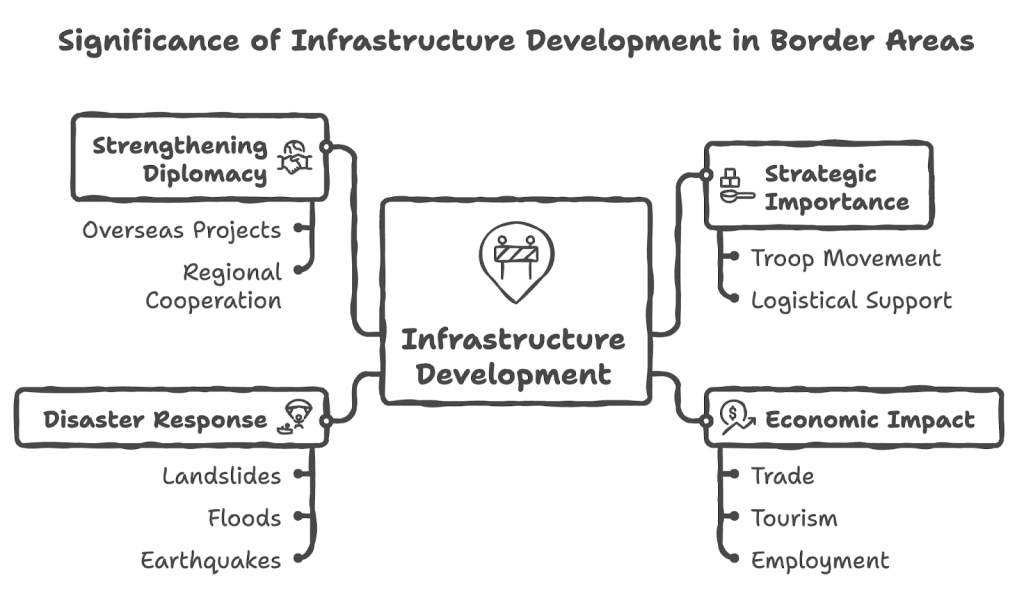
Source: AIR
Filaments: Gentle Giants in Space
Syllabus: GS3/Space
Context
- Researchers reported a ~50-million-lightyear-long filament traced by at least 14 galaxies.
- The team has claimed it as “one of the largest spinning structures ever found in the universe.”
What are Cosmic Filaments?
- Cosmic filaments are long, thin, thread-like structures of the cosmic web, spanning hundreds of millions of lightyears.
- They form when gravity pulls gas, dark matter, and galaxies into elongated strands linking massive galaxy clusters.
- Filaments surround cosmic voids (vast, empty regions), acting as boundaries of the cosmic web.

How Do Filaments Form?
- They arise where sheets of matter intersect and collapse, forming dense strands.
- Filaments act as highways for gas and small galaxies, which flow toward large gravitational hubs like clusters.
- As matter falls in, it can induce rotational motion in both the filament and the galaxies embedded within it.
Role in Galaxy Evolution
- Filaments influence where galaxies form, their growth rate, and how much fresh gas they accrete over billions of years.
- They can also shape the spin orientation of galaxies along their length.
How Astronomers Study Filaments
- Astronomers map them by measuring galaxy positions and distances, then tracing the patterns.
- Computer simulations show similar filamentary networks, confirming they arise from initial ripples in the early universe that evolved under gravity.
Source: TH
Next article
150 Years of Vande Mataram
