


Syllabus: GS1/ Modern History
Context
- India is celebrating the 150th anniversary of its national song, Vande Mataram.
Historical Background
- Vande Mataram was composed by Bankim Chandra Chatterjee in Sanskrit and first appeared in the novel Anandamath in 1882.
- Anandamath is set against the backdrop of the 1769–73 Bengal famine and the Sanyasi Rebellion.
- First sung by Rabindranath Tagore at the 1896 Indian National Congress session gave it national exposure.
- The song celebrates the motherland as an embodiment of strength, prosperity, and divinity and provided a poetic voice to India’s awakening national consciousness.
Rise of National Consciousness
- During the Swadeshi Movement of 1905, Vande Mataram emerged as the anthem of civil resistance.
- Vande Mataram, as a political slogan, was first used on 7 August 1905.
- For many young revolutionaries facing execution, Vande Mataram became the last chant before martyrdom, turning the song into a symbol of sacrifice.
- In 1907, Madam Bhikaji Cama raised the tricolour flag for the first-time outside India in Stuttgart, Berlin. The words Vande Mataram were written on the flag.
- In October 1905, a Bande Mataram Sampradaya was founded in North Calcutta to promote the idea of the Motherland as a mission and a religious passion.
- In 1906, an English daily titled Bande Mataram was launched under the editorship of Bipin Chandra Pal, with Aurobindo later joining as joint editor.
National Song
- After independence, the Constituent Assembly deliberated on the status of Vande Mataram.
- On 24 January 1950, the first two stanzas were adopted as India’s National Song.
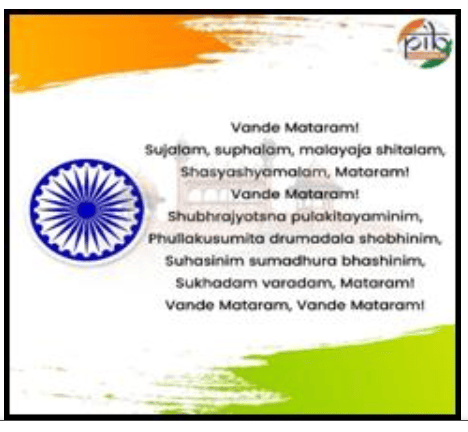
About Bankim Chandra Chattopadhyay
- Bankim Chandra Chattopadhyay was one of the architects of modern Indian literature.
- As a distinguished novelist, poet, and essayist, his contributions significantly influenced the development of modern Bengali prose and the articulation of an emerging Indian nationalism.
- Other works: Durgeshanandini (1865), Kapalkundala (1866), and Devi Chaudhurani (1884).
Source: IE
Previous article
News In Short 08-12-2025
