
Government Strengthens Logistics Framework to Boost Exports Amid Global Disruptions

Syllabus: GS3/ Economy

Context

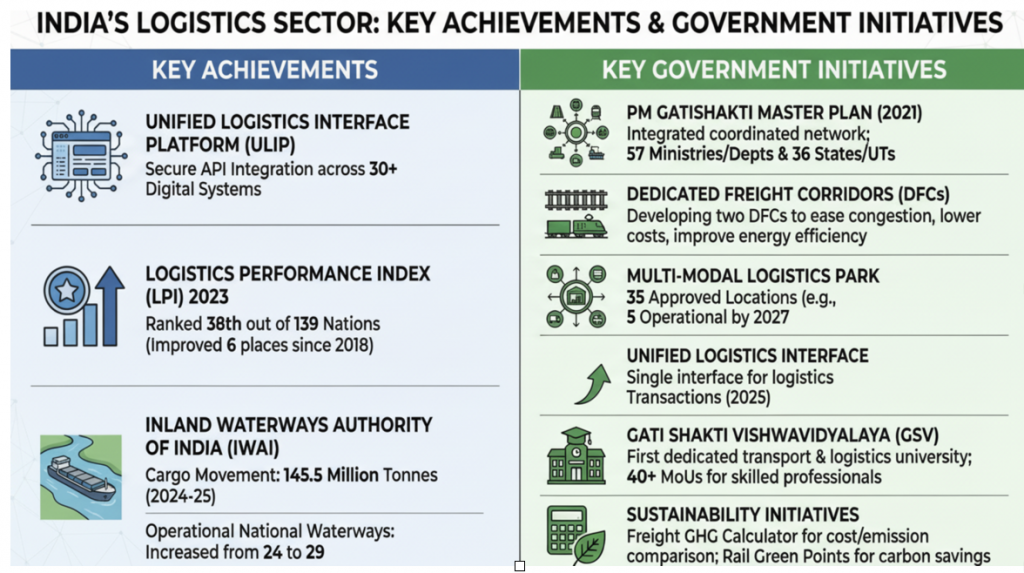
  • The Government of India is actively enhancing logistics infrastructure to address global logistics disruptions and enhance export efficiency.

Overview of the Logistics Landscape in India

  • India’s logistics sector was valued at USD 215 billion in 2021. It is well-positioned for strong growth with an expected compound annual growth rate (CAGR) of 10.7% till 2026. 
  • In 2017, a separate logistics unit was created under the Department of Commerce to oversee the Integrated Development of Logistics Sector. 
  • The Logistics Industry supports manufacturing, retail, e-commerce, and services by managing inventory, transportation, storage, warehousing, and distribution, linking producers to consumers, both domestically and internationally.

Key Advantages of Efficient Logistics Infrastructure

  • Supply chain efficiency: Logistics ensures a smooth and efficient supply chain, minimising delays and reducing lead times. 
  • Connectivity and Accessibility: Logistics networks enhance connectivity and accessibility, linking various regions and markets. 
  • Cost reduction and competitiveness: Efficient logistics operations contribute to cost reduction in transportation, storage, and distribution. 
  • Job creation: The sector is projected to add 1 crore jobs by 2027.
  • Economic integration: A well-developed logistics sector facilitates economic integration by connecting various economic zones and promoting a seamless flow of goods and services. 
Challenges

  • High Logistics Cost: India’s logistics cost is very high at around 13–14% of GDP, making Indian exports less competitive compared to global peers.
  • Infrastructure Gaps: The sector suffers from infrastructure gaps in warehousing, cold storage, and last-mile connectivity.
  • Overdependence on Road: There is an overdependence on road transport, which causes congestion, delays, and higher transportation costs.
  • Environmental Concerns: Heavy dependence on diesel-based trucking increases carbon emissions and contributes to environmental pollution.

Source: PIB


Other News of the Day

Syllabus: GS2/IR Context India and Russia held their 23rd annual bilateral summit, marking a major milestone — 25 years of the Declaration on Strategic Partnership (2000). Key Outcomes of the Visit Economic Programme 2030: The Leaders welcomed the adoption of the Programme for the Development of Strategic Areas of India – Russia Economic Cooperation till...
Read More

Syllabus: GS1/History  In News President Droupadi Murmu and  Prime Minister Narendra Modi  paid floral tributes to Dr. B.R. Ambedkar on Mahaparinirvan Diwas at the Parliament complex in New Delhi. Mahaparinirvan Diwas It is observed annually on December 6 to commemorate the death anniversary of Bharat Ratna Dr. Bhimrao Ramji Ambedkar, fondly known as Babasaheb Ambedkar,...
Read More

Syllabus: GS2/Judiciary; GS3/Role of IT Context Recently, the Chief Justice of India (CJI) observed that the judges are ‘over-conscious’ of the risks in using Artificial Intelligence (AI), while hearing a PIL seeking guidelines to check the misuse of AI in Courts. Promise of AI in the Courts AI technologies such as Natural Language Processing (NLP),...
Read More

Syllabus: GS2/Polity Context A private member bill “Right to Disconnect Bill, 2025”, reintroduced in the Lok Sabha. What is Right to Disconnect? The Right to Disconnect refers to an employee’s right to not engage in work-related communications—such as calls, emails, or messages—outside official working hours. It aims to protect workers from excessive digital connectivity and...
Read More

Syllabus: GS3/ Environment Context The Central Ground Water Board (CGWB) highlights a disturbing rise in toxic contaminants across India’s aquifers.  About India holds 18% of the world’s population but only 4% of its freshwater resources, placing enormous pressure on available water systems.  India depends on groundwater for about 85% of its rural drinking water needs...
Read More

Directorate General of Civil Aviation (DGCA) Syllabus: GS2/ Statutory Bodies In News A large-scale cancellation of flights by a major Indian airline recently led the Directorate General of Civil Aviation (DGCA) to grant a one-time exemption from the newly implemented Flight Duty Time Limitations (FDTL) rules. These rules are designed to prevent pilot fatigue by...
Read More
scroll to top