


Directorate General of Civil Aviation (DGCA)
Syllabus: GS2/ Statutory Bodies
In News
- A large-scale cancellation of flights by a major Indian airline recently led the Directorate General of Civil Aviation (DGCA) to grant a one-time exemption from the newly implemented Flight Duty Time Limitations (FDTL) rules.
- These rules are designed to prevent pilot fatigue by restricting maximum duty hours and mandating adequate rest periods.
About Directorate General of Civil Aviation (DGCA)
- Overview: DGCA is India’s statutory civil aviation regulator mandated to ensure aviation safety, airworthiness, and compliance with global aviation standards.
- Establishment: Created in 1927 as a government organisation. Became a statutory body in 2020 after amendments to the Aircraft Act.
- Administrative Control: Functions under the Ministry of Civil Aviation (MoCA).
- Aim: To promote safe, efficient, and reliable air transport through proactive safety oversight, strong regulatory frameworks & alignment with ICAO (International Civil Aviation Organization) norms.
Source: AIR
Goldilocks Economy
Syllabus: GS3/ Economy
In News
- RBI trims repo rate to 5.25% as the governor highlights a rare Goldilocks moment for India’s economy.
What is Goldilocks Economy Phase?
- A Goldilocks economy describes an ideal economic state that is “just right”, neither overheating with high inflation nor cooling into recession, but featuring steady growth, low inflation, and low unemployment.
Why does the RBI call it a Goldilocks phase?
- Retail inflation has dropped well below the 4% target and is hovering near the lower end of the 2–6% band.
- At the same time, real GDP growth has stayed robust at about 8%, even amid weak global conditions and external headwinds such as higher tariffs and currency pressures.
Source: FE
Govt. to Streamline its Public Communications Framework
Syllabus: GS2/Governance
Context
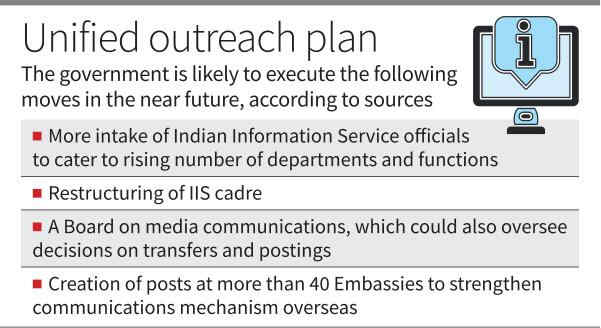
- The Centre has begun revamping its information network, through measures ranging from reorganising human resources to strengthening technological infrastructure.
About
- The government may establish a Board on media communications, which could also be entrusted with the responsibility of overseeing decisions related to transfers and postings.
- Restructuring of Indian Information Service (IIS) is under consideration.
About Indian Information Service (IIS)
- The IIS is the central civil service under Group A and Group B of the Central Civil Services of the executive branch of the Government.
- Indian Information Service officers are the media managers of the Government.
- Function: They act as a vital communication link between the Government and the people by way of disseminating information and communicating various Government policies and schemes to the public.
- They also collect and provide valuable feedback to the Government for policy formulation.
- Most IIS officers work in various media units which are under the Ministry of Information and Broadcasting such as DD News, All India Radio, Press Information Bureau, etc.
Source: TH
Open Market Operations (OMO)
Syllabus: GS3/Economy
In News
- The Reserve Bank of India (RBI) announced measures to inject durable liquidity into the system, including ₹1,00,000 crore worth of government securities purchases through Open Market Operations (OMO) and a $5 billion USD/INR buy-sell swap.
About Open Market Operations (OMO)
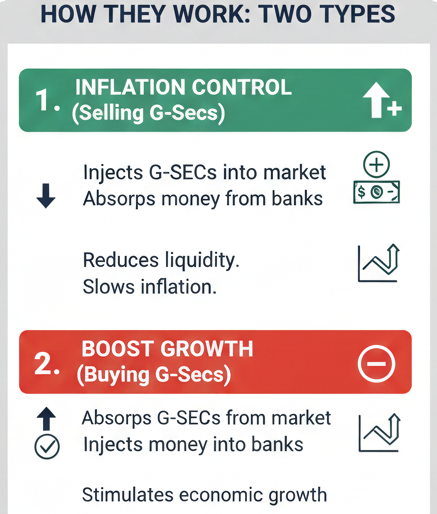
- They are a key monetary policy instrument through which the RBI buys or sells government securities to regulate liquidity in the banking system.
- OMO purchases inject liquidity, as the RBI pays banks for the securities. OMO sales absorb liquidity, as banks pay the RBI.
Operation Twist
- Operation Twist is a monetary policy of the central banks used to bring down interest rates and control investments in a country.
- RBI deployed this policy in India in 2019 and 2020. Under this operation, the RBI twisted the yield of government securities to bring liquidity into the markets.
- This is done by simultaneous buying and selling government securities—both short-term and long-term—through Open Market Operations (OMOs).
- Operation Twist was first used by the United States Federal Reserves in 1961 to stimulate the US economy. The mechanism worked by reviving the US Economy through increased short-term rates.
Source :TH
Finfluencers
Syllabus: GS3/ Economy
In News
- SEBI has taken regulatory action against unregistered financial influencers (“finfluencers”) who provide stock market advice, trading strategies, and research content through social media.
SEBI Guidelines on Finfluencers
- Anyone offering investment advice or research analysis must be registered under SEBI Regulations, 2013.
- Finfluencers cannot promise guaranteed returns, promote unverified “success stories”, give misleading profit screenshots etc.
- Brokers and mutual fund distributors are barred from partnering with unregistered finfluencers.
About SEBI
- Establishment: Statutory body established in 1992 through the SEBI Act.
- Aim: regulate the securities market and protect investors.
Source: FE
Infrastructure Investment Trusts (InvITs)
Syllabus: GS3/Economy
Context
- The Securities and Exchange Board of India (SEBI) has granted in-principle approval for the registration of the Raajmarg Infra Investment Trust (RIIT) as a Public Infrastructure Investment Trust (InvIT).
About Infrastructure Investment Trusts (InvITs)
- An InvIT works like a mutual fund, but instead of investing in equities, it invests in revenue-generating infrastructure assets (e.g., toll roads).
- InvITs are created by sponsors, usually infrastructure companies or private equity firms.
- Sponsors transfer ownership of eligible infrastructure assets to a Trust.
- InvITs are governed by SEBI (Infrastructure Investment Trusts) Regulations, 2014.
Source: BS
Exercise Harimau Shakti
Syllabus: GS3/ Defence
In News
- India and Malaysia have commenced the 5th edition of Exercise Harimau Shakti 2025 at the Mahajan Field Firing Range, Rajasthan.
About
- It is a bilateral military exercise between the Indian Army and the Malaysian Army.
- The exercise aimed at training both forces in jungle warfare, counter-insurgency operations, semi-urban combat & enabling smoother cooperation in future missions.
- The exercise began in 2012 and is conducted regularly, strengthening defence ties.
Source: AIR
DRDO’s New Rocket-sled Ejection Test
Syllabus: GS3/Defence
In News
- The Defence Research and Development Organisation (DRDO) conducted a successful high-speed rocket-sled test of a fighter aircraft escape system at controlled velocity.
- The technical achievement places India in an elite club of nations with advanced in-house escape system testing capability.
| Do you know? – The rocket sled is a ground-based testing system, which is propelled by rockets to climb to high speeds while moving on rail tracks, simulating the aerodynamic conditions of an aircraft in flight. |
High-speed rocket-sled test
- It was conducted in collaboration with the Aeronautical Development Agency (ADA) of the Ministry of Defence and public sector entity Hindustan Aeronautics Limited (HAL).
- It was carried out at the Rail Track Rocket Sled (RTRS) facility of the Terminal Ballistics Research Laboratory (TBRL), a key DRDO facility in Chandigarh.
- Using a rocket-propelled dual-sled system, the aircraft forebody was accelerated to 800 km/h to replicate real flight conditions and assess complex, millisecond-precise mechanisms like canopy severance and ejection sequencing.
- Sensor-equipped dummies measured the extreme forces pilots face during emergencies, ensuring the system meets global safety standards.
Strategic importance of indigenous pilot safety tests
- India’s successful indigenous test of a fighter aircraft escape system marks a major strategic leap, reducing reliance on foreign facilities and cutting costs to a fraction of earlier levels.
- The new in-house dynamic ejection-testing setup enables faster design, certification, and upgrades for current and future aircraft, while advanced simulations using instrumented dummies improve understanding of pilot safety.
- The newly developed infrastructure provides high-speed, precise testing capabilities and strengthens India’s self-reliance in critical aerospace technologies.
Source :TH
Technology Development Fund Scheme
Syllabus: GS2/Governance; GS3/Science and Tech
In News
- Defence Research and Development Organisation (DRDO) has handed over seven technologies developed under the Technology Development Fund (TDF) scheme to the three Services.
The Technology Development Fund (TDF) scheme
- It is a flagship programme of the Ministry of Defence executed by DRDO under ‘Make in India’ initiative.
- It extends financial support and expertise to upgrade existing products/ systems, processes and its applications by reducing production costs, improving functionality and quality by promoting Make in India, and the development of futuristic technologies with defence applications.
Source :PIB
