

Syllabus: GS2/IR
Context
- The External Affairs Minister met Qatar’s top leadership and discussed major aspects of the bilateral relationship, including energy and trade, as well as regional and global issues.
Brief on India-Qatar Relations
- Strategic Partnership: In 2025 India and Qatar have signed an agreement to elevate their ties to the level of a strategic partnership.
- India currently has strategic partnerships with four other members of the Gulf Cooperation Council – the United Arab Emirates (UAE), Saudi Arabia, Oman, and Kuwait.
- Economic and Trade Relations: Qatar is the largest provider of liquefied natural gas (LNG) and liquefied petroleum gas (LPG) to India, supplying 10.91 million metric tonnes of LNG and 4.92 million metric tonnes of LPG in FY 2023-24.
- The current annual trade is worth $14.08 billion.
- Two sides also signed a double taxation avoidance treaty and also planned on doubling their trade to $28 billion within five years.
- Defence: India participates in the biennial Doha International Maritime Defence Exhibition and Conference (DIMDEX).
- Exercise Zair-Al-Bahr is a joint naval exercise between the Indian Navy and the Qatar Emiri Naval Force (QENF).
- The India-Qatar Defence Cooperation Agreement was signed in 2008 and extended for five years in 2018, it is managed through the Joint Defence Cooperation Committee (JDCC).
- Labor and Diaspora: India has a large expatriate community in Qatar, numbering over 700,000.
- The Indian diaspora in Qatar plays a crucial role in the country’s development, particularly in construction and other sectors.
- Regional Cooperation: Gulf Cooperation Council (GCC) is a political and economic alliance of six Middle Eastern countries—Saudi Arabia, Kuwait, the United Arab Emirates, Qatar, Bahrain, and Oman. It was established in 1981.
- India engages regularly with GCC and aims to deepen its relationship with the GCC.
Gulf Region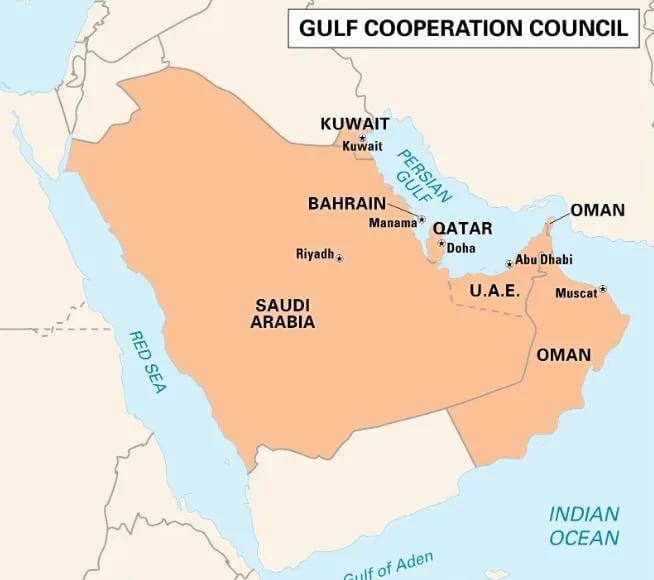 – The Gulf Region typically refers to the countries surrounding the Persian Gulf in the Middle East. – It includes nations like Saudi Arabia, Kuwait, Bahrain, Qatar, Oman, and the United Arab Emirates (UAE). – This region is known for its vast oil reserves, which have significantly influenced global economics and politics. |
Challenges/Concerns
- The Hamas–Israel war and shipping attacks in the Red Sea affect India’s energy security and economic growth.
- India remains cautious in Middle Eastern politics, balancing relations with the Gulf, Iran, and Israel.
- Delay in Connectivity Projects: The conflict has delayed progress for the I2U2 group since 2023.
- India urges economic initiatives like I2U2 and IMEC to progress despite the conflict.
- FTAs with GCC: Delays in finalizing the India–GCC Free Trade Agreement (FTA) due to changes in the GCC’s trade negotiator.
- Reaching an agreement that satisfies all GCC states remains a key challenge.
Way Forward
- The India–Qatar partnership is strategic, energy-critical, and diaspora-centric.
- Strengthening institutional frameworks, expanding economic complementarities, and ensuring the welfare of the Indian community will be key to future-proofing this vital West Asian partnership.
Source: TH
Previous article
National Press Day
Next article
Precision Biotherapeutics
