

Syllabus: GS3/Environment
In News
- At the 3rd International Conference on Green Hydrogen,the Union Minister for New & Renewable Energy highlighted the National Green Hydrogen Mission (NGHM) as a catalyst for India’s clean energy transition, job creation, and global leadership in green hydrogen.
The National Green Hydrogen Mission
- It was launched by the Government of India in January 2023 and spearheaded by the Ministry of New and Renewable Energy (MNRE).
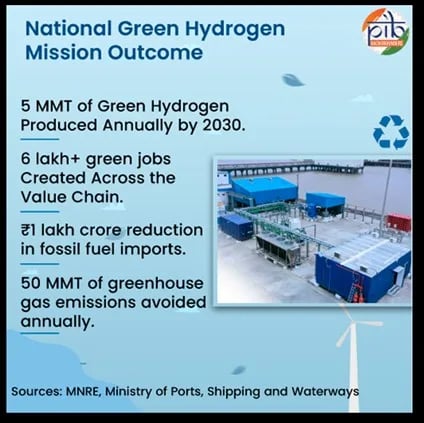
- It is a cornerstone of India’s strategy to achieve energy independence by 2047 and net-zero emissions by 2070.
- It aims to position India as a global hub for the production, utilization, and export of green hydrogen and its derivatives.
Objectives
- It aims to reduce dependence on fossil fuels and cut emissions in hard-to-abate sectors like steel, cement, refining, and mobility.
- It aims to create export opportunities for green hydrogen and its derivatives such as ammonia and methanol.
- It aims to generate employment and stimulate economic growth through innovation and infrastructure development.
- It aims to develop green hydrogen hubs and promote public-private partnerships for technology advancement.
Challenges
- High production costs: Electrolyser technology and renewable energy inputs remain expensive.
- Infrastructure gaps: Limited hydrogen pipelines, refueling stations, and storage facilities.
- Technology maturity: Many green hydrogen applications are still in pilot or demonstration stages.
- Policy coordination: Cross-sectoral alignment is needed across energy, transport, industry, and finance ministries.
- Global competition: Countries like the EU, US, and China are also aggressively pursuing green hydrogen leadership.
Way Ahead
- India’s National Green Hydrogen Mission is a strategic push to align clean energy with industrial growth and global competitiveness.
- Key priorities include scaling domestic manufacturing, expanding pilot projects, boosting R&D, building hydrogen infrastructure, improving policy coherence, and leveraging renewable energy to produce affordable green hydrogen for domestic and export markets.
Source :PIB
Previous article
SEBI Warns Against Digital Gold Risks
Next article
Tropical Forest Forever Facility (TFFF)
