



Baliyatra Festival
Syllabus: GS1/ Culture
In News
- The President extends greetings on the occasion of the historic ‘Baliyatra’ festival to the people of Odisha.
About
- Baliyatra is an annual festival celebrated in coastal Odisha on the day of Kartika Purnima, commemorating the ancient maritime trade and cultural links between Odisha (ancient Kalinga) and Southeast Asian countries like Bali, Java, and Sumatra.
- The festival is associated with the legend of ‘Taapoi’ and includes rituals such as ‘Bhalukuni Osha’ (or ‘Khudurukuni Osha’) and ‘Bada Osha’.
- During Baliyatra, people traditionally float miniature boats with lamps on the Mahanadi River, symbolizing the sea voyages made by their ancestors.
Source: TH
Gogabeel Lake
Syllabus: GS1/ Geography
In News
- Gogabeel Lake has been officially designated as India’s 94th Ramsar site.
About Gogabeel Lake
- Gogabeel Lake is a naturally formed oxbow wetland situated in the riverine landscape of the Katihar district of Bihar.
- Its strategic location between the Ganga and Mahananda rivers makes it a critical hydrological and ecological buffer zone.
- The addition of Gogabeel Lake highlights India’s commitment to the Ramsar Convention, which was signed in Ramsar, Iran, in 1971 to promote the conservation and wise use of wetlands worldwide.
Source: TOI
Umngot River
Syllabus: GS1/Geography
In News
- Meghalaya’s Umngot river has turned unusually murky, sparking concerns over pollution from highway construction activities.
About Umngot River
- Umngot River, also called Dawki or Wah Umngot, flows through Dawki in Meghalaya’s West Jaintia Hills and is famed for its crystal-clear, transparent waters that reveal the riverbed below.
- It runs along the India–Bangladesh border, serving both as a natural boundary and a key cross-border trade route.
- The discoloration, typically seen only during monsoons, is being linked to construction activities for the Shillong-Dawki road upgrade.
Source :IE
Starlink Signs First Deal with Maharashtra
Syllabus: GS3/Science and Technology
Context
- Maharashtra has become the first Indian state to formally collaborate with Starlink to deliver satellite-based internet connectivity across remote and underserved regions.
About
- Under the partnership, satellite internet will be deployed in government institutions, public infrastructure and underserved districts.
- The move is part of the state’s Digital Maharashtra mission and aims to strengthen digital connectivity in areas with limited network access.
Starlink
- Starlink, owned by Elon Musk’s SpaceX, provides internet through a constellation of low-Earth orbit (LEO) satellites that beam signals directly to users on the ground.
- Unlike traditional broadband that depends on cables or mobile towers, Starlink’s system can reach regions where laying fibre or building towers is difficult or uneconomical.
- Significance:
- Satellite internet can support essential services such as online education, telemedicine, digital payments, and e-governance.
- It can also maintain communication during disasters when ground infrastructure fails.
Source: IE
Vaishvik Bhartiya Vaigyanik (VAIBHAV)
Syllabus: GS3/Science and Technology
Context
- Minister of State for Science and Technology interacted with Vaishvik Bhartiya Vaigyanik (VAIBHAV) fellows from across the world.
About
- Launched: VAIBHAV fellowship was launched in 2023 and is implemented by the Department of Science & Technology, Ministry of Science and Technology.
- Aim: The goal is to create an ecosystem of Knowledge and Innovation in the country through global outreach.
- Eligibility: Non-Resident Indian (NRI), Persons of Indian Origin (PIO), and Overseas Citizen of India (OCI), currently working abroad.
- Implementation: Collaboration between scientists of the Indian Diaspora with Indian Higher Educational Institutions (HEIs), Universities and/or Public Funded Scientific Institutions.
- The VAIBHAV Fellow would identify an Indian Institution for collaboration and may spend up to two months in a year for a maximum of 3 years.
- Fellowship is ₹4,00,000/- for a minimum of 1 month and a maximum of up to 2 months per year for a period of a maximum of 3 years.
- Institutional Financial Support: The financial support (up to ₹5 Lakhs per year for 3 years) will be given to the host institution to facilitate the VAIBHAV fellow.
Source: AIR
Project Suncatcher
Syllabus: GS3/ Science & Technology
In News
- Google launches Project Suncatcher to test AI data centres in space.
About
- The initiative envisions a constellation of compact satellites, each carrying Google’s custom-built Tensor Processing Unit (TPU) chips (processors designed specifically for machine learning and AI applications).
- Each satellite will feature high-efficiency solar panels for power and will be connected through free-space optical communication beams, enabling them to relay data between satellites and back to Earth.
- In its initial phase, Google intends to launch two prototype satellites by early 2027 to test TPU operations in orbit.
Source: BS
GW250114 & Hawking’s Law
Syllabus:GS3/Science and Technology
In News
- A network of detectors, Laser Interferometer Gravitational-wave Observatories (LIGO), Virgo (Italy) and KAGRA (Japan) detected GW250114.
About
- In September, 2015, LIGO in the U.S. made the first-ever detection of gravitational waves, a century after Einstein predicted them.
- For building LIGO, Rainer Weiss, Kip Thorne, and Barry Barish won the 2017 Nobel Prize in Physics.
- Gravitational waves are ripples in spacetime caused by accelerating massive objects, such as colliding black holes or neutron stars, and can travel across billions of light-years.
GW250114 : Latest Observations
- It is the clearest gravitational wave signal to date, from merging black holes 1.3 billion light-years away.
- It allowed researchers to test fundamental physics, including Hawking’s black-hole area theorem and Kerr’s solution for rotating black holes.
- Advances in detector sensitivity, like lower laser noise and cleaner mirrors, helped capture the signal.
- Hawking’s black-hole area theorem states that the total surface area of black holes should never decrease, referring to the sum of the areas of the event horizons.
- The detection confirmed that the total area of black holes increases after a merger and revealed the resulting black hole’s vibrations, behaving as a rotating black hole.
Importance
- Ongoing gravitational wave detections are helping scientists build a growing catalogue of black-hole mergers, refine understanding of black hole formation, and test predictions of relativistic physics, marking significant milestones in gravitational-wave science.
Source :TH
QS Asia University Rankings
Syllabus: Miscellaneous
In News
- The QS World University Rankings: Asia 2026 has been released.
About the Rankings
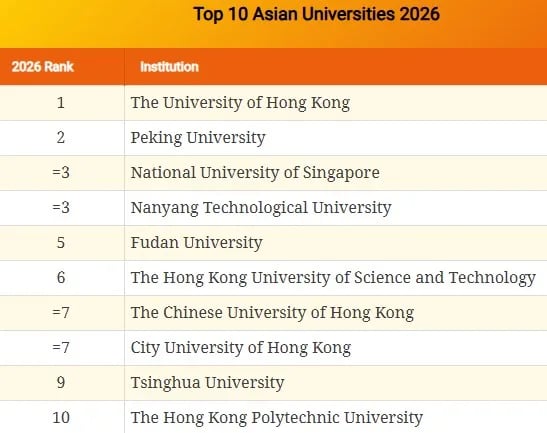
- It features a record 1,526 universities from 25 locations, including 557 new entries.
- It is designed to offer a more region-specific view of higher education and incorporates unique indicators such as ‘Staff with a PhD’ and ‘Exchange Students’, with adjusted weightings to reflect Asian academic priorities.
- It evaluates universities based on academic and employer reputation, faculty-student ratio, research output and impact, staff with PhDs, international faculty and students, and student exchange programs.
- Ranking: QS notes that East and Southeast Asian countries are outperforming India in research impact, faculty resources, and internationalisation, with South Korea and Malaysia showing strong upward mobility due to strategic investments in higher education.
- Universities in China, Hong Kong, Singapore, South Korea, and Malaysia dominated the top ranks, with The University of Hong Kong taking first place.
- India Specific Data: It reveals a sharp decline in rankings for nine of the top 10 Indian institutions, including seven IITs, despite improvements in their overall scores.
- IIT Delhi, India’s highest-ranked institution, fell from 44th to 59th, while IIT Bombay dropped 23 places to 71st—its lowest in recent years.
- The only Indian institution to improve was Chandigarh University, rising to 109th.
Source :IE
Previous article
India’s Largest Geothermal Energy Technology Pilot Project
Next article
Karnataka’s Menstrual Leave Policy
