


Syllabus: GS2/AI in Governance
Context
- The Ministry of Electronics and Information Technology (MeitY) released the India AI Governance Guidelines.
About
- These guidelines present a governance framework that seeks to advance technical progress and mitigate the potential risks of AI to society, while being firmly grounded in the needs and aspirations of India.
- A drafting committee was constituted by the Ministry of Electronics and Information Technology (MeitY) in July 2025.
- Its mandate was to draw on available literature, review existing laws, study global developments, and develop suitable guidelines for AI governance in India.
Major Highlights
- Seven principles have been adapted for application across sectors and aligned with national priorities.
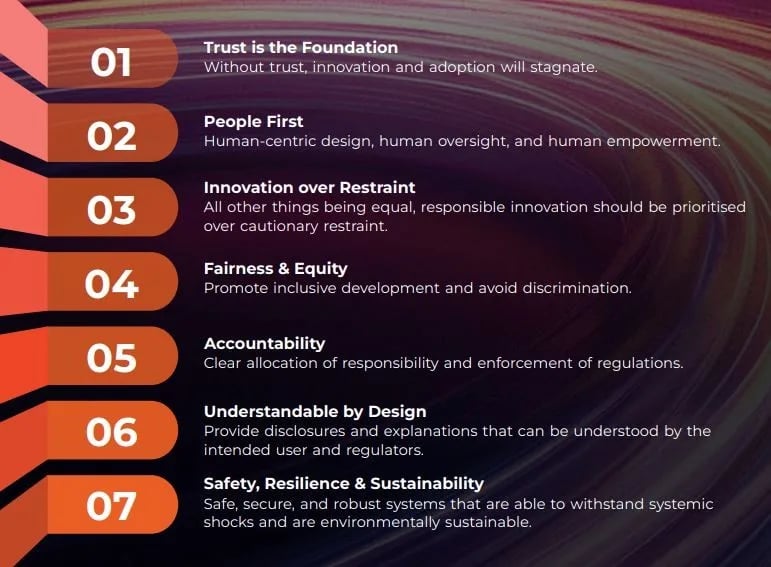
- Key Recommendations: It examines key issues in AI governance from India’s perspective & makes recommendations across six pillars:
- Infrastructure: Enable innovation and adoption of AI by expanding access to foundational resources such as data and compute, attract investments, and leverage the power of digital public infrastructure.
- Capacity Building: Initiate education, skilling, and training programs to empower people, build trust, and increase awareness about the risks and opportunities of AI.
- Policy & Regulation: Adopt balanced, agile, and flexible frameworks that support innovation and mitigate the risks of AI. Review current laws, identify regulatory gaps in relation to AI systems, and address them with targeted amendments.
- Risk Mitigation: Develop an India-specific risk assessment framework that reflects real-world evidence of harm.
- Accountability: Adopt a graded liability system based on the function performed, level of risk, and whether due diligence was observed.
- Institutions: Adopt a whole of government approach where ministries, sectoral regulators, and other public bodies work together to develop and implement AI governance frameworks.
- An institutional framework to implement the AI governance guidelines has also been suggested:
- High-level body (AI Governance Group) Government agencies (MeitY, MHA, MEA, DoT, etc.)
- Sectoral regulators (RBI, SEBI, TRAI, CCI, etc.)
- Advisory bodies (NITI Aayog, Office of PSA, etc.)
- Standards bodies (BIS, TEC, etc.).
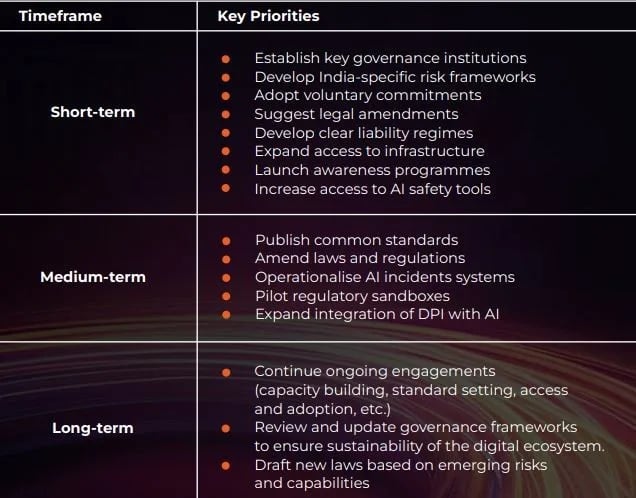
- Action Plan: The Action Plan identifies outcomes mapped to short, medium, and long-term timelines.
Conclusion
- Together, these guidelines create a balanced, agile, flexible, pro-innovation, and future-ready governance framework, enabling India to unlock AI’s benefits for growth, inclusion, and competitiveness, while safeguarding against risks to individuals and society.
Source: TH
