


Syllabus: GS3/Energy
Context
- Recently, Energy Efficiency Services Limited (EESL) has announced plans to establish India’s largest geothermal energy technology pilot project in Araku Valley and Visakhapatnam in Andhra Pradesh.
| About Energy Efficiency Services Limited (EESL) – It is a joint venture of four public sector undertakings (PSUs) like NTPC Limited, Power Finance Corporation (PFC), Rural Electrification Corporation (REC) and Power Grid Corporation of India under the Union Ministry of Power. – It was established to lead large-scale energy efficiency projects across India, acting as a ‘Super ESCO’ (Energy Service Company). – Other Key Initiatives By EESL: 1. UJALA: Distribution of LED bulbs and appliances; 2. Smart Metering: Deployment of advanced metering infrastructure; 3. National Efficient Cooking Programme (NECP): Promoting induction cookers to reduce cooking costs; 4. Energy Efficient Fans Programme (EEFP): Distribution of BLDC fans nationwide. Araku Valley – It is located in the Alluri Sitharama Raju (ASR) district of Andhra Pradesh in Eastern Ghats. – Galikonda Hill is located in it. |
About Geothermal Energy (Geo = Earth, Thermal=Heat)
- It is the heat stored within the Earth’s crust, and comes from the natural heat of the Earth primarily due to the decay of the naturally radioactive isotopes of uranium, thorium and potassium.
- On average, the temperature of the Earth increases with depth, about 25–30°C/km above the surface ambient temperature (geothermal gradient).
- The heat is transferred from the interior towards the surface mostly by conduction.
- Types:
- High-enthalpy Resources: Often associated with volcanic regions, geysers and hot springs are primarily used for electricity generation.
- Low to Medium-enthalpy Resources: Such as hot rocks and shallow ground layers, are better suited for direct-use applications and geothermal heat pumps.
- Geothermal plants offer high capacity utilization (>80%), reliable baseload supply, and no recurring fuel costs, making them economically viable in the long term.
- These are capital-intensive and site-specific, requiring high upfront investment in exploration, drilling, and infrastructure.
- Global Geo-Thermal Capacity (15.4 GW): United States, followed by Indonesia, the Philippines, Turkey, and New Zealand.
Geothermal Potential Sites in India
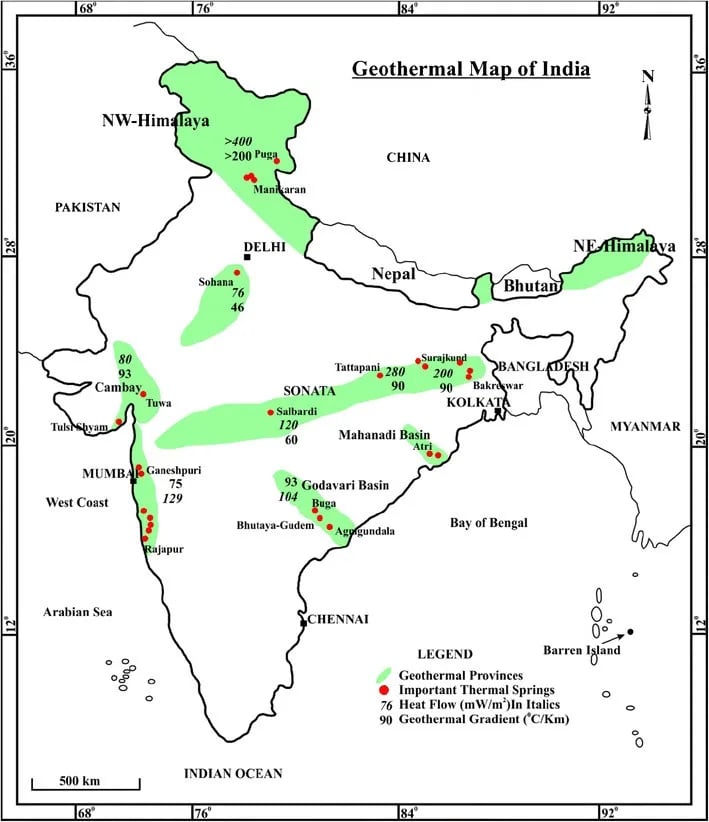
- The Geological Survey of India (GSI), since 1973, has identified 381 hot springs with surface temperatures ranging from 35°C to 89°C.
- It can be utilized effectively, with advancements in Enhanced Geothermal Systems (EGS) and Advanced Geothermal Systems (AGS).
- India falls within a medium to low heat enthalpy zone (100–180°C), spread across 10 geothermal provinces.
- ‘Geothermal Atlas of India, 2022’ estimated the potential of about 10,600 MW of geothermal power in India.
Previous article
Amul Ranked World’s Number 1 Cooperative, Iffco Second
Next article
News in Short – 6 November, 2025
