


International Convention for the Suppression of the Financing of Terrorism
Syllabus: GS2/IR
Context
- Iran ratified a law joining a United Nations convention against terror financing.
About
- Adoption: It was adopted by the UN General Assembly in 1999. Entered into force in 2002.
- Purpose: To criminalize the financing of terrorism.
- Key Features:
- Criminalization of Financing: Making funds available with intent or knowledge that they will be used to carry out terrorism.
- Jurisdiction: States must establish jurisdiction over offenses committed in their territory, by their nationals, or on board their ships/aircraft.
- Extradition & Cooperation: Facilitates extradition of offenders and promotes international cooperation in investigations and prosecutions.
- Preventive Measures: Encourages countries to freeze funds linked to terrorist activities and share information to prevent financing.
- India: India ratified the convention in 2003.
- Supports India’s legal framework under Unlawful Activities (Prevention) Act (UAPA), 1967 and anti-money laundering laws.
Source: TH
Online National Drugs Licensing System
Syllabus: GS2/ Health, GS3/ Governance
Context
- The Drugs Controller General of India (DCGI) has directed digital monitoring on the Online National Drugs Licensing System (ONDLS) for tracking the supply chain of high-risk solvents.
Online National Drugs Licensing System
- ONDLS is a single-window digital platform in India for processing drug- and cosmetic-related applications for manufacturing and sales licences, and various certificates.
- It is developed by the Centre for Development of Advanced Computing (CDAC) in coordination with the Central Drugs Standard Control Organisation (CDSCO).
- Key Features:
- Digital Tracking System: The ONDLS portal now enables real-time monitoring of solvent batches used in drug manufacturing.
- Mandatory Registration: All state drug regulators and pharmaceutical manufacturers must register on the portal.
- Batch-Wise Digital Record: Every solvent batch must be digitally logged with details such as, Batch number, Quantity, Certificate of Analysis (CoA), Vendor or buyer information.
- Pre-Market Verification: State regulators must ensure no batch is released until data has been uploaded and verified on the portal.
Source: TH
Indian Railways Deploys Real-Time Heat-Mapping and Crowd Control System
Syllabus: GS2/ Technology in Governance
In News
- With Chhath Puja witnessing one of the largest annual migration surges, the Indian Railways has introduced an AI-based real-time heat-mapping and crowd control system across 35 major stations.
About the Initiative
- Technology Used: Uses AI-enabled CCTV analytics, thermal sensors, and real-time data dashboards to detect crowd density and movement patterns.
- Function:
- Generates heat maps of platforms and concourses showing congestion levels.
- Enables automated alerts to station managers and Railway Protection Force (RPF) for quick crowd dispersal.
- Integrates with Railway Helpline 139 and the Integrated Security System (ISS) for coordination.
- Coverage: Implemented at high-traffic stations such as Delhi, Patna, Varanasi, Lucknow, Kolkata, and Mumbai.
Source: TH
Quantum Echoes Algorithm
Syllabus: GS3/Science and Technology
Context
- Google claims its quantum processor “Willow” has achieved the first verifiable quantum advantage—performing a task practically impossible for classical computers.
About
- Willow ran the Quantum Echoes algorithm 13,000x faster than the best classical supercomputers.
- Quantum Echoes is a special algorithm developed to study how information spreads and scrambles in a quantum system.
- It helps scientists “unscramble” information in chaotic quantum systems to understand the underlying rules (the Hamiltonian).
Significance
- Google’s Willow quantum processor ran a task 13,000 times faster than the world’s fastest classical supercomputer.
- Classical simulation would take over 3 years, Willow did it in hours.
- Helps understand complex quantum systems, study new materials, and possibly discover drugs.
- A big step toward practical quantum computing and real-world applications.
Willow
- Willow is a superconducting quantum processor developed by Google.
- It uses quantum bits (qubits) instead of classical bits to perform computations.
- Key Features:
- Can create entanglement and quantum interference between qubits.
- Designed to handle complex quantum calculations that classical computers struggle with.
- Used in experiments like the Quantum Echoes algorithm to study quantum chaos.
Source: TH
Defence Procurement Manual (DPM)
Syllabus: GS3/Defence
In News
- Defence Minister Rajnath Singh launched the Defence Procurement Manual (DPM) 2025.
Defence Procurement Manual (DPM) 2025
- It is designed to streamline procurement processes and enhance operational readiness.
- It will oversee revenue procurement worth ₹1 lakh crore across the Armed Forces and Defence Ministry establishments.
- It emphasizes transparency, fairness, and support for MSMEs and start-ups in defence manufacturing.
Key Features of the Revised Defence Procurement Procedures
- Ease of Business: Procedures have been streamlined to expedite decision-making and minimize bureaucratic delays, making it easier for vendors to participate.
- Relaxed Penalties: The cap on liquidated damages (LD) for major delivery delays is set at 10%, and for indigenisation projects, it is now 0.1% per week, reduced from the earlier 0.5%.
- Long-term Orders: Indigenously developed items can now receive assured orders for up to five years or longer.
- No NOC Required: The requirement for a No Objection Certificate (NOC) from the Ordnance Factory Board has been abolished, simplifying vendor participation and reducing procedural hurdles.
- Procurement Thresholds: Limited Tender Enquiries are now allowed for procurements up to ₹50 lakh, with higher-value cases permitted only under exceptional circumstances.
- Growth Provisions: Ship repair and aviation overhaul work can now benefit from an upfront growth allowance of 15%, ensuring greater platform readiness.
- Structured Format: The procedures are divided into two volumes—Volume I covers main provisions, while Volume II contains forms, appendices, and government orders.
- New Chapters Added:
- Promoting Self-Reliance through Innovation and Indigenisation
- Information & Communication Technology Procurement
- Consultancy and Non-Consultancy Services.
Source: TH
Cassava/Tapioca crops
Syllabus: GS3/Agriculture
Context
- A tiny parasitic wasp, Anagyrus lopezi, has been successfully used for biological control of the invasive cassava mealybug in tapioca plantations.
About
- Cassava, popularly known as tapioca, is a woody perennial shrub.
- Scientific Name: Manihot esculenta.

- Production: It is grown over approximately 1.73 lakh hectares in India, with Tamil Nadu and Kerala contributing over 90% of production.
- Under India’s “One District One Product” (ODOP) scheme, cassava has been identified as a key crop for several districts in Kerala and Tamil Nadu.
- Origin: It is believed to have originated in Latin America, particularly in Brazil and the Amazon basin.
- Introduction in Asia: Portuguese traders introduced cassava into India in the 17th Century.
- Largest Producer and Exporter: Nigeria stands as the world’s largest cassava producer and Thailand is the largest exporter of cassava starch globally.
Tapioca
- Tapioca is a starch extracted from cassava root that serves as a versatile ingredient in cooking, baking, and beverage production worldwide.
- It is a gluten-free and grain-free product with a neutral flavor profile, making it valuable for both culinary applications and dietary requirements.
Source: TH
5th Edition of “An Eye on Methane: From Measurement to Momentum”
Syllabus: GS3/ Environment
In News
- The UN Environment Programme (UNEP) has released the fifth edition of its flagship publication — “An Eye on Methane: From Measurement to Momentum”, prepared by the International Methane Emissions Observatory (IMEO).
Key Highlights of the 2025 Report
- Methane emissions from energy, agriculture, and waste sectors remain high, despite available cost-effective mitigation technologies.
- Methane has 80 times more warming potential than CO₂ over 20 years.
- Approximately 60% of current methane emissions originate from human activities, with the largest contributors being agriculture, fossil fuel extraction and use, and landfill waste.
- The report calls for integrating methane data into national climate strategies (NDCs) and global stocktake under the Paris Agreement.
- The report highlights India’s effective role in the Global Methane Pledge (GMP) and its efforts through SATAT, National Biogas Mission, and waste-to-energy projects.
Source: DTE
International Day of the Snow Leopard 2025
Syllabus: GS3/ Environment
Context
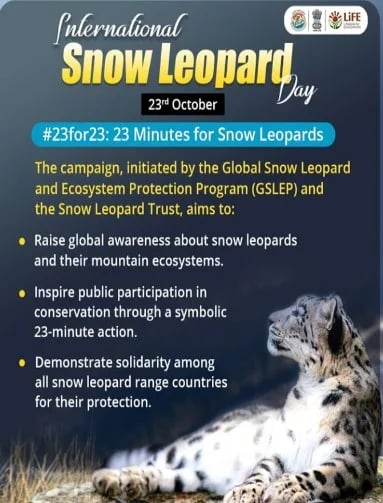
- India celebrated International Snow Leopard Day on October 23, with a nationwide campaign “#23for23”.
About
- In 2024, the United Nations General Assembly proclaimed October 23 as the International Day of the Snow Leopard to enhance international and regional cooperation for its conservation.
- The ‘#23for23’ campaign is an initiative of the Global Snow Leopard and Ecosystem Protection Programme (GSLEP) and the Snow Leopard Trust Worldwide.
About Snow Leopards (Panthera uncia)
- Physical traits: Snow leopards are adapted to rugged, cold environments, with thick fur, stocky bodies, and long tails that serve as rudders for balance and warmth.
- Habitat: They inhabit the high-altitude mountain ranges of 12 Asian countries, including India, Afghanistan, Bhutan, China, Kazakhstan, Kyrgyzstan, Mongolia, Nepal, Pakistan, Russia, Tajikistan, and Uzbekistan.
- They are often referred to as the ‘ghosts of the mountains’ as they are hardly ever seen.
- Population: The global population is estimated at 4,500–7,500, with India accounting for 10–15%.
- The first-ever Snow Leopard Census across the Indian Himalayas recorded 718 individual snow leopards, of which Ladakh alone hosts 477.
- Conservation Status:
- IUCN Red List: Vulnerable
- Wildlife (Protection) Act, 1972: Schedule I species
- Convention on International Trade in Endangered Species of Wild Fauna and Flora (CITES): Appendix I (since 1975)
- CMS (Convention on Migratory Species): Appendix I (since 1986)
- Threats: Climate change, habitat loss, reduced prey, retaliatory killings, and poaching.
- Significance: State animal of Himachal Pradesh and Ladakh.
Conservation Initiatives
- Bishkek Declaration entitled “Caring for snow leopards and mountains: our ecological future”, signed by 12 snow leopard range countries, including all five Central Asian countries.
- Samarkand Resolution of 2024 for snow leopard conservation and climate adaptation, adopted at the eighth Steering Committee Meeting of the Global Snow Leopard and Ecosystem Protection Programme.
- International Big Cat Alliance (IBCA): An Indian initiative to promote the conservation of seven big cats, including the snow leopard, through research collaboration, funding, and capacity building across range countries.
- Project Snow Leopard (2009): A flagship scheme of the Ministry of Environment, Forest and Climate Change (MoEFCC) focusing on landscape-based management of high-altitude ecosystems.
Source: DD News
Chrysanthemum Flowers or Gul-e-Dawood
Syllabus: GS3/Environment
In News
- Kashmir’s new Chrysanthemum Garden, Bagh-e-Gul-e-Dawood will open near the Zabarwan range, featuring over 30 lakh blooms across 50+ varieties.
Chrysanthemum
- It is a perennial flowering plant from the Asteraceae family.
- It is widely cultivated in China, Japan, Europe, and the U.S. for its medicinal properties and use in aromatic beverages.
- It is rich in phenolic compounds and exhibits potent antioxidant, antimicrobial, anti-inflammatory, anticancer, and other therapeutic activities.
Source: IE
International Convention Against Doping in Sport
Syllabus: Miscellaneous
In News
- India was re-elected as Vice-Chairperson of the Bureau representing the Asia-Pacific (Group IV) during the 10th Session of the Conference of Parties (COP10) to UNESCO’s International Convention against Doping in Sport, held in Paris to commemorate the Convention’s 20th anniversary.
International Convention against Doping in Sport
- UNESCO’s International Convention against Doping in Sport (2005) is a multilateral treaty by which States agree to adopt national and international measures to prevent and eliminate doping in sport.
- The Convention was adopted during the 33rd session of UNESCO’s General Conference (19 October 2005) and entered into force on 1 February 2007.
- Since its initial ratification by 30 countries, the Convention now counts with 192 States Parties, making it UNESCO’s second most ratified treaty.
- It is the only legally binding international instrument committed to promoting integrity and eliminating doping in sport globally.
Objectives
- It aims to harmonize anti-doping legislation, guidelines, regulations, and rules internationally in order to provide a level and safe playing environment for all athletes.
- It offers a legal framework for States Parties to promote integrity in sport by encouraging international cooperation, restricting access to banned substances, supporting doping controls and national testing programs, and fostering best practices in supplement distribution.
- It also backs anti-doping education and research.
Source:PIB
Previous article
India Reframes Its Renewable Revolution
