


Syllabus: GS3/ Economy
Context
- At the 16th United Nations Conference on Trade and Development (UNCTAD16) held in Geneva, a new global initiative, the Sevilla Forum on Debt, was launched.
About the Sevilla Forum
- The Forum, led by Spain and supported by UNCTAD and the United Nations Department of Economic and Social Affairs (UN DESA), aims to create a permanent, inclusive platform for dialogue and coordinated action on sovereign debt challenges.
- It marks one of the first tangible outcomes of the Fourth International Conference on Financing for Development (FfD4) and is part of the broader Sevilla Platform for Action, which operationalizes the Sevilla Commitment.
- The Sevilla Commitment lays down a roadmap for strengthening development financing and ensuring debt sustainability in developing economies.
Rising Global Debt Levels
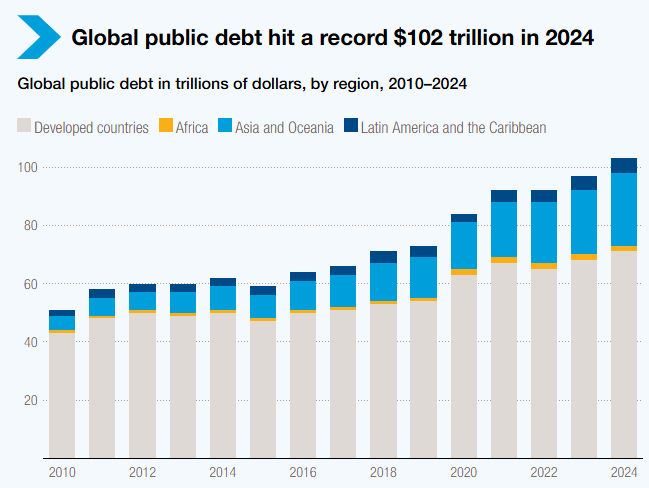
- According to UNCTAD, global public debt reached a record $102 trillion in 2024.
- Developing countries accounted for $31 trillion of this debt.
- These countries collectively paid $921 billion in interest payments, a burden exceeding spending on health and education in many cases.
- As per the World Bank 2024 Report, Developing countries spent a record $1.4 trillion to service their foreign debt as their interest costs climbed to a 20-year high in 2023.
- Currently, more than half of developing countries allocate at least 8% of government revenues to interest payments, a figure that has doubled over the past decade.
- This unsustainable debt trajectory threatens progress toward the Sustainable Development Goals (SDGs) and has amplified calls for comprehensive sovereign debt reform.
Public debt of India
- India’s public debt-to-GDP ratio has barely increased from 81% in 2005-06 to 84% in 2021-22, and is back to 81% in 2022-23.
- As per the Fiscal Responsibility and Budget Management (FRBM) Act 2003, the general government debt was supposed to be brought down to 60% of GDP by 2024-25.
- The IMF states that India’s general government debt, including the Centre and States, could be 100% of GDP under adverse circumstances by fiscal 2028.
- It has projected the ratio at 82.4% for 2024-25.
Factors Contributing to Debt Burden
- Oil Price Shock (1970s): The 1970s saw a sharp rise in oil prices due to geopolitical tensions, including the 1973 Arab Oil Embargo.
- Oil-importing developing countries faced a financial squeeze due to rising import bills.
- Petrodollar Recycling: Oil-exporting Arab nations deposited their surplus “petrodollars” in Western banks.
- These funds were loaned to developing countries, enabling them to afford higher oil prices and continue purchasing Western exports.
- This system supported Western economies by keeping factories open and avoiding recession.
- Rise of Private Lending: Private Western banks began overtaking official sources (like governments or IMF) in lending.
- By 1982, banks lent $63 billion annually—nearly double the official lending.
- Many developing countries experienced rapid economic growth in the 1970s as a result.
- The Debt Crisis (1980s): A global recession and high interest rates hit in the 1980s.
- Developing countries struggled to repay their debts and began borrowing more just to pay interest, a classic debt trap.
- High Interest: The UNCTAD report showed that developing regions borrow at rates that are 2-4 times higher than those of the US and 6-12 times higher than those of Germany.
- This is largely because developing countries are perceived to have a more “high-risk environment”, and thereby face higher cost of borrowing.
Concerns of rising debt
- Impact on climate action: Developing countries need to increase climate investments from their current level of 2.1% of GDP to 6.9% by 2030 to meet the Paris Agreement targets. However, they are currently spending more on interest payments than on climate investments.
- Increase the cost of resolving debt crises: The increasing complexity of the creditor base makes debt restructuring more difficult as it requires negotiating with a broader range of creditors with diverging interests and legal frameworks.
- Inequalities in the international financial architecture: Borrowing from private sources on commercial terms is more expensive than concessional financing from multilateral and bilateral sources.
- Countries with high debt reduce expenditure in public services such as healthcare, education, and social welfare. This can exacerbate poverty and inequality.
Way Ahead
- Promote Responsible Borrowing and Lending: Encourage countries to follow fiscal prudence and avoid excessive reliance on high-cost commercial loans.
- Enhance Coordination Among Stakeholders: Foster collaboration between multilateral institutions, bilateral creditors, private banks, and borrower nations.
- Link Debt Relief to Development Goals: Tie debt swaps and relief measures to investments in health, education, climate action, and sustainable infrastructure.
Source: DTE
