


Syllabus: GS2/Governance/GS3/Poverty
Context
- The Deendayal Antyodaya Yojana – National Rural Livelihood Mission (DAY-NRLM), implemented by the Ministry of Rural Development, is one of the world’s largest poverty alleviation programmes.
About the Mission
- Launch: It was launched in 2010 by restructuring the earlier Swarnajayanti Gram Swarozgar Yojana (SGSY), the initiative was renamed in 2016 as Deendayal Antyodaya Yojana – National Rural Livelihood Mission (DAY-NRLM).
- Aim: It is a centrally sponsored scheme, aimed to reduce rural poverty through self-employment and skilled wage employment.
- Women Centric Model: The mission promotes economic independence by linking women to credit, markets, and technology through SHGs and federations.
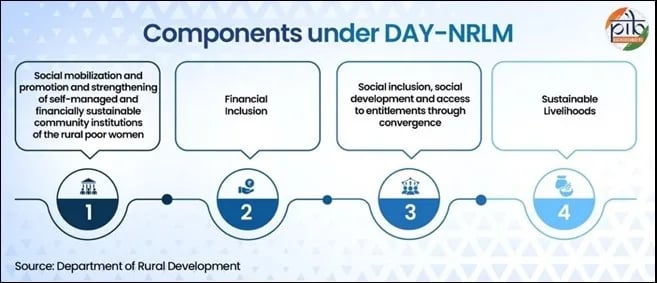
Implementation of DAY-NRLM
- Community Institutions: DAY-NRLM promotes building strong institutions such as Self-Help Groups (SHGs) for the poor, particularly women.
- These institutions provide them with long-term support to diversify their livelihoods, enhance their incomes, and improve their quality of life.
- SHG women are trained as community resource persons (CRPs) – Krishi Sakhis, Pashu Sakhis, Bank Sakhis, Bima Sakhis, Banking Correspondent Sakhis, etc.
- Entrepreneurship Promotion: The mission also promotes micro-enterprises in areas like handicrafts and food processing through sub-schemes such as the Start-up Village Entrepreneurship Program (SVEP).
- Skill Development and Employment Programs: The Ministry implements two Centrally Sponsored Schemes under DAY-NRLM:
- Deen Dayal Upadhyaya Grameen Kaushalya Yojana (DDU-GKY): Provides placement-linked skill training for rural youth aged 15–35 years.
- A total of 17.50 lakh candidates have been trained and a total of 11.48 lakh have been placed, as of June 2025.
- Rural Self Employment Training Institutes (RSETIs): Bank-sponsored centres for youth aged 18–50 that provide entrepreneurship training and promote self- and wage-employment, with financial support for infrastructure and training costs.
- A total of 56.69 lakh candidates have been trained and a total of 40.99 lakh have been settled since inception till June 2025.
- Deen Dayal Upadhyaya Grameen Kaushalya Yojana (DDU-GKY): Provides placement-linked skill training for rural youth aged 15–35 years.
- Leading States in Skill Development: Uttar Pradesh, Odisha, Andhra Pradesh, Rajasthan, Madhya Pradesh, and Karnataka.
Achievements of the Mission
- Mobilized 10.05 crore rural households into 90.9 lakh SHGs across India.
- Supported 4.6 crore Mahila Kisans and 3.74 Lakh enterprises through entrepreneurship programs.
- Trained 17.5 lakh rural youth under DDU-GKY, with a total of 11.48 lakh already placed.
- Deployed 47,952 Bank Sakhis to boost rural financial inclusion and credit access.
- Promoted sustainable livelihoods through agriculture, non-timber forest produce, livestock, and non-farm enterprises.
- High-performing states under DAY- NRLM: Bihar, Uttar Pradesh, and Andhra Pradesh.
Conclusion
- With its emphasis on women’s empowerment, financial inclusion, and sustainable livelihoods, the DAY-NRLM stands as a global model for community-driven poverty alleviation.
- By turning rural women into entrepreneurs, leaders, and changemakers, the mission continues to drive inclusive and resilient growth across India’s villages.
Source: PIB
Previous article
Government Defends Forest Rights Act in Supreme Court
