

Syllabus: GS3/ Environment
Context
- The Philippines has launched Southeast Asia’s first coral larvae cryobank to preserve coral genetic diversity and protect reef ecosystems.
Coral Cryobank Initiative
- The initiative involves collaboration among research institutions in the Philippines, Taiwan, Indonesia, Malaysia, and Thailand.
- The objective is to freeze and preserve coral larvae, ensuring long-term protection of coral genetic diversity.
| What is Cryopreservation? – Cryopreservation is the preservation of living cells or tissues at ultra-low temperatures (–196°C), halting all biological activity for long-term storage. – Coral larvae are first treated with cryoprotectant solutions (glycerol, ethylene glycol, DMSO) to replace water and prevent ice formation. – Through vitrification, larvae are plunged into liquid nitrogen, turning into a glass-like state that avoids cell damage. |
About the Coral Triangle
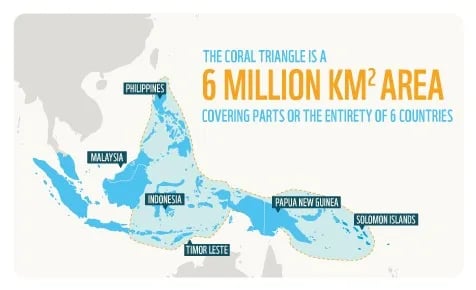
- The Coral Triangle also known as the Amazon of the Seas spans around 6 million sq. km across Indonesia, Malaysia, Papua New Guinea, the Philippines, Solomon Islands, and Timor-Leste.
- It encompasses portions of 2 biogeographic regions: the Indonesian-Philippines Region, and the Far Southwestern Pacific Region.
- It is home to more than 75% of the world’s coral species, a third of reef fish, vast mangrove forests, and six out of seven marine turtle species.
Threats to Coral Ecosystems
- Climate change is driving coral bleaching and habitat destruction through rising ocean temperatures.
- According to the Status of Coral Reefs of the World 2020 report, 14% of the world’s corals were lost between 2009 and 2018.
- Destructive fishing, pollution, and unregulated tourism further accelerate reef decline.
| What are Corals? – Corals are invertebrates that belong to a large group of animals called Cnidaria. 1. Corals are formed by multiple small, soft organisms known as polyps. 2. They secrete a rocky chalk-like (calcium carbonate) exoskeleton around themselves for protection. 3. Coral reefs are therefore created by millions of tiny polyps forming large carbonate structures. – Appearance: Corals range in color from red to purple and even blue, but are most commonly shades of brown and green. 1. They get most of their colors from the millions of microscopic algae that grow inside each polyp’s tissues. – There are three types of coral reefs – fringing reefs, barrier reefs and atolls. 1. Fringing reefs form along shorelines, barrier reefs form in open water and atolls are circular reefs that have formed around sunken volcanoes. – Significance: They provide food, shelter, resting and breeding grounds to a quarter of all marine life, acting as nurseries and refuges to protect critical biodiversity. Coral Bleaching – Corals have adapted to survive and grow within a specific temperature range. – Coral Bleaching occurs when sea temperatures rise too high and corals expel their algae, subsequently turning white. – The phenomenon also occurs due to low salinity, cold waters or pollution, regional and global mass bleaching events. |
Source: TH
Previous article
RBI Grants SRO Status to Finance Industry Development Council (FIDC)
Next article
News in Short – 6 October, 2025
