

Pandit Chhannulal Mishra
Syllabus: Personality in News
Context
- The Prime Minister has expressed deep sorrow at the passing away of Padma Vibhushan Pandit Chhannulal Mishra ji.
Pandit Chhannulal Mishra (1936–2025)
- Born: He was born on August 3, 1936, in Azamgarh U.P.
- He was a renowned Indian Hindustani classical music singer.
- He learned not only khayal but also absorbed nuances of the Kirana gharana, making him versatile in multiple classical styles.
- Known for his mastery in thumri, dadra, and bhajans as well.
- Major Honours: Padma Bhushan (2010), Padma Vibhushan (2020), Sangeet Natak Akademi Fellowship
- Legacy: He is known for rigorous discipline in riyaaz and deep devotion to accuracy.
Source: GOI
NATO Pipeline System (NPS)
Syllabus: GS2/IR
In News
- Recently, Poland announced plans to join NATO Pipeline System (NPS) with a €4.7 billion investment.
NATO Pipeline System (NPS)
- It was established during the Cold War, and supplies fuel and lubricants to NATO forces with modern flexibility.
- It spans about 10,000 km across 12 countries, has a storage capacity of 4.1 million cubic meters, and connects depots, air bases, airports, refineries, and transport points.
- While most networks are managed nationally, the Central Europe Pipeline System (CEPS) is a multinational system overseen by NATO’s Support and Procurement Agency.
| Do you know? – North Atlantic Treaty Organization (NATO) is a political and military alliance which was founded in 1949 and is a group of 32 countries from Europe and North America that exists to protect the people and territory of its members. – It is founded on the principle of collective defence, meaning that if one NATO Ally is attacked, then all NATO Allies are attacked. |
Source :TH
Stablecoins
Syllabus: GS3/Economy
Context
- The Finance Minister said that countries would have to “prepare to engage” with stablecoins whether they welcome the change or not.
What are stablecoins?
- Stablecoins are cryptocurrencies designed to maintain price stability by pegging their value to underlying assets such as:
- Fiat currencies (e.g., USD, Euro),
- Commodities (e.g., gold),
- Other cryptocurrencies, or
- Algorithm-based systems.
- Stablecoins are different from or Central Bank Digital Currencies (CBDCs), which are digital currencies officially issued and controlled by a government’s central bank.
- Meanwhile, stablecoins can be privately issued and can also be pegged to foreign currencies.
Global Scenario in stablecoins
- The U.S. passed the Genius Act, which mandates that stablecoins be fully backed by liquid assets (like cash or Treasury bills) and requires regular disclosures.
- Japan & Singapore have introduced targeted regulations for stablecoins.
- China has long prioritized the development of its sovereign digital yuan, however it is now also examining the rising use of yuan-backed stablecoins.
Source: TH
Electronics Component Manufacturing Scheme
Syllabus: GS3/ Economy
Context
- The Union Minister for Electronics and IT announced that under the ECMS, the government has received investment proposals worth ₹1.15 lakh crore, indicating strong industry response to India’s push for self-reliance in electronics manufacturing.
Electronics Component Manufacturing Scheme
- Objective: To develop a robust component manufacturing ecosystem by attracting investments (global / domestic) across the value chain by integrating its domestic electronic industry with the Global Value Chains (GVCs).
- The Target Segment Category under Scheme includes;
- Sub-assemblies
- Bare components
- Selected bare components
- Supply chain ecosystem and Capital equipment
- Sub-assembly – Telecom.
- Types of Incentive: Turnover linked incentive, capex incentive and hybrid incentive.
- Tenure of the Scheme:
- Turnover Linked Incentive: Six years with one year of gestation period.
- Capex Incentive: Five years.
Source: AIR
Aspirational Agriculture Districts to be developed under the Prime Minister Dhan-Dhaanya Krishi Yojana (PMDDKY)
Syllabus:GS3/Economy
In News
- The Centre announced 100 Aspirational Agriculture Districts to be developed under the Prime Minister Dhan-Dhaanya Krishi Yojana (PMDDKY) across 29 states and UTs.
- Uttar Pradesh leads with 12 districts, followed by Maharashtra (9), Madhya Pradesh and Rajasthan (8 each) and Bihar (7).
About Prime Minister Dhan-Dhaanya Krishi Yojana (PMDDKY)
- The Union Cabinet approved the Prime Minister Dhan-Dhaanya Krishi Yojana (PMDDKY) in July 2025.
- It is designed on the lines of the Aspirational Districts Programme (ADP).
- It is a transformative agricultural initiative announced in the Union Budget 2025–26. With an annual outlay of ₹24,000 crore over six years, PMDDKY aims to boost growth in 100 agri-districts by converging 36 existing Central schemes across 11 Ministries, alongside state programmes and private sector partnerships.
- Instead of launching new schemes, it focuses on coordinated, saturation-based delivery to last-mile farmers, minimizing duplication and maximizing impact.
- The PMDDKY aims to boost rural development with five key goals: increase agricultural productivity, promote crop diversification and sustainability, expand post-harvest storage at local levels, improve irrigation infrastructure, and enhance farmers’ access to agricultural credit.
| Aspirational Districts Programme (ADP) – It was launched in 2018 to develop backward and remote areas, and has significantly improved key development indicators. – Building on its success, the Aspirational Blocks Programme (ABP) was launched in 2023 to expand essential government services across 500 blocks in areas like health, education, sanitation, agriculture, financial inclusion, and infrastructure. 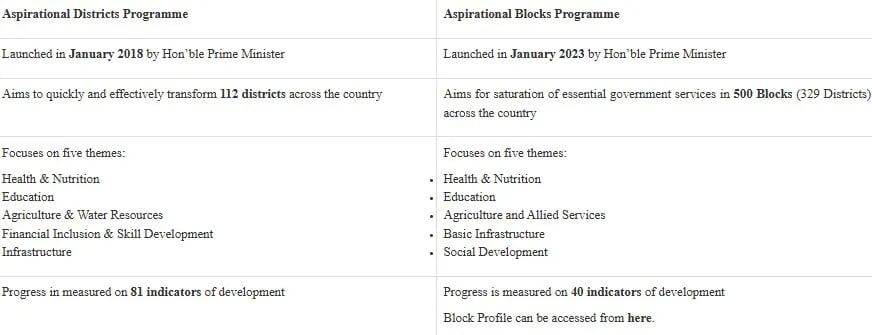 |
Source :IE
H125 Helicopters
Syllabus: GS3/ Defence
Context
- Airbus Helicopters, in partnership with Tata Advanced Systems, is setting up a final assembly line for the Indian made H125 utility helicopter in Vemagal, Karnataka.
About H125 Helicopters
- The Airbus H125 is a light, single-engine utility helicopter known for its versatility and exceptional performance in high-altitude and high-temperature conditions.
- The H125 was formerly known as the Eurocopter AS350.
- The H125 will cater to civil needs like emergency medical services, tourism, disaster relief, and law enforcement, while its military version (H125M) will serve India’s armed forces, especially in high-altitude areas like the Himalayas.
Source: IT
India Conferred with Prestigious ISSA Award 2025
Syllabus :Miscellaneous
In News
- India has been awarded the prestigious International Social Security Association (ISSA) Award 2025 for ‘Outstanding Achievement in Social Security’ at the World Social Security Forum in Kuala Lumpur.
The International Social Security Association (ISSA)
- It is the world’s leading international organization for social security institutions, government departments and agencies.
- The ISSA, founded in 1927 under the International Labour Organization, promotes excellence in social security administration worldwide.
- It supports over 320 member institutions from 160+ countries by providing a professional community, developing standards and research, offering practical services, fostering innovation, and advocating for comprehensive social security systems globally.
India’s Achievements
- International Social Security Association (ISSA) Award recognized India’s expansion of social security coverage from 19% in 2015 to 64.3% in 2025, now reaching over 940 million citizens.
Source :PIB
Snow Leopards
Syllabus: GS3/Species
In News
- Himachal Pradesh’s snow leopard population has risen by 62 per cent over the past four years.
About Snow Leopards (Panthera uncia)
- They are often called the “ghost of the mountains,” a reclusive feline native to the mountainous regions of Central and South Asia.
- They are sparsely distributed across 12 countries in central Asia, from southern Russia down to the Tibetan plateau, including Mongolia, China, Afghanistan, Pakistan, India and Nepal.
- They are classified as ‘Vulnerable’ by the International Union for Conservation of Nature (IUCN) Red list and listed in Schedule-I species of the Indian Wildlife (Protection) Act, 1972.
- The snow leopard is the state animal of Himachal Pradesh and Ladakh.
- Project Snow Leopard was launched by the Government of India in 2009 to ensure scientific and community-focused conservation of the species.
Source: IE
