

Syllabus: GS3/ Agriculture
Context
- India’s dairy sector has expanded by 70% in the past 11 years, with milk production rising from 146 million tonnes in 2014-15 to 239 million tonnes in 2023-24.
Dairy Sector of India
- Global Leadership: India is the world’s largest milk producer, contributing 24.76% of global milk output.
- Economic Contribution: Dairy is India’s single largest agricultural commodity, contributing 5% to GDP and employing over 8 crore farmers.
- Growth Performance: Livestock sector grew at a CAGR of 7.9% (2014-15 to 2020-21), outpacing the agriculture sector.
- Per Capita Availability: Rose to 471 g/day in 2023–24, substantially above the world average of 322 g/day.
- Top Producing states: Uttar Pradesh, Rajasthan, and Madhya Pradesh.
Key Enablers of India’s Dairy Success
- Institutional Support:
- The National Dairy Development Board (NDDB) was established in 1965 at Anand to replicate the Amul cooperative model across India.
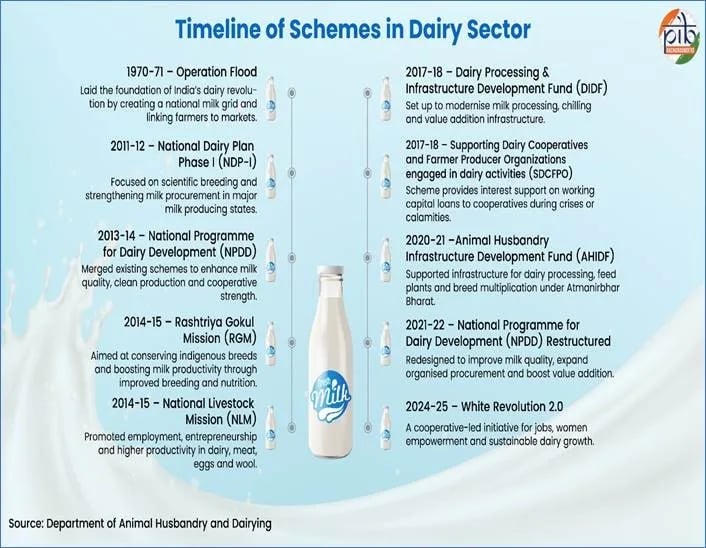
- The launch of Operation Flood in 1970 transformed India into the world’s largest milk producer by creating a nationwide cooperative structure for procurement and distribution.
- In recognition of its contribution, NDDB was declared an Institution of National Importance in 1987 by an Act of Parliament.
- Growth in Bovine Productivity:
- India possesses 303.76 million bovines, which form the backbone of dairy production.
- Between 2014 and 2022, bovine productivity in India increased by 27.39%, the highest globally, surpassing countries such as China, Germany, and Denmark.
- Cooperative Network: India’s dairy cooperatives are supported by a strong network consisting of 22 milk federations, 241 district cooperative unions, 28 marketing dairies, and 25 Milk Producer Organisations (MPOs).
- Contribution of Women: Nearly 70% of the workforce in dairy farming consists of women, and about 35% are active in dairy cooperatives.
Structural Weaknesses in Indian Dairying
- Breed Productivity Gaps: Yields still lag behind advanced dairy nations, especially among indigenous breeds.
- Average yield of Indian cows is 1.64 tonnes/year vs. 7.3 tonnes in EU and 11 tonnes in US.
- Land & Fodder Constraints: Unlike New Zealand, India lacks abundant pasture land.
- Reliance on crop residues and purchased feed makes dairying costly.
- Dependence on Cheap Labour: Dairy sector has labour-intensive tasks such as feeding, milking, bathing cattle, cleaning sheds. The model survives on unpaid family labour with little opportunity cost.
- Climate Impact & Market Volatility: Extreme heat reduces yields and drives up prices.
- Slowing Growth: Production growth has slowed, from ~6% in earlier years to 3.78% in 2023–24, with buffalo milk output declining 16%.
- Post-Harvest Losses: Inadequate cold-chain and processing infrastructure cause wastage.
Concluding remarks
- India’s dairy sector is the backbone of rural livelihoods and a symbol of inclusive growth.
- As the largest milk producer in the world, the country has combined farmer-led cooperatives, women’s participation and scientific practices to achieve remarkable progress.
- With the momentum of White Revolution 2.0, the sector is poised to boost productivity, expand opportunities and continue transforming rural prosperity.
Source: PIB
Previous article
RBI Rolled Out Liquidity Measures
