

Syllabus: GS2/IR
Context
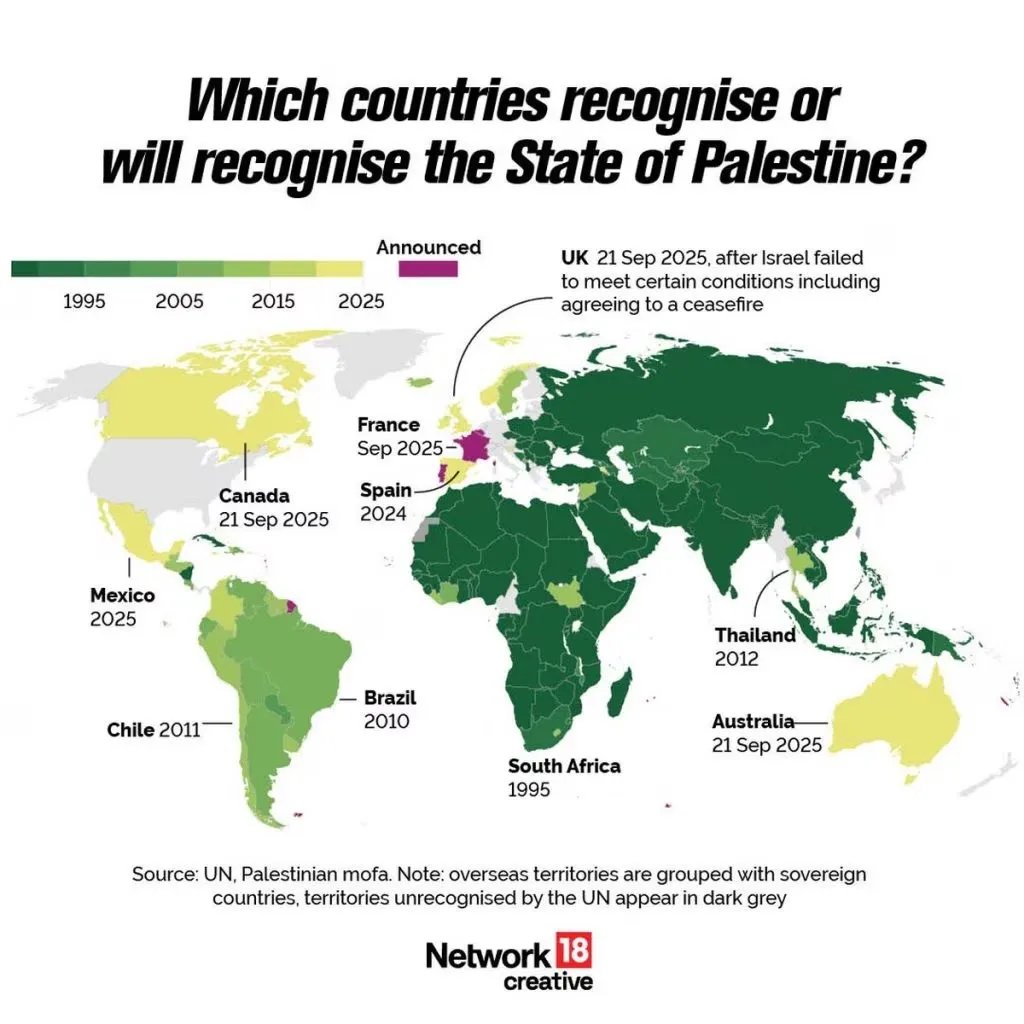
- France and several other Western nations formally declared their recognition of a Palestinian state at the United Nations.
About
- France’s announcement comes as the United Kingdom, Canada, Australia and Portugal declared recognition recently.
- The move, however, is largely symbolic without support from the United States, which has the power to veto membership.
- The Israeli Prime Minister reiterated his position that there would be no Palestinian state and vowed to accelerate the creation of new settlements.
Attempt for Recognition of Palestine
- Earlier Attempts: Palestinian attempts for UN recognition as a full member state began in 2011.
- They are currently a non-member observer state, a status that was granted in 2012.
- Recognition at UN: The path to becoming a member-state requires at least nine of the 15 members of the Security Council to vote in favor, and none of its five permanent members – the US, France, China, Britain and Russia – to veto it.
- The US has frequently wielded its veto power in line with Israel’s foreign policy, blocking a Security Council resolution.
- More than 145 UN member states had already recognized Palestinian statehood.
- Algeria became the first country to officially recognise a Palestinian state on November 15, 1988.
- India formally recognised Palestinian statehood in 1988.
- At least 45 countries including the United States reject the idea of Palestinian State.
Criteria to be Recognised as a Sovereign State
- Under the Montevideo Convention of 1933, officially the Convention on the Rights and Duties of States, there are several criteria before Palestine can be recognised as a sovereign state under international law. The process requires the state to have:
- A permanent population.
- A defined territory.
- An effective government and international relations.
- Formal diplomatic processes including embassies, ambassadors and treaties.
Current Status of Palestine
- Palestine has international recognition, diplomatic missions abroad and teams that compete in sporting competitions, including the Olympics.
- But because of its long-standing dispute with Israel, Palestine has no internationally agreed boundaries, no capital and no army.
- Also, because of Israel’s military occupation in the West Bank, the Palestinian Authority (PA) which was set up in the wake of peace agreements in the 1990s does not have full control of its land or people.
| What is the two-state solution? – UN 1947 Partition Plan: When the British mandate over Palestine ended, the UN partition plan in 1947 envisioned dividing the territory into Jewish and Arab states. – Arab War: Upon Israel’s declaration of independence the following year, war erupted with its Arab neighbours and the plan was never implemented. 1. More than half of the Palestinian population fled or were forced to flee. 2. Under a 1949 armistice, Jordan held control over the West Bank and East Jerusalem, and Egypt over Gaza. 3. Israel captured the West Bank, East Jerusalem and Gaza in the 1967 six-day war. 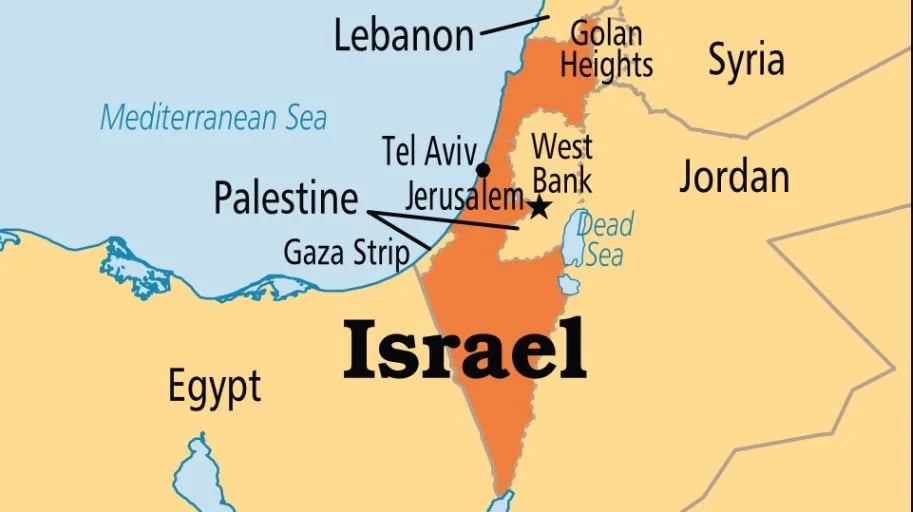 – Two State Solution: The Palestinians seek these lands for a future independent state, and the idea of a two-state solution based on Israel’s pre-1967 boundaries has been the basis of peace talks dating back to the 1990s. 1. The two-state solution has wide international support, but there is disagreement about how it would be implemented. 2. Israel’s creation and expansion of settlements in the Occupied West Bank, which are illegal under international law, are seen as a major obstacle to this. |
What Does Recognition as a State Means?
- Diplomatic Meaning: Countries that recognize Palestine agree it has the right to exist as an independent state, separate from Israel.
- They may establish formal diplomatic relations i.e. embassies, ambassadors, treaties.
- Recognition strengthens Palestine’s claim to sovereignty and self-determination.
- Legal & International Law Aspect: Recognition affirms Palestine as a subject of international law, not just a territory under dispute.
- UN and Multilateral Forums: Palestine already has “non-member observer state” status at the UN since 2012.
- Recognition by more countries gives Palestine greater legitimacy in multilateral negotiations.
- Political Significance: Recognition is often seen as a symbolic but powerful statement of support for the two-state solution.
- It puts pressure on Israel to negotiate seriously.
Conclusion
- Recognition of Palestine means the international community treating it as a legitimate, independent country.
- However, without control over land, borders, and full UN membership, it remains merely a political and diplomatic step.
- Thus, recognition is a necessity but true legitimacy and stability can only emerge through a negotiated settlement and lasting solution to the conflict.
Source: TH
Previous article
News In Short – 22 September, 2025
Next article
Need To Decriminalise Defamation
