


Syllabus: GS2/Important International institutions
Context
- As the United Nations General Assembly (UNGA) convenes for its 80th session, the institution faces an existential challenge, compounded by the United States’ accelerated efforts to diminish the UN’s role in global governance.
About the United Nations General Assembly (UNGA)
- It was established in 1945 as one of the six principal organs of the United Nations (UN). It serves as the only body within the UN where all 193 member states have equal representation, each holding one vote.
- It meets annually in New York (Headquarter), for its General Debate — a high-profile event where world leaders address global challenges and outline their national priorities.
- It plays a vital role in shaping global norms and fostering consensus on pressing issues, while its resolutions are non-binding.
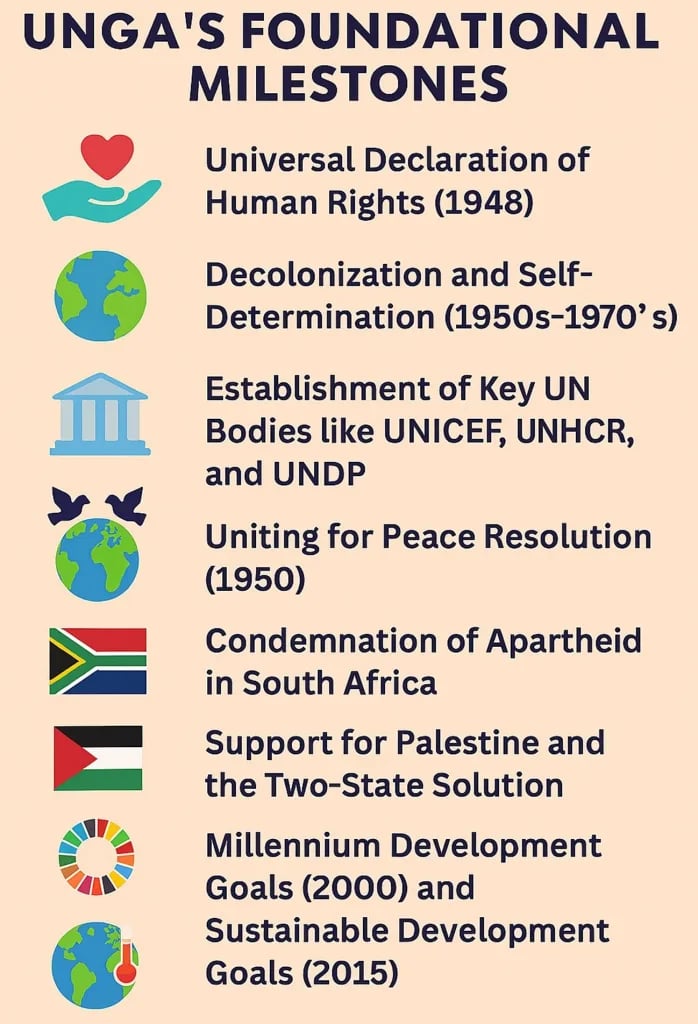
UNGA’s Role
- Discussing and making recommendations on international peace and security;
- Promoting human rights and sustainable development;
- Approving the UN budget and electing non-permanent members to the UN Security Council;
- Coordinating humanitarian aid and global health initiatives;
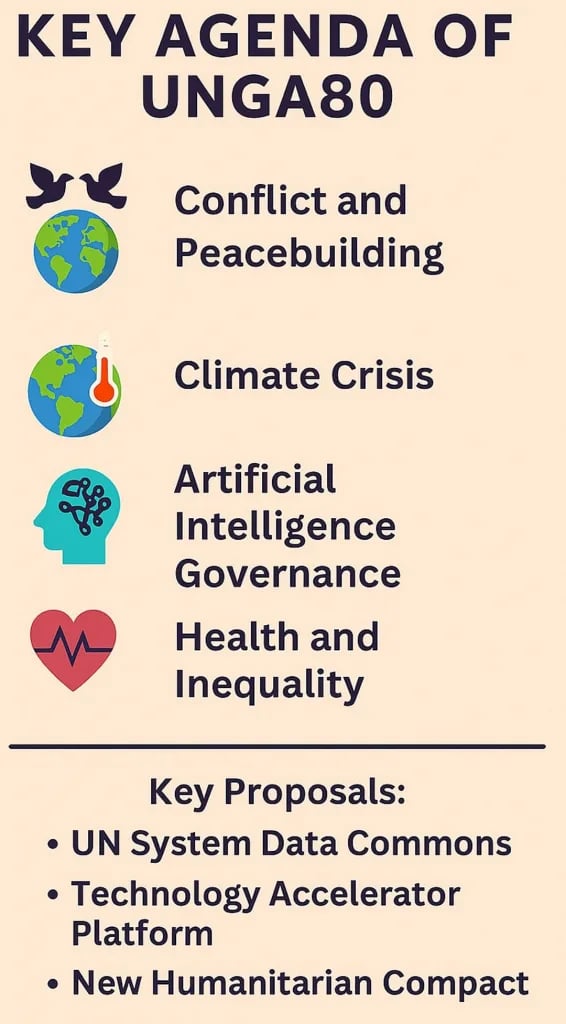
80th Session of UNGA (UNGA80)
- Theme: ‘Better Together: 80 Years and More for Peace, Development and Human Rights’
- Presided over by Annalena Baerbock, the former German foreign minister and only the fifth woman to hold the position in UN history.
- It convenes at a time when the world is grappling with overlapping crises — conflict, climate change, inequality, and technological disruption.
Crisis Facing By UNGA
- Structural and Procedural Limitations:
- Non-binding Nature: UNGA’s decisions lack enforceability, unlike the UN Security Council (UNSC).
- Over-politicization: Voting blocs such as the G-77, NAM, and Western alliances reduce the scope of consensus.
- Agenda Overload: With over 170 agenda items annually, deliberations often become ritualistic.
- Duplication with Other UN Bodies: Overlaps with the Human Rights Council, ECOSOC, and Security Council dilute UNGA’s authority.
- Crisis of Representation and Legitimacy: Countries of the Global South remain under-represented in decision-making on finance, security, and climate action.
- It fuels perceptions of marginalization, particularly when resolutions on sanctions, climate commitments, or development aid remain advisory rather than operational.
- Case Studies of Ineffectiveness:
- Ukraine War (2022–23): Overwhelming resolutions condemning Russia failed to deter aggression.
- Middle East Conflicts: Successive resolutions on Palestine remain unimplemented for decades.
- Climate Emergency: Despite annual debates, global climate commitments are driven by COP negotiations, not UNGA.
USA’s Role in the Erosion of the UNGA
- Funding Cuts and Financial Pressure: The US, traditionally the largest contributor to the UN budget, has withheld or delayed payments, triggering liquidity crises across UN agencies. It includes:
- Withdrawal from WHO, UNESCO, and the Human Rights Council;
- Funding cuts to the UN Relief and Works Agency for Palestine Refugees;
- Halting support for the Paris Agreement and climate-related funds;
- Reducing contributions to UN operations, including peacekeeping and health, by more than 80%;
- Unilateralism Over Multilateralism: The Trump administration’s ‘America First’ doctrine has often clashed with the UN’s multilateral ethos.
- Trump is expected to highlight his record of ‘ending seven wars’, reinforcing his self-image as a peace President.
- Selective Engagement on Global Issues: The US has distanced itself from key UNGA initiatives, such as high-level conferences on Palestine and the two-state solution.
India’s Choices in a Shifting Order
- Traditional demands, such as UNSC expansion, face little chance of progress in today’s fractured environment. Instead, India needs to:
- Focus on strategic priorities like AI governance and digital regulation;
- Build coalitions that bridge the North-South divide;
- Increase financial contributions, both to the UN’s regular budget (currently only $38 million) and to agencies aligned with national interests;
- India needs to scale up its support to reflect its status as the world’s fourth-largest economy.
- China contributes nearly $680 million, and the US $820 million.
Way Forward
- The existential crisis of UNGA is less about survival and more about relevance. It risks becoming increasingly ceremonial, unless reforms enhance its ability to influence international action.
- Reform Proposals and Resistance:
- Strengthening links between UNGA resolutions and Security Council mandates;
- Creating mechanisms to track compliance with General Assembly decisions;
- Rationalizing agenda items to prioritize urgent global crises;
- Giving greater budgetary autonomy to implement development-focused mandates;
- To reclaim legitimacy, the UNGA needs to:
- Embrace digital diplomacy and transparent global reporting.
- Act as the custodian of global public goods—climate, health, technology governance.
- Serve as the moral compass that pressures powerful states through global opinion, if not binding law.
| Daily Mains Practice Question [Q] Critically examine the factors contributing to the existential crisis of the United Nations General Assembly (UNGA). What reforms are necessary to restore its relevance in contemporary global governance? |
Previous article
India’s Deep Dependence on Foreign Nations
