

Syllabus: GS3/Economy
Context
- PM Modi has urged Indians to buy made in India products, to build a developed India by 2047.
- The Prime Minister laid the foundation for the country’s first PM Mega Integrated Textile Region and Apparel (PM MITRA) park in Madhya Pradesh’s Dhar district.
About
- The PM MITRA park in Dhar is one of seven such establishments approved by the Union Ministry of Textiles.
- The other sites are Tamil Nadu’s Virudhnagar, Telangana’s Warangal, Gujarat’s Navasari, Karnataka’s Kalaburagi, Uttar Pradesh’s Lucknow, and Maharashtra’s Amravati.
- Based on the 5F theme: Farm to Fibre to Factory to Fashion to Foreign – the initiative aims to boost India’s textile manufacturing and exports.
Manufacturing Sector of India
- India’s manufacturing sector is currently contributing 17% to India’s GDP.
- India has a goal to achieve the target of 25% GDP share for the manufacturing sector.
- India is focussing on 14 identified sunrise sectors like semiconductors, renewable energy components, medical devices, batteries and labour intensive industries, including leather and textile, to enhance the share of manufacturing in GDP
- Growth and Performance: According to the Annual Survey of Industries (ASI) for 2022-23, the manufacturing sector registered a robust growth rate of 21.5% in output, with a Gross Value Added (GVA) growth of 7.3%.
- Key sectors such as basic metal manufacturing, coke and refined petroleum products, food products, chemicals, and motor vehicles collectively contributed 58% to the total manufacturing output.
- Employment Generation: The manufacturing sector has also been a significant source of employment, adding approximately 22 lakh jobs in 2022-23.
- Major states like Maharashtra, Gujarat, Tamil Nadu, Karnataka, and Uttar Pradesh have been leading contributors to the sector’s GVA and employment.
Challenges Faced by India’s Manufacturing Sector
- Infrastructure Bottlenecks: High logistics cost, poor port connectivity, and power shortages leads to low output.
- Low R&D and Innovation: India invests less than 1% of GDP in R&D, limiting high-tech manufacturing.
- Import Dependence: Heavy reliance on imports for semiconductors, electronics components, and defence equipment.
- Skill Gaps: There is a major Mismatch between workforce skills and industry requirements.
- Low Productivity: Due to the outdated machinery, small-scale fragmented units, and limited automation productivity remains low.
- Global Competition: Countries like Vietnam, Bangladesh, and China offer cheaper production and better ecosystems making Indian products less competitive.
- Environmental Concerns: Rising pressure for sustainable and green manufacturing with high compliance costs.
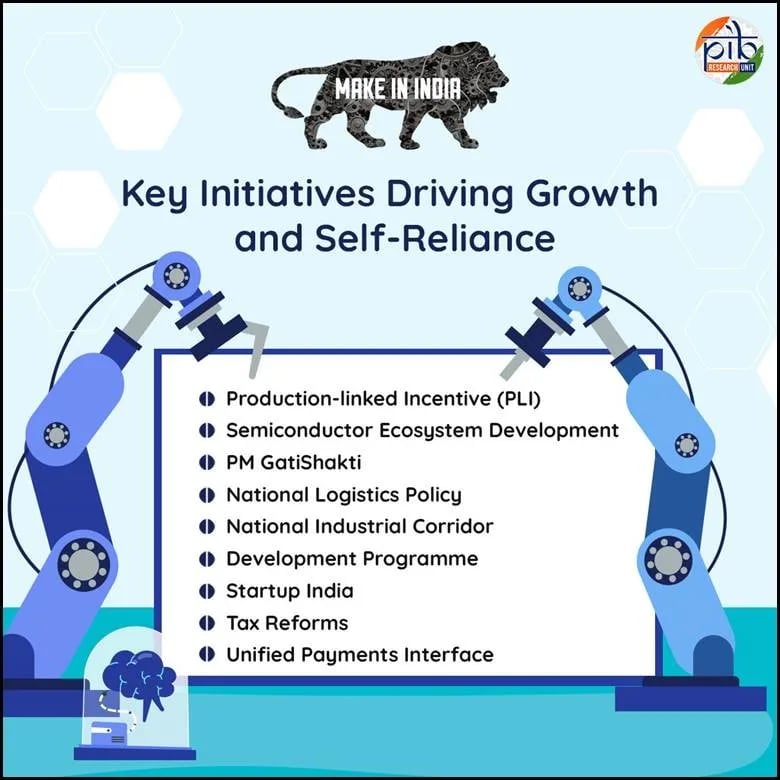
Major Initiatives Taken to Enable Make in India
Recent Achievements of Manufacturing Sector of India
- Ease of Doing Business: In the World Bank’s Doing Business Report (DBR) 2020 India was ranked 63rd up from 142nd rank in 2014.
- Production of Vaccine: India achieved COVID-19 vaccination coverage in record time but also became a major exporter to many developing and underdeveloped countries across the world.
- India supplies nearly 60% of the world’s vaccines, meaning every second vaccine globally is proudly made in India.
- Vande Bharat Trains: It is India’s first indigenous semi-high-speed trains, and are a shining example of the success of the ‘Make in India’ initiative.
- As of now, 102 Vande Bharat train services (51 trains) are operational across Indian Railways.
- INS Vikrant: It is the first domestically made aircraft carrier.
- In 2023-24, defence production soared to ₹1.27 lakh crore, with exports reaching over 90 countries, showcasing India’s growing strength and capability in this critical area.
- Electronics: Production nearly doubled from USD 48 billion in FY17 to USD 101 billion in FY23, driven primarily by mobile phones, which now constitute 43% of total electronics production.
- India is the second-largest mobile manufacturer in the world and now manufactures 99% domestically.
- Indian bicycles have gained international acclaim, with exports to the UK, Germany, and the Netherlands soaring.
- Made in Bihar’ boots are now part of the Russian Army’s equipment, marking a significant milestone for Indian products in the global defence market.
- Amul has expanded its presence by launching its dairy products in the US promoting Indian dairy on the world stage.
- The textile industry has created a staggering 14.5 crore jobs across the country, significantly contributing to India’s employment landscape.
Conclusion
- The ‘Make in India’ initiative has had a transformative impact on the heavy industries and engineering sector.
- By fostering technological advancements, increasing domestic production, enhancing competitiveness, and generating employment, the initiative has played a pivotal role in strengthening India’s industrial base.
- With sustained policy support and continued investment, the sector is poised for further growth in the coming years.
Source: TH
Previous article
Out-of-Pocket Health Expenditure (OOPE) in India
Next article
Global Innovation Index (GII) 2025
