


Gussadi Dance
Syllabus: GS1/ Culture
Context
- Members of the Raj Gond Tribe from Adilabad district of Telangana are going to perform Gussadi dance for the 78th Hyderabad Liberation Day.
Gussadi Dance
- Gussadi is a traditional dance of the Raj Gond tribe, especially from Adilabad (Telangana), as well as parts of Maharashtra.
- The dance is performed by men, organized into groups called Dandari, and smaller groups within them called Gussadi.
- They dress in saffron and turmeric-colored clothes and wear bandages around their legs and waist.
- During the Dance, the performers wear vibrant attire, including turbans studded with peacock feathers, deer horns, and goat skins.
- They use instruments like Dappu, Tudumu, Pipri, and Kolikammu.
- The famous exponent Kanaka Raju, from the Raj Gond community, was awarded the Padma Shri in 2021 for his role in preserving/teaching the Gussadi dance.
Source: TH
India to Start Pilot Projects in Venezuela
Syllabus: GS2/ International Relations, GS3/ Economy
Context
- India and Venezuela have agreed to collaborate on pilot projects in priority sectors such as agriculture, pharmaceuticals, and digital public infrastructure.
Cooperation between India-Venezuela
- Bilateral Trade between India and Venezuela
- Total Trade: $1.8 billion
- Indian Exports: $216 million
- Indian Imports: $1.6 billion
- Pharmaceuticals and Health Cooperation: Pharmaceuticals form the backbone of India’s exports to Venezuela, meeting about 40% of the country’s annual requirement.
- India supplied $110 million worth of pharma products to Venezuela in 2024–25, alongside vaccines and essential medicines on grant.
| About Venezuela – Venezuela, is located at the northern end of South America. – Venezuela is bounded by the Caribbean Sea and the Atlantic Ocean to the north, Guyana to the east, Brazil to the south, and Colombia to the southwest and west. – Orinoco Belt: This is a vast region in Venezuela rich in heavy crude oil, making up a large part of the country’s total reserves. – Lake Maracaibo of Venezuela is the largest lake in Latin America and one of the oldest water bodies on the planet. – Angel Falls, located in Venezuela’s Canaima National Park, is the world’s highest uninterrupted waterfall. 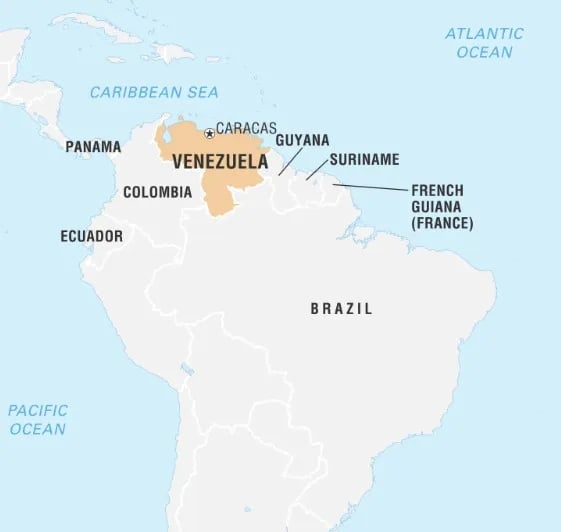 |
Source: TH
Ozone Hole Growth
Syllabus: GS1/Geography/GS3/Environment
In News
- The ozone hole over Antarctica has grown to 20 million sq km—larger than average but still within the decade’s normal range, according to NASA.
| What is Ozone? – Ozone (O₃) is a gas made of three oxygen atoms, found naturally in the atmosphere. – In the stratosphere (10–50 km above Earth), it forms the “good ozone” layer that protects life by absorbing harmful ultraviolet (UV) radiation. 1. This ozone is created and destroyed through natural processes but is being damaged by human-made chemicals like CFCs, leading to ozone depletion and increased UV exposure. – In contrast, “bad ozone” at ground level (in the troposphere) is formed by pollution from vehicles and industries reacting with sunlight. 1. It is harmful to humans and the environment, causing respiratory problems and worsening conditions like asthma. |
Ozone Hole
- It is not a literal hole but a region of severely depleted ozone in the stratosphere over Antarctica, occurring during the Southern Hemisphere spring (Aug–Oct).
- It was first detected in 1985 and is caused by harmful substances like chlorofluorocarbons (CFCs) and hydrochlorofluorocarbons (HFCs) that thin the ozone layer, increasing harmful UV radiation on Earth.
- Factors like polar stratospheric clouds, volcanic eruptions (e.g., Hunga Tonga in 2023), and climate change (which strengthens the polar vortex) influence ozone depletion.
- Phytoplankton habitats in the Arctic are shifting due to changing UV exposure, affecting marine ecosystems
Montreal Protocol
- The Montreal Protocol (1987) is pivotal in reducing ozone-depleting substances (ODS), preventing millions of skin cancer cases and avoiding a 0.5°C rise in global temperatures.
- However, variations in ozone healing continue, with the ozone layer expected to recover by 2066 in Antarctica, 2045 in the Arctic, and 2040 in the tropics.
What more needs to be done?
- Experts stress the need for stronger global cooperation, scientific innovation, and policy action to fully restore the ozone layer and combat climate change.
Source :IT
East African Crude Oil Pipeline (EACOP)
Syllabus :GS2/IR
In News
- The East African Crude Oil Pipeline (EACOP) faces strong opposition from environmental activists.
The East African Crude Oil Pipeline Project (EACOP)
- It is a 1,443-km oil pipeline that will transport oil produced from Uganda’s Lake Albert oilfields to the port of Tanga in Tanzania where the oil will then be sold onwards to world markets.
- It is backed by TotalEnergies, China’s CNOOC, and the governments of Uganda and Tanzania.
Cristism
- The pipeline cuts through 44 protected areas and 7 key biodiversity zones, endangering species and local livelihoods.
- Critical habitats are being fragmented, opening landscapes to poaching, logging, and encroachment.
- The project will emit over 34 million tons of CO₂ annually, threatening global climate goals and local ecosystems.
Source :DTE
The Implications of Oil and Gas Field Decline Rates: Report
Syllabus: GS3/Economy
Context
- The International Energy Agency (IEA) has released a report warning that global oil and gas fields are declining faster than before.
Major Highlights
- Faster Decline Rates of Oil & Gas Fields: Global oil and gas fields are depleting faster than before, especially because more production is coming from shale and deep offshore fields which have much steeper decline curves than conventional onshore supergiant fields.
- Investment Mostly Maintaining Current Supply, Not Growth: Nearly 90% of upstream oil & gas investment is now being used just to offset natural declines, rather than increasing production.
- Without fresh investments, global oil output could shrink by 5.5 million barrels/day every year; for natural gas, a drop of 270 billion cubic meters (bcm) annually, both significantly higher than in 2010.
- Risks & Implications for India:
- India is heavily import-dependent: over 85% of its crude oil is imported; about 45% of its gas demand is met through imports.
- Faster decline in global production and delays in new projects could therefore increase supply, price risks for India.
- The IEA recommends that India diversify its sources, expand domestic exploration, build strategic reserves, and invest in cleaner alternatives such as green hydrogen and biofuels to reduce dependence.
Source: DTE
50% US Tariff on Indian Diamonds and Gems
Syllabus: GS3/Economy
Context
- The US currently has a 50% tariff on Indian diamonds and gems, which took effect on August 27, 2025.
About
- Exports by India’s diamond industry have already hit a two-decade low on weak Chinese demand, and now higher tariffs under the US.
- The US accounts for nearly a third of annual shipments of gem and jewellery.
- In Surat, where more than 80% of the world’s rough diamonds are cut and polished, orders have started drying up.
- Some bigger players plan to shift part of their operations to countries like Botswana, which faces a lower 15% US tariff.
Gems and Jewellery Sector of India
- In FY 2023–24, India’s gems and jewellery exports stood at US$ 22 billion, projected to reach US$ 100 billion by 2027.
- The gems and jewelry sector contributes 7% of India’s GDP and employs about 5 million workers.
- About 33% of India’s gems and jewelry exports went to the U.S. in fiscal year 2025.
- India is the top global exporter of diamonds and the largest consumer of gold.
- Surat, Jaipur and Mumbai are the major hubs of Gems and Jewellery in India.
- The United States is the largest export market, followed by the UAE and Hong Kong.
Source: TM
India-ILO MoU on Occupational Classification to Boost Global Job Opportunities
Syllabus: GS3/ Economy
Context
- The Union government has signed a Memorandum of Understanding (MoU) with the International Labour Organisation (ILO) to advance the International Reference Classification of Occupations (IRCO).
About
- The IRCO, developed by the ILO, is a system that classifies occupations based on job functions, tasks and duties.
- It classifies occupations based on job functions, tasks, and duties, providing a universal framework.
- It enables cross-country comparison of occupational data and supports:
- International migration management.
- Vocational training and skilling policies.
- Labour market analysis and workforce planning.
- By adopting the IRCO framework, India aims to streamline its skill ecosystem, facilitate mutual recognition of qualifications, and position Indian workers more competitively in global labour markets.
| International Labour Organisation (ILO) – It is an United Nations Agency established in 1919 as part of the Treaty of Versailles that ended World War I, and it became the first specialized agency of the UN in 1946. – India became a founding member of the ILO in 1919, even before gaining independence. – It has 187 Member states. – It sets labour standards, develops policies and devises programmes promoting decent work for all women and men. – It is the only tripartite U.N. agency that brings together governments, employers and workers. – It is headquartered in Geneva, Switzerland. |
Source: BL
ED has secured over 94% conviction rate in PMLA cases
Syllabus :GS3/Internal Security
In News
- The Enforcement Directorate (ED) has achieved a 94% conviction rate in PMLA cases.
Directorate of Enforcement (ED)
- It is a multi-disciplinary organization mandated with investigation of the offence of money laundering and violations of foreign exchange laws.
- It plays a central role in financial crime enforcement, asset recovery, and safeguarding India’s economic sovereignty.
Mandate and Functions
- Its key functions include enforcing the following laws:
- The Prevention of Money Laundering Act, 2002 (PMLA): A criminal law to combat money laundering.
- ED investigates, attaches properties derived from crime, and ensures prosecution and confiscation by special courts.
- The Foreign Exchange Management Act, 1999 (FEMA) : A civil law regulating foreign exchange.
- ED investigates violations, adjudicates cases, and imposes penalties.
- The Fugitive Economic Offenders Act, 2018 (FEOA) : Targets fugitive economic offenders abroad.
- ED attaches and confiscates their properties for the central government.
- Sponsoring agency under COFEPOSA: Under the Conservation of Foreign Exchange and Prevention of Smuggling Activities Act, 1974 (COFEPOSA), this Directorate is empowered to sponsor cases of preventive detention with regard to contraventions of FEMA.
- The Prevention of Money Laundering Act, 2002 (PMLA): A criminal law to combat money laundering.
Source :TH
Public Financial Asset Management (PFAM) Program
Syllabus: Miscellaneous
Context
- Vivekanand Gupta, the Regional Provident Fund Commissioner of EPFO has been selected in the Public Financial Asset Management (PFAM) Program 2025–26.
- He was the sole participant from India and the first-ever representative from EPFO to be selected for the PFAM cohort.
About the PFAM Program
- PFAM is a prestigious initiative jointly organised by the World Bank and the Milken Institute.
- It is a globally recognised leadership initiative aimed at equipping senior professionals with cutting-edge expertise in capital markets, governance frameworks, and strategic asset management.
- The 2025–26 cohort consists of 16 participants from 13 countries, including 11 from Central Banks, three from Sovereign Wealth Funds, and two from Pension Funds.
- Selection brings India into this elite circle of global financial professionals for the first time under this initiative.
| Employees’ Provident Fund Organisation (EPFO) – EPFO is a statutory body under the Ministry of Labour and Employment.It administers the Employees’ Provident Fund and Miscellaneous Provisions Act, 1952. – Objectives: To ensure financial security and social welfare of employees post-retirement. 1. To promote voluntary savings among employees. 2. To regulate and supervise provident fund, pension, and insurance schemes. |
Source: PIB
Machu Picchu
Syllabus: GS1/ Geography
Context
- Around 900 tourists have been left stranded near Peru’s ancient Inca citadel of Machu Picchu after passenger train services were suspended due to protests.
About Machu Picchu
- Machu Picchu is a 15th-century Inca citadel located in the Eastern Cordillera of southern Peru, perched at 2,430 meters above sea level.
- Often called the “Lost City of the Incas”, it is one of the most iconic symbols of the Inca civilization.
- Constructed in classical Inca style with finely crafted dry-stone walls, its notable structures include the Temple of the Sun, the Temple of the Three Windows, and the Intihuatana stone.
- Recognitions:
- Declared a National Historic Sanctuary by Peru in 1981.
- Inscribed as a UNESCO World Heritage Site in 1983.
Source: FP
Previous article
Stubble-Burning: Stand of Government and Judiciary
Next article
Defence Pact Between Saudi Arabia and Pakistan
