

Syllabus: GS3/Energy
Context
- Recently, the Union Ministry of New and Renewable Energy (MNRE) launched its first national policy on geothermal energy, joining a growing list of countries betting on subterranean heat to achieve net-zero emissions by 2070.
National Policy on Geothermal Energy
- Vision & Goals: To establish geothermal energy as a key pillar of India’s renewable energy sector, enhancing energy security, reducing greenhouse gas emissions, and supporting sustainable development.
- Implementation Framework (By MNRE):
- International collaboration with leading geothermal nations.
- Pilot projects under the Renewable Energy Research and Technology Development Programme.
- Soft loans from IREDA and DFIs for project financing.
- Establishment of Centres of Excellence (CoEs) for capacity building and technical support.
- Periodic progress reports to track milestones and ensure accountability.
- Developmental Model and Deployment: The geothermal development model includes exploration, drilling, feasibility studies, construction, and operation.
- Fiscal Incentives: Long-term concessional loans, Sovereign Green Bonds, Viability Gap Funding (VGF).
- Import duty and GST exemptions, tax holidays, and accelerated depreciation benefits.
- Inclusion in Renewable Purchase Obligations (RPOs) and Carbon Credit Trading.
- Investment Support: 100% foreign direct investment (FDI), concessional loans, and international collaborations.
- Project Duration: Support for geothermal projects up to 30 years, with extensions based on resource availability.
- Special funding support for North-Eastern and high-altitude states.
- Conversion of abandoned oil and gas wells into geothermal projects.
- Joint ventures with oil, gas, and mineral companies for resource sharing.
- Fiscal Incentives: Long-term concessional loans, Sovereign Green Bonds, Viability Gap Funding (VGF).
Guidelines for States and Union Territories
- Allocation of geothermal blocks with exploration permits (3–5 years).
- Single-window clearance system for permits and approvals.
- Land leasing at concessional prices for developers.
- Community engagement and compensatory measures in tribal and remote regions.
- Provisions for long-term project development (up to 30 years).
| About Geothermal Energy (Geo= Earth, Thermal= Heat) – It is the heat stored within the Earth’s crust, and comes from the natural heat of the Earth primarily due to the decay of the naturally radioactive isotopes of uranium, thorium and potassium. – On average, the temperature of the Earth increases with depth, about 25–30°C/km above the surface ambient temperature (geothermal gradient).The heat is transferred from the interior towards the surface mostly by conduction. – Types: 1. High-enthalpy Resources: Often associated with volcanic regions, geysers and hot springs are primarily used for electricity generation. 2. Low to Medium-enthalpy Resources: Such as hot rocks and shallow ground layers, are better suited for direct-use applications and geothermal heat pumps. – Geothermal plants offer high capacity utilization (>80%), reliable baseload supply, and no recurring fuel costs, making them economically viable in the long term. 1. These are capital-intensive and site-specific, requiring high upfront investment in exploration, drilling, and infrastructure. – Global Geo-Thermal Capacity (15.4 GW): United States, followed by Indonesia, the Philippines, Turkey, and New Zealand. Geothermal Potential Sites in India – The Geological Survey of India (GSI), since 1973, has identified 381 hot springs with surface temperatures ranging from 35°C to 89°C. 1. It can be utilized effectively, with advancements in Enhanced Geothermal Systems (EGS) and Advanced Geothermal Systems (AGS). – India falls within a medium to low heat enthalpy zone (100–180°C), spread across 10 geothermal provinces.‘ – Geothermal Atlas of India, 2022’ estimated the potential of about 10,600 MW of geothermal power in India. 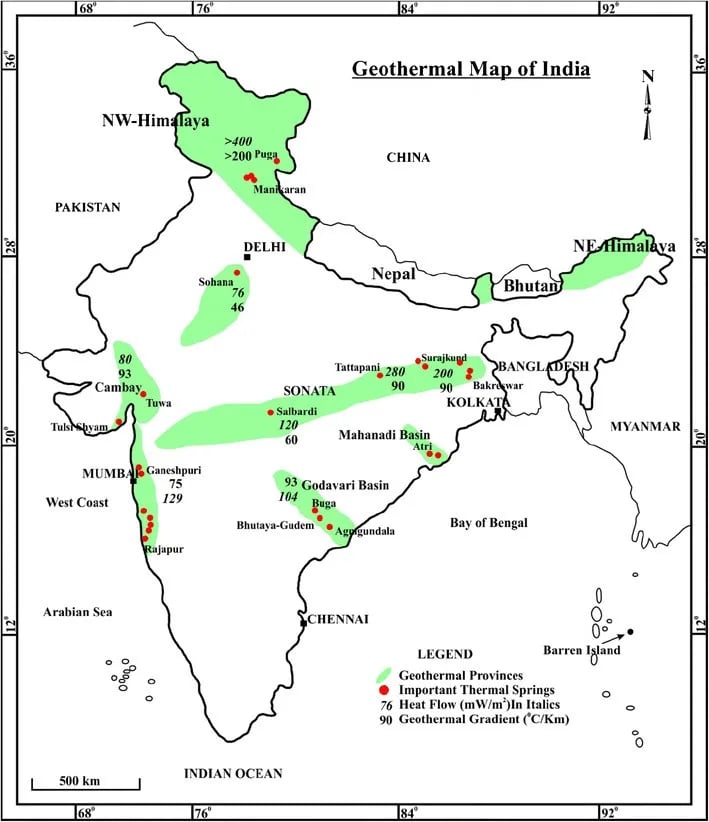 |
