

Syllabus: GS3/Environment
Context
- India has registered 56.75 lakh electric vehicles by February 2025, reflecting the rapid adoption of clean mobility.
About
- Electric two-wheeler (e-2W) sales hit 11.49 lakh units, up 21% from the previous year’s 9.48 lakh.
- The Government of India has set a vision to achieve 30% EV penetration by 2030, aligning with the global EV30@30 initiative.
- India has set its sights on an ambitious green horizon, aiming to slash projected carbon emissions by 1 billion tonnes by 2030.
- India also aims to cut the economy’s carbon intensity to below 45% by 2030 and ultimately transform into a net-zero nation by 2070.
What are Electric Vehicles?
- An electric vehicle (EV) operates on an electric motor, instead of an internal-combustion engine that generates power by burning a mix of fuel and gases.
- Therefore, such a vehicle is seen as a possible replacement for current-generation automobiles in order to address the issue of rising pollution, global warming, depleting natural resources, etc.
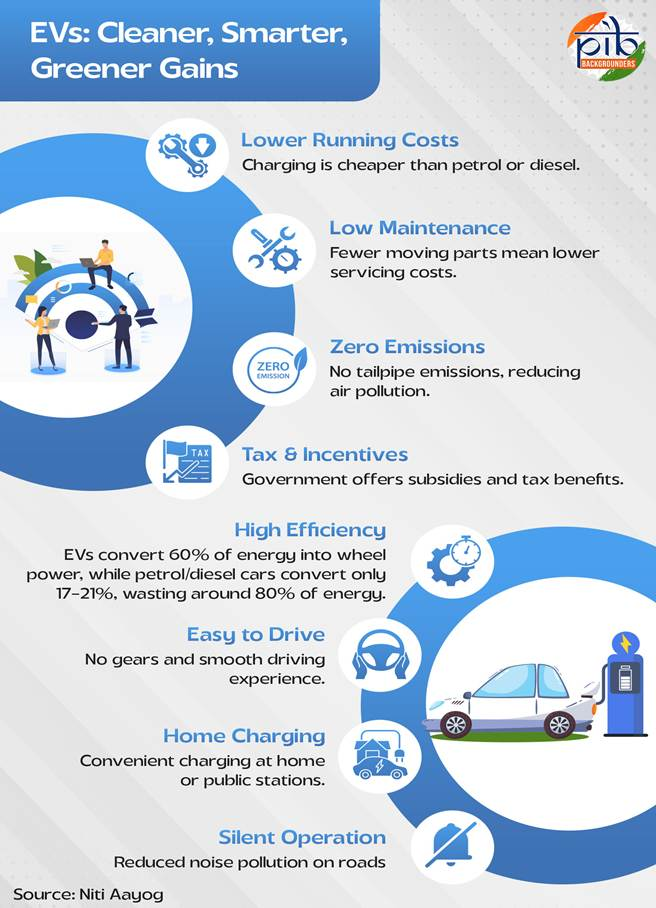
Challenges in Adoption
- High Initial Cost: The upfront cost of purchasing an electric vehicle in India is relatively high compared to traditional internal combustion engine vehicles.
- This cost includes not only the vehicle itself but also the cost of batteries.
- Limited Charging Infrastructure: The availability of charging infrastructure remains a significant barrier to EV adoption in India.
- Range Anxiety: Range anxiety, or the fear of running out of battery charge before reaching a charging station, is a prevalent concern among Indian consumers considering EVs.
- Battery Technology and Supply Chain: India relies heavily on imported lithium-ion batteries, which increases costs and makes EVs vulnerable to supply chain disruptions.
- Consumer Awareness and Education: Many consumers in India lack awareness and understanding of electric vehicles, including their benefits, technology, and available models.
Government Initiatives
- National Electric Mobility Mission Plan (2020) and FAME-I: NEMMP was brought into effect to accelerate the adoption and production of electric vehicles (EVs).
- As part of this mission, the FAME India Scheme (Faster Adoption and Manufacturing of Hybrid and Electric Vehicles) was implemented from 2015 to 2019 to encourage the adoption of electric and hybrid vehicles.
- FAME II (Faster Adoption and Manufacturing of Electric Vehicles) — Phase II: Launched in 2019, the scheme focuses on increasing EV adoption, expanding the e-bus network, and strengthening the charging infrastructure.
- Production Linked Incentive (PLI) Scheme for Automobile and Auto Component Industry in India (PLI-Auto): Launched in 2021, the scheme aims to boost domestic manufacturing of Advanced Automotive Technologies (AAT).
- Major players like Tata Motors and Mahindra & Mahindra have stepped up with significant EV production investments.
- A key mandate is that companies must ensure at least 50% domestic value addition (DVA) to qualify for incentives.
- PM E-Drive: The scheme was launched in 2024 and is being implemented until 2028.
- The key objective is to speed up the transition to electric vehicles by offering upfront incentives for EV purchases and encouraging the development of charging infrastructure.
- Scheme for Promotion of Manufacturing of Electric Passenger Cars in India 2024 (SPMEPCI): To draw global automakers to invest, the scheme grants approved applicants a five-year window to import Completely Built-in Units (CBUs) of electric four-wheelers (e-4W) valued at a minimum CIF (Cost, Insurance, and Freight) of USD 35,000 at a significantly reduced customs duty of 15%.
- India Electric Mobility Index (IEMI): NITI Aayog unveiled the India Electric Mobility Index (IEMI) in 2025. It is designed to track, measure, and compare how States and Union Territories are progressing on their electric mobility ambitions.
- Based on these results, regions are ranked as frontrunners with thriving ecosystems; Delhi, Maharashtra, and Chandigarh are leading as ‘Frontrunners’ in the recent IEMI score.
Suggestions by NITI Aayog
- Moving from incentives to Mandates: Announce a clear policy, with target timelines, for Zero Emission Vehicle (ZEV) adoption.
- Design a progressively more stringent plan for mandating the production and purchase of EVs and disincentivising the continued use/production of ICE vehicles.
- Saturation instead of thin distribution: Design and start a saturation program to support 5 cities over 5 years.
- Have entities in the States to manage this program.
- Scale up to 20 cities and then to 100 cities.
- Enable financing for e-Buses and e-Trucks: Create a pooled fund with contributions from the public budget and multilateral institutions.
- Design and launch an appropriate scheme to channel the funds.
- Scale up research for new battery technologies: Set up an academia-industry-government partnership for accelerating research on new battery chemistries.
Source: PIB
