
Production Linked Incentive Scheme

Syllabus: GS3/ Economy & Development

In News

  • The Government has decided not to extend the PLI Scheme beyond the existing 14 sectors.
    • Despite initial success in some areas, the scheme underperformed in others and saw delays in incentive payouts.

More About the News

  • Out of the $23 billion allocated, only $1.73 billion (8%) has been disbursed as of October 2024.
  • $151.93 billion worth of goods have been produced under the scheme—just 37% of the original target. Firms like Foxconn, Reliance, and Adani faced delays, unmet targets, or non-compliance.
  • Hence, the government has declined requests to extend production deadlines or add new sectors to the scheme.

About the PLI Scheme

  • Lauch: In 2020 under the Ministry of Commerce & Industry with an outlay of ₹1.97 lakh crore.
  • Sectors Included: It covers 14 sectors (Mobile, Pharma, Auto, ACC Battery, Telecom, White Goods, Solar, etc.)
  • Objectives:  It offers incentives to eligible firms on incremental sales for five years as part of the Make in India initiative.
    • It aims to reduce India’s dependence on foreign countries like China and increase employment in labor-intensive sectors.
    • Raise manufacturing’s share in GDP to 25% by 2025
  • Incentive Mechanism: 4–6% on incremental sales over a base year.
    • Applicable to both domestic and foreign companies registered in India.

Benefits of PLI Scheme

  • Electronics Success: India produced $49 billion worth of mobiles in FY 2023–24; Apple now manufactures high-end models in India.
  • Pharmaceutical Growth: Exports nearly doubled to $27.85 billion from a decade ago.
  • Boosted FDI inflow, helped develop core industries, and supported India’s ‘China Plus One’ strategy.
  • Encouraged production in strategic sectors (e.g., semiconductors, solar modules).
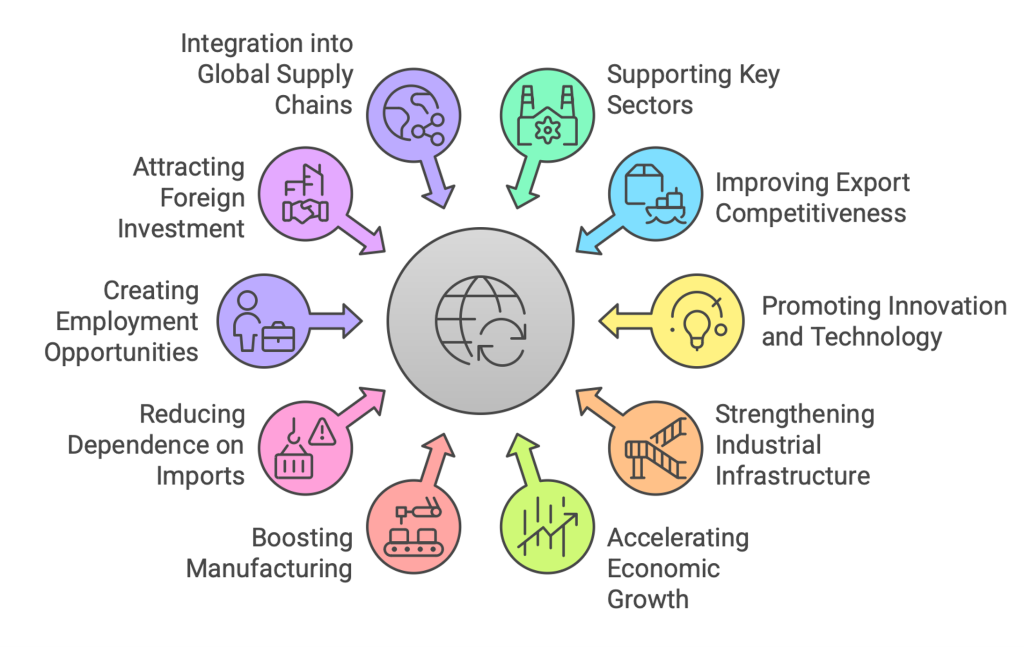
Benefits-of-PLI-Scheme

Issues and Concerns

  • Low Disbursement: Only 8% of incentives disbursed despite meeting targets.
  • Delays in Subsidies: They are not released on time, eventually affecting cash flow.
  • Unmet Targets:  Many firms failed to initiate or scale up production.
  • Red Tapism: Bureaucratic hurdles and rigid compliance conditions.
  • No GDP Boost: Manufacturing share fell from 15.4% to 14.3% (2020–2024).

Source: TH


Other News of the Day

Syllabus: GS2/Governance Context Over 30 civil society organisations are urging the Union government to preserve the Right to Information Act, 2005. About Concern Raised: Organizations urge the government to avoid fully implementing changes to the RTI Act through the Digital Personal Data Protection Act (DPDP) of 2023. Section 8(1)(j) of the RTI Act now includes...
Read More

Syllabus: GS2/ Polity, Judiciary  In Context With an disposal rate of 96.28%, Fast Track Special Courts (FTSCs) have significantly expedited justice for survivors of sexual crimes by ensuring swift legal proceedings in cases of rape and offenses under the POCSO Act. The Protection of Children from Sexual Offences (POCSO) Act, 2012 is a gender-neutral law...
Read More

Syllabus :GS 2/Governance   In News The Andhra Pradesh Cabinet approved the one-member commission’s recommendations on the sub-categorisation of Scheduled Castes (SCs) to ensure equitable distribution of benefits. The demand for sub-categorisation has been ongoing for over 30 years, with earlier efforts including the Justice Ramachandra Rao Commission in 1996. Sub-categorisation It  divides the SC category...
Read More

Syllabus: GS3/Environment and Conservation Context Satellite images taken more than three decades apart show the disappearance of Iceland’s Okjökull. It was the first glacier to be officially declared dead as a result of human-caused climate change in 2014. About Okjökull was a dome-shaped glacier situated around the summit crater on Ok, a 1,200 meters shield...
Read More

Syllabus: GS3/S&T, Agriculture Context Recently, the Department of Biotechnology (DBT) Secretary stated that there is ‘progress’ on Genetically Modified (GM) food crops, acknowledging ongoing research and development.  About the Genetically Modified (GM) Food Crops These are plants whose genetic material has been artificially modified using biotechnological methods to enhance desirable traits. It is done to...
Read More

Kaliyattam Festival Syllabus: GS1-Culture Context The Kaliyattam festival takes place in the Malayalam month of Kumbham (February-March). About Also known as Theyyam, this festival showcases ritual dance performances primarily held to honour and worship Goddess Kali. Recognized as an essential part of Kerala’s intangible heritage, it is celebrated in Kavus (sacred groves) and tharavadus (ancestral...
Read More
scroll to top