

Syllabus: GS2/Polity and Governance
Context
- August 5th 2025, marks the sixth year for the abrogation of Article 370.
What was Article 370?
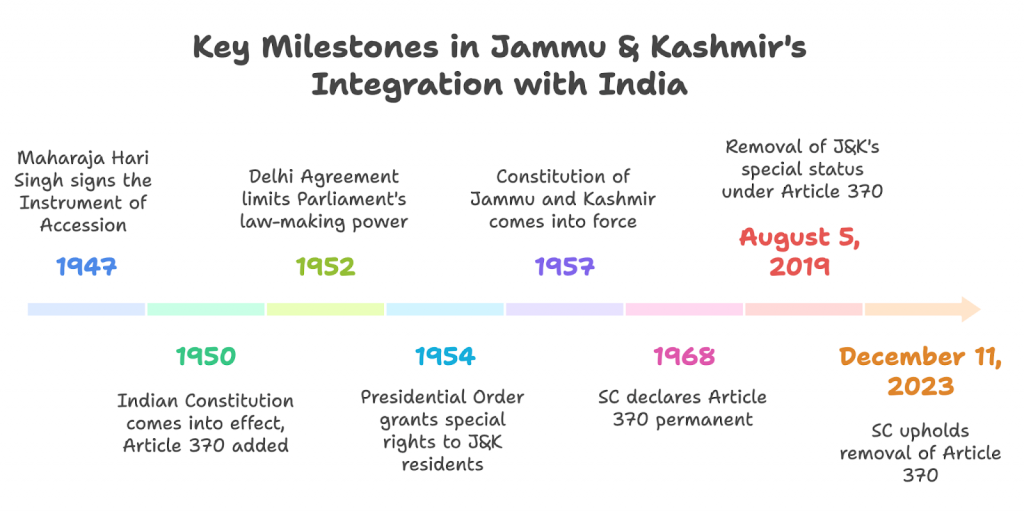
- Article 370 was drafted as a temporary provision under Part XXI and came into effect in 1952.
- It allowed the state to have its own constitution, flag, and make laws on all matters except finance, defence, foreign affairs, and communications.
- This meant the state had significant control over its internal matters.
- Article 35A: This article was added through a Presidential Order called The Constitution (Application to Jammu and Kashmir) Order, 1954, issued under the powers of Article 370.
- Key provisions of Article 35A were:
- It allowed the state to grant special rights to permanent residents in areas like land ownership, government jobs, and education scholarships.
- It barred non-residents from permanently settling, buying property, or accessing state benefits.
- It had a discriminatory clause: if a female resident married someone from outside the state, she could lose her property rights, and the same applied to her children.
- The provision mandates that no act of the state legislature coming under the ambit of Article 35A can be challenged for violating the Indian Constitution or any other law of the land.
Why was there a need to Remove Article 370?
- Integration and Uniformity: Article 370 prevented J&K to merge with India rather than being a basis of its merger.
- Its removal was aimed at bringing J&K at par with other Indian states in terms of constitutional, legal, and administrative structures.
- Security and National Integrity: The region has suffered from decades of terrorism and instability, often due to the cross-border influences.
- Removal was a step to ensure national sovereignty and stronger internal security.
- Socio-Economic Development: Due to Article 35A (derived from Article 370), non-residents could not buy land or settle in J&K, limiting investment and development.
- Constitutional and Legal Grounds: Provision were temporary in the first place and has to go in the larger interest of the people of J&K
- Discriminatory: Daughters of the state marrying outside the state lose their rights to property. It was discriminatory to women and their children.
- 73rd and 74th Amendments to the Constitution could not be applied to J&K due to article 370. Panchayat and Nagar Palika elections could not be held.
Road Ahead for J&K
- Article 370 was abrogated to achieve full constitutional integration of Jammu and Kashmir with the rest of India, improve governance, strengthen national unity, eliminate legal discrimination, and promote development and peace in the region.
- Restoration of J&K’s statehood remains a major demand, the government has promised to restore it at the right time, but petitions in the Supreme Court urge faster action for statehood restoration, emphasising the need to uphold federal principles.
- Article 370’s abrogation marked a turning point in India’s constitutional history, with its full impact still unfolding across J&K.
Source: BS
Previous article
Women’s Inclusion in Armed Forces a Priority
Next article
15th Indian Organ Donation Day Ceremony
