

Syllabus: GS1/Women Empowerment; GS3/Defence
In News
- The Parliamentary Consultative Committee on Defence, led by Defence Minister Rajnath Singh, was briefed on the growing representation of women in the armed forces.
Women’s Inclusion in Armed Forces
- Employment in the Indian Armed Forces is gender neutral, with no distinction in deployment or working conditions between male and female soldiers within their respective arms and services.
- Postings are based on organizational needs and individual qualifications.
- Women can join through various entry schemes for technical and non-technical roles, and most defence training institutes and academies are now open to women.
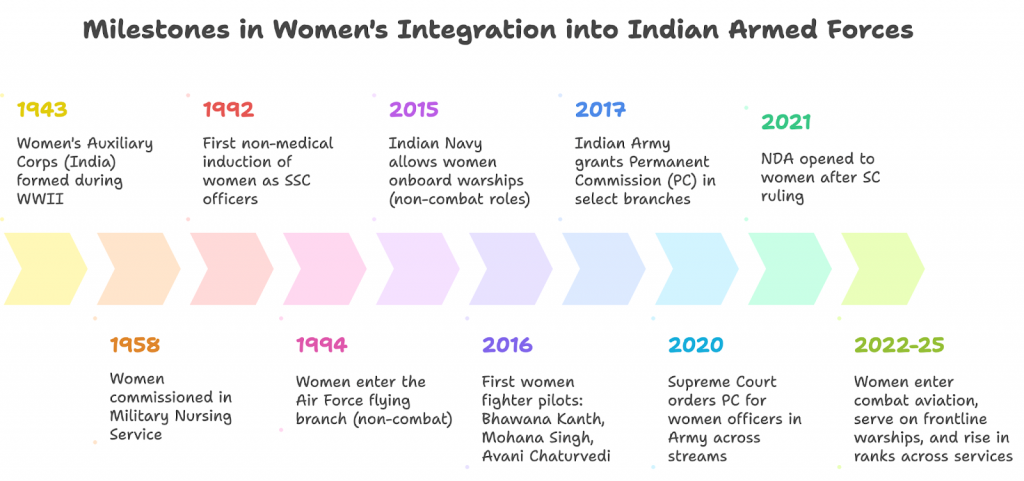
Current Status and Progress
- As per the data from the Ministry of Defence (MoD), women form 13.4% of the Indian Air force workforce — the highest among all three services — while they make up 6.85% of the Army’s workforce and 6% of the Navy’s.
- In 2024, there were a total of 1,735 women in the Army, 1,614 in the Air Force, and 674 in the Navy.
- In 2005, the figures were 767, 574, and 154, respectively.
- Twelve branches in the Army are open to women officers, including combat.
- In the Navy, all branches are open for women officers except submarines.
- All branches of the Air Force are open for women officers.
Importance of Women in Armed Forces
- Diversity of Thought and Experience: Women bring diverse perspectives, creative solutions, and unique problem-solving approaches, leading to better decision-making and improved mission outcomes.
- Enhanced Operational Capability: As modern warfare demands expertise in technology, intelligence, communication, and logistics, women significantly contribute to these domains, boosting the armed forces’ operational readiness and adaptability.
- Gender-Neutral Talent Pool: Including women expands the available talent pool, helping the military meet recruitment needs and tap into a broader spectrum of skills and leadership potential.
- Role Models and Social Change: Colonel Sofiya Qureshi of the Indian Army, who led the Operation Sindoor briefing along with Wing Commander Vyomika Singh of the Air Force, have become an inspiration for women aiming to join the armed forces.
- Resilience and Morale: The presence of women boosts the overall morale, resilience, and discipline of the armed forces. Their exemplary service in diverse roles—from medical corps to pilots to commanding officers—underscores their capability and commitment.
- Meeting Global Standards: Increased participation of women aligns India’s forces with global norms, bolsters its credentials in UN peacekeeping missions, and enhances diplomatic engagement
Existing Challenges
- Sometimes the lack of gender-sensitive facilities in remote postings remains a barrier to full integration.
- Gendered perceptions of leadership styles often undermine women commanding officers.
- Women are still excluded from frontline combat roles due to logistical and cultural concerns.
Source :TH
Previous article
News In Short 04-08-2025
Next article
6 Years of Abrogation of Article 370
