
 80813-00200


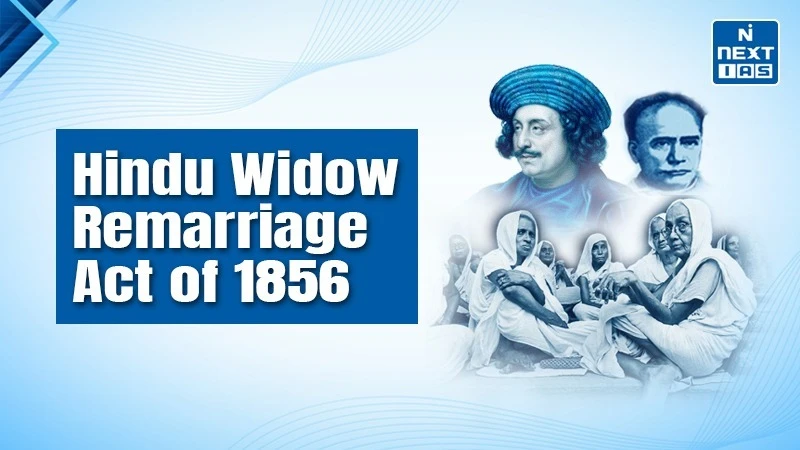
The Hindu Widow Remarriage Act of 1856 legalized and allowed the remarriage of Hindu Widows in British India and ensured the complete legitimacy to their children. It was passed on 16th July 1856 and enacted on 26th July 1856. It was drafted under Lord Dalhousie and was passed by Lord Canning. Ishwar Chandra Vidyasagar used the vedic scriptures to challenge the orthodox Hindu customs and traditions. As per section 2 of the act, the women lost all inheritance rights, maintenance and property claims from their 1st deceased husband. This orthodox opposition to the intervention of the state in personal laws led to the Revolt of 1857 which was popularly known as the 1st war of Indian Independence.
Historical Context of Hindu Widow Remarriage Act
- In the 19th-century, Hindu widows faced severe hardships due to orthodox traditions in India. The existing social norms compelled the hindu widow to live in austerity after the death of their husband. Many times, these women were as young as 10 years old in child marriages. They used to cut their hair and keep it short, wore only white cloth and avoided attending celebrations. They were often economically dependent on their sons or other relatives. This was the main reason which sometimes forced them to beg or engage in prostitution.
- The Bengal Renaissance further promoted the reforms in the society. Widow immolation was banned under the Sati Regulation in 1829 by the continuous efforts of Raja Ram Mohan Roy. However, widow remarriage was still prevalent and considered a taboo and adultery in the ancient scriptures such as Manusmriti.
- Ishwar Chandra Vidyasagar was a Sanskrit scholar and inspector of schools. He strongly advocated for remarriage of childless or young widows in 1850 as mentioned in ancient texts such as Parashara Smriti.
- There were many petitions which collected about 987 signatures and were discussed in the Legislative Council despite opposition from traditionalists who feared dilution of their property. Lord Dalhousie was in favor of the bill which was passed on 16th july 1856 and enacted on 26th july 1856. This act was the 1st secular legislation on Hindu personal law. It was an extension of the reforms introduced by the Caste Disabilities Removal Act of 1850. It initiated colonial intervention in social problems and also being cautious about cultural feelings.
Detailed Provisions of the Act
- The Hindu Widow Remarriage Act, 1856 comprises a Preamble and 7 sections which balances the legalization of the act with appropriate safeguards.
- The following table explains the key provisions & important sections of the act.
| S.No. | Section | Important Provision |
|---|---|---|
| 1 | Section 1 |
|
| 2 | Section 2 |
|
| 3 | Section 3 |
|
| 4 | Section 4 |
|
| 5 | Section 5 |
|
| 6 | Section 6 |
|
| 7 | Section 7 |
|
What was the Immediate Impact of the Act?
- After the legislation, the Act resulted in a gradual increase despite the opposition.
- Vidyasagar performed the first remarriage in Calcutta on December 7, 1856, of 14-year-old Ram Kumari, which was advertised to make it acceptable in society.
- In 1858, 15 remarriages occurred in Bengal, and the number gradually rose to hundreds per year by 1880, as it was restricted by social acceptability.
- It led to legislation, resulting in the 1860 Female Infanticide Prevention Act and the 1872 Native Marriage Act.
- It provided widows with a feeling of freedom, with examples such as Bindumoyee's remarriage in 1857 going against the courts.
- It led to political discussions, with added strength to the Brahmo Samaj and Arya Samaj movement for women's education.
- It reduced the number of poor widows, although the ones involved were declared excommunicated by the caste panchayats.
- It altered the manner of public discourse on the topic, from prohibition to conditional acceptance, which led to legislation in the 20th century.
Criticisms & Limitations
The penal provisions of the hindu remarriage act of 1856 were severely criticized. The provision of total loss property under Section 2 of the act was a strong disincentive and compelled widows to stay in abusive natal homes or beg as mentioned by famous social reformer Behramji Malabari.
It did not provide for maintenance which was usually an impractical assumption in joint families. The consent for minors was one-sided and favoured the paternal relatives which could result in forced remarriages for property gain. There were no provisions for older widows or those with children. The caste endogamy which is the marriage within one's own caste or social group, was also continued which further limited the marriages. There was also gender discrimination as widowers (male person) were free to remarry without any restrictions.
FAQs about Widow Remarriage Act
Who was the supporter of the Widow Remarriage Act?
The supporter of the act was Ishwar Chandra Vidyasagar who relied on ancient texts to support the legalization of widow remarriage.
What did Section 2 of the Widow Remarriage Act state?
The section 2 of the act states that the widow loses all rights of her first husband's property after remarriage.
When was the first widow remarriage held under the Act?
The first widow remarriage was held on 7th December 1856 in Calcutta. It was organized by Ishwar Chandra Vidyasagar.
Which communities did the Widow Remarriage Act apply to?
The Widow Remarriage act of 1856 applies to Hindus, Sikhs, Jains, and Buddhists but not on Muslims and Christians.
Was the Widow Remarriage Act an immediate success?
No, the act was not an immediate success as it was considered a social taboo. Moreover, it restricted the number of remarriages to a few hundred every year despite being made legal.
