
 80813-00200


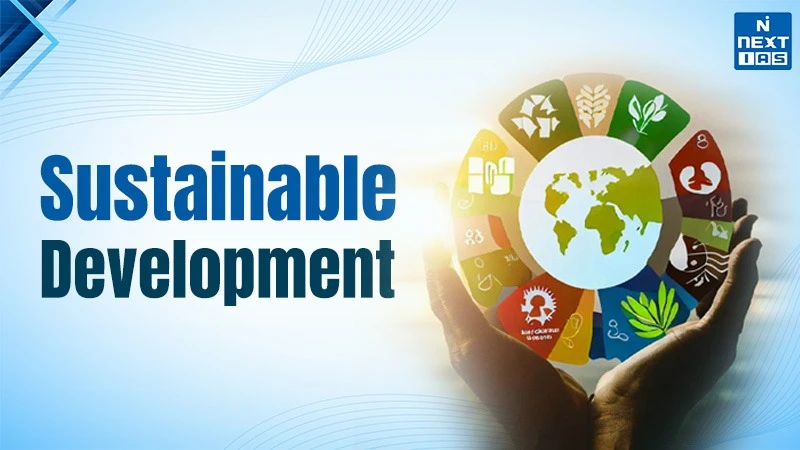
Definition of Sustainable Development is a long-term approach to development and planning that ensures the present needs are fulfilled with 'due consideration' of future generations. It maintains a balance among 3 pillars of Environment means biodiversity conservation, Social means prioritizing human rights and health, Economic means wealth creation without depleting resources. Governments enforce global frameworks like the SDGs while Industries shift to circular economy and net-zero norms to ensure long-term, responsible Economic prosperity.
On its practical implementation, the United Nations in 2015 adopted 17 Sustainable Development Goals (SDGS) to be achieved by the year 2030. Interestingly with the 'circular economy', many companies are designing or manufacturing their products so that they can be re-assembled and reused. Moreover, the waste material like heat and carbon dioxide can be used as fuel in neighbouring factories.
The '15 minute city' is an urban planning concept where every necessity such as food, work, health and education are available within a 15 minute walk or bike-ride. Additionally, regenerative agriculture which includes techniques like no-till farming, is a farming practice which not only sustains but also heals the soil.
Meaning of Sustainable Development
- "Sustainable Development" is a development that meets the needs of the present without compromising the ability of future generations to meet their own needs.
List of Sustainable Development Goals
| No. | Sustainable Development Goal |
|---|---|
| SDG 1 | No Poverty – End poverty in all its forms everywhere. |
| SDG 2 | Zero Hunger – End hunger, achieve food security and promote sustainable agriculture. |
| SDG 3 | Good Health and Well-being – Ensure healthy lives and promote well-being for all. |
| SDG 4 | Quality Education – Ensure inclusive and equitable quality education and lifelong learning opportunities. |
| SDG 5 | Gender Equality – Achieve gender equality and empower all women and girls. |
| SDG 6 | Clean Water and Sanitation – Ensure availability and sustainable management of water and sanitation. |
| SDG 7 | Affordable and Clean Energy – Ensure access to affordable, reliable, sustainable and modern energy. |
| SDG 8 | Decent Work and Economic Growth – Promote sustained, inclusive and sustainable economic growth and decent employment. |
| SDG 9 | Industry, Innovation and Infrastructure – Build resilient infrastructure and promote sustainable industrialisation and innovation. |
| SDG 10 | Reduced Inequalities – Reduce inequality within and among countries. |
| SDG 11 | Sustainable Cities and Communities – Make cities and human settlements inclusive, safe, resilient and sustainable. |
| SDG 12 | Responsible Consumption and Production – Ensure sustainable consumption and production patterns. |
| SDG 13 | Climate Action – Take urgent action to combat climate change and its impacts. |
| SDG 14 | Life Below Water – Conserve and sustainably use oceans, seas and marine resources. |
| SDG 15 | Life on Land – Protect terrestrial ecosystems, forests, biodiversity and land resources. |
| SDG 16 | Peace, Justice and Strong Institutions – Promote peaceful societies, justice and accountable institutions. |
| SDG 17 | Partnerships for the Goals – Strengthen global partnerships for sustainable development. |
Features of Sustainable Development
- Intergenerational Equity: This policy makes sure that needs of the present generation are satisfied without affecting the capacity of the future generation to satisfy its own needs.
- Integration of Environment and Development: It emphasizes the inclusion of environmental aspects within social and economic policies, since healthy ecosystems are necessary for sustainable development.
- Inclusive Economic Growth: This policy highlights the significance of inclusive economic opportunities, which would benefit the entire population of people, not just the privileged few.
- Social Inclusion and Equity: It stresses on the need of social equity, which means that all people would get access to the basic services, opportunities and resources.
- Sustainable Resource Management: This policy calls for the management of natural resources in an environmentally friendly manner so that they are available for the generations to come.
- Participatory Governance: This policy encourages participation of all stakeholders in the decision making process.
- Resilience and Adaptability: It focuses on building resilience and adaptability within communities.
Major Objectives
The aim of sustainable development are as follows:
- Their primary goal is to completely wipe out poverty while taking care of basic needs and providing individuals with good chances for self-improvement.
- They intend to create economic growth that is environmentally friendly and to develop the cities which will not only be good for the inhabitants but good to the environment and also help cope with the climate change.
- Equality in access to all resources, services, and opportunities will be guaranteed for everyone.
- They will also work towards making the world more eco-friendly and less dependent on fossil fuels by promoting clean energy.
- Emphasis will be on reducing waste and encouraging sustainable consumption and production patterns.
- Moreover, they will make the world a better place to live by developing urban areas that are inclusive, safe, resilient, and sustainable.
- Education will be inclusive and equitable in quality, and opportunities for lifelong learning will be given to everyone so that they will gain the skills and knowledge for living in a sustainable way.
- Striving for similar goals all over the world, the partnership will focus on joining forces among the governments, civil society, and the private sector to reach the sustainable development objectives.
- The health of various age groups will be taken care of along with wellness promotion through the combating of health disparities and making the healthcare essentials more accessible. ll-being for all ages, addressing health disparities and improving access to essential healthcare services.
Need and Importance
- The earth is our common home, and our survival and development depend on the resources provided by the environment. However, these environmental resources are limited.
- Despite increasing human needs, the earth cannot be made bigger and richer to supply our growing demands.
- Our development activities should be enabled to continue growth in the long term; future generations must get what we have. Consequently, we must prudently use resources to let our generation live comfortably.
- Sustainable development is necessary and important to balance our economic, environmental, and social needs, allowing well-being for now and future generations.
- Sustainable development encourages us to conserve and enhance our resource base by gradually changing how we develop and use technologies.
- Countries must be allowed to meet their basic needs of employment, food, energy, water, and sanitation.
- This implies ways in which development activities do not damage the environment. It undoubtedly sets certain limits on human activities. It must be understood that when supply cannot be increased, needs must be reduced.
Sustainable Development in India
- The concept of sustainable development in India aims at a tripartite balance of economic growth, social inclusion and environmental protection.
- The approach is to satisfy current needs without affecting the needs of the future generations.
- India is successful in getting rid of poverty, improving health and education and providing access to clean drinking water.
- The renewable energy capacity is growing very fast and the social protection of more people is becoming a reality. But, still, there are challenges to tackle like reducing inequality, the sustainable management of natural resources and climate change.
- According to the 2025 SDG Index, India holds the 99th position out of 193 countries, which denotes a considerable uplift but also points to the necessity of the ongoing efforts to meet the United Nations Sustainable Development Goals by 2030.
Strategies of Sustainable Development
- India's approaches for sustainable development prioritize decarbonization, green energy expansion, and inclusive economic growth.
- The main activities include the use of renewable energy (solar, wind, and green hydrogen), bettering the energy efficiency, and the application of low-carbon technologies.
- Eco-friendly industries are encouraged by the Government schemes such as the Green Credit Programme (2025), National Solar Mission, and Production-Linked Incentives for clean tech.
- Sustainable agriculture is promoted which leads to crop diversification, regenerative farming, and water conservation, thus making the rural areas more resilient.
- Efforts go on the same lines with green infrastructure, waste management, and urban sustainability.
- These strategies facilitate India in the quest of reaching the net-zero target by 2070 and also assist in the implementation of the UN 2030 Sustainable Development Agenda.
FAQs
How many sustainable development goals are there?
There are 17 Sustainable Development Goals (SDGs).
What is sustainable development?
Sustainable development is meeting the needs of the present without compromising the ability of future generations to meet their own needs.
