
 80813-00200


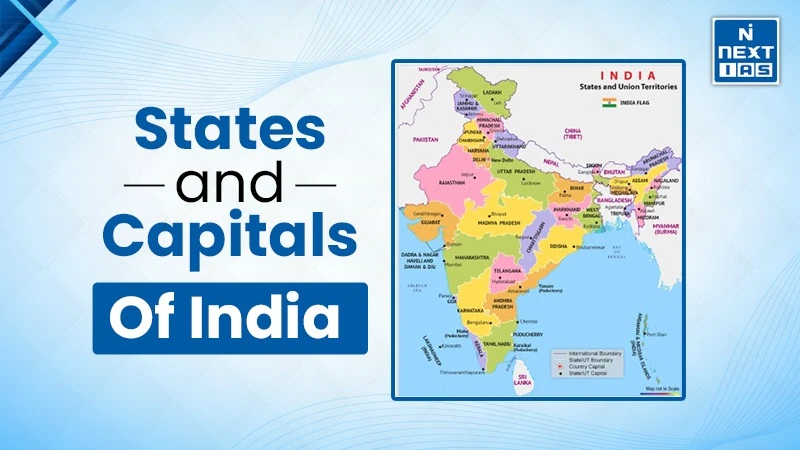
There are total 28 states and 8 union territories in India. Each state has a unique capital serving as its administrative, political, and cultural centre. The states and union territories reflect the rich regional diversity of the country. It is essential to understand states and their capitals for having an awareness of India's geography, governance, and cultural diversity.
- India is a significant, cultural, linguistic and diverse nation in the southern part of Asia. To organise this diversity, the nation is divided into these many states.
- States are governed by their legislative assemblies whereas union territories (except Delhi and Puducherry) are administered directly by the central government. The union territories of Delhi and Puducherry have their own legislative assemblies.
Complete List of 28 States and Capitals of India
The following is a list of the 28 total states in india and their respective capitals:
| S.No. | State | Capital |
|---|---|---|
| 1 | Andhra Pradesh | Amaravati |
| 2 | Arunachal Pradesh | Itanagar |
| 3 | Assam | Dispur |
| 4 | Bihar | Patna |
| 5 | Chhattisgarh | Raipur |
| 6 | Goa | Panaji |
| 7 | Gujarat | Gandhinagar |
| 8 | Haryana | Chandigarh |
| 9 | Himachal Pradesh | Shimla |
| 10 | Jharkhand | Ranchi |
| 11 | Karnataka | Bengaluru |
| 12 | Kerala | Thiruvananthapuram |
| 13 | Madhya Pradesh | Bhopal |
| 14 | Maharashtra | Mumbai |
| 15 | Manipur | Imphal |
| 16 | Meghalaya | Shillong |
| 17 | Mizoram | Aizawl |
| 18 | Nagaland | Kohima |
| 19 | Odisha | Bhubaneswar |
| 20 | Punjab | Chandigarh |
| 21 | Rajasthan | Jaipur |
| 22 | Sikkim | Gangtok |
| 23 | Tamil Nadu | Chennai |
| 24 | Telangana | Hyderabad |
| 25 | Tripura | Agartala |
| 26 | Uttar Pradesh | Lucknow |
| 27 | Uttarakhand | Dehradun |
| 28 | West Bengal | Kolkata |
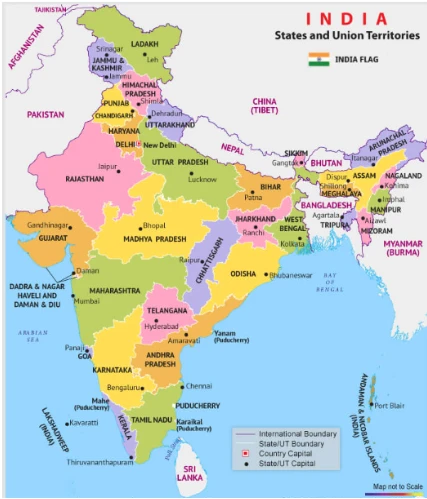
List of India's 8 Union Territories and their Capitals
India has a total of 8 union territories. Their respective capitals are listed as follows:
| S.No. | Union Territory | Capital |
|---|---|---|
| 1 | Andaman and Nicobar Islands | Port Blair |
| 2 | Chandigarh | Chandigarh |
| 3 | Dadra and Nagar Haveli and Daman and Diu | Daman |
| 4 | Delhi (National Capital Territory) | New Delhi |
| 5 | Jammu and Kashmir | Srinagar (Summer), Jammu (Winter) |
| 6 | Ladakh | Leh |
| 7 | Lakshadweep | Kavaratti |
| 8 | Puducherry | Puducherry |
Evolution of States & Capitals in India
The states and capitals of India evolved through the States Reorganization Act of 1956. The act delimited state boundaries based on linguistic and cultural identities of the people of India. Over the period of time, modern states have emerged from ancient kingdoms and British provinces. It gradually shaped India's diverse federal structure.
- India became a sovereign democratic republic on the day when the constitution of the nation was adopted on 26 January 1950. With time, the political boundaries of the states were modified to address the cultural, linguistic and administrative requirements.
- The state of Telangana was the latest state which was formed in 2014 under the States Reorganization Act of 1956. The state has been formed out of Andhra Pradesh.
Unique Facts About Few State Capitals
- The capital of Telangana - Hyderabad was earlier served as the capital city for both Andhra Pradesh and Telangana after the state's bifurcation in 2014. Although, the city of Amaravati has now been designated as the new capital for Andhra Pradesh.
- The capital of Maharashtra serves as the Financial capital of India whereas the capital of the country serves as the administrative capital.
- The National Capital Territory (NCT) serves as the nodal centre for central government, Rashtrapati Bhavan and foreign embassies.
- Kargil and Leh are the important towns, both of which lie in the UT of Ladakh and were established in 2019.
Official and Major Local Languages of Indian States
| No. | State | Official Language(s) | Major Local / Regional Languages |
|---|---|---|---|
| 1 | Andhra Pradesh | Telugu; Urdu | Telugu, Urdu, Tamil, Kannada, Odia |
| 2 | Arunachal Pradesh | English | Nyishi, Adi, Apatani, Monpa, Galo, Tagin |
| 3 | Assam | Assamese, Bodo, Bengali | Assamese, Bodo, Bengali, Karbi, Mishing, Dimasa |
| 4 | Bihar | Hindi; Urdu | Maithili, Bhojpuri, Magahi, Angika, Urdu |
| 5 | Chhattisgarh | Hindi; Chhattisgarhi | Chhattisgarhi, Gondi, Halbi, Kurukh |
| 6 | Goa | Konkani; Marathi | Konkani, Marathi, Kannada, Portuguese |
| 7 | Gujarat | Gujarati | Gujarati, Hindi, Bhili, Marathi, Sindhi |
| 8 | Haryana | Hindi | Haryanvi, Punjabi, Urdu |
| 9 | Himachal Pradesh | Hindi; Sanskrit | Pahari varieties, Kangri, Mandeali, Kinnauri |
| 10 | Jharkhand | Hindi | Santali, Mundari, Ho, Kurukh, Nagpuri, Khortha, Kurmali |
| 11 | Karnataka | Kannada | Kannada, Tulu, Konkani, Kodava, Urdu, Marathi |
| 12 | Kerala | Malayalam | Malayalam, Tamil, Kannada, Tulu, Konkani |
| 13 | Madhya Pradesh | Hindi | Malvi, Bundeli, Bagheli, Nimadi, Gondi, Bhili |
| 14 | Maharashtra | Marathi | Marathi, Hindi, Urdu, Konkani, Gujarati, Bhili |
| 15 | Manipur | Meitei (Manipuri); English | Meitei, Tangkhul, Thadou, Paite, Hmar, Rongmei |
| 16 | Meghalaya | English | Khasi, Garo, Jaintia/Pnar, Bengali |
| 17 | Mizoram | Mizo; English | Mizo, Lai, Mara, Hmar, Chakma |
| 18 | Nagaland | English | Ao, Angami, Sumi, Lotha, Konyak, Chakhesang |
| 19 | Odisha | Odia | Odia, Sambalpuri, Kui, Santali, Ho, Mundari |
| 20 | Punjab | Punjabi | Punjabi, Hindi, Urdu, Dogri |
| 21 | Rajasthan | Hindi | Rajasthani varieties, Marwari, Mewari, Dhundhari, Harauti, Wagdi |
| 22 | Sikkim | Nepali, Sikkimese, Lepcha, English | Nepali, Bhutia/Sikkimese, Lepcha, Limbu, Tamang, Rai |
| 23 | Tamil Nadu | Tamil | Tamil, Telugu, Kannada, Malayalam, Urdu |
| 24 | Telangana | Telugu; Urdu | Telugu, Urdu, Lambadi/Banjari, Marathi, Kannada |
| 25 | Tripura | Bengali, Kokborok; English | Bengali, Kokborok, Reang/Bru, Chakma, Manipuri |
| 26 | Uttar Pradesh | Hindi; Urdu | Hindi, Urdu, Awadhi, Bhojpuri, Braj, Bundeli, Kannauji |
| 27 | Uttarakhand | Hindi; Sanskrit | Garhwali, Kumaoni, Jaunsari, Hindi, Bhotiya varieties |
| 28 | West Bengal | Bengali; English | Bengali, Nepali, Hindi, Santali, Urdu, Kurmali, Rajbanshi |
Importance of Capitals
State capitals play a crucial role and serve as the administrative centers for better governance. The capitals of any state includes:
- Raj Bhavan
- State Legislative building
- State Secretariat and the office of the Chief Minister
- High Court
These state capitals usually consist of advanced infrastructure, educational institutions, healthcare facilities, and transportation networks as an outcome of their political and administrative significance.
Northern and Southern States of India
| S.No. | Northern States | Southern States |
|---|---|---|
| 1 | Uttar Pradesh | Andhra Pradesh |
| 2 | Haryana | Telangana |
| 3 | Himachal Pradesh | Karnataka |
| 4 | Punjab | Kerala |
| 5 | Uttarakhand | Tamil Nadu |
| 6 | Rajasthan | - |
The total GSDP of 6 northern states is about Rs. 80 Lakh crore whereas the total GSDP of 5 southern states is about Rs. 117 Lakh crore. The figure clearly indicates that the share of southern states have higher economic contribution. However, the southern states are allocated the smaller share of union capital expenditure and funds also the debate of lesser political representation remains an issue. This is due to the reason that the government favors the development of less developed regions such as North-east India and highly populated north India.
Conclusion
India's political and administrative bodies, that includes states and union territories, are essential for governing the large and diverse population. Each state possesses a distinct language, cultural past that is reflected in the character of its capital city. The awareness of the states and their capitals is important for academic study and for understanding the country's federal governance and regional diversity.
FAQs about States and Capitals of India
How many states and union territories are there in India?
There are 28 states and 8 union territories in India.
Which is the capital of India?
The capital of India is New Delhi and also serves as the National Capital Territory.
Which state in India has Amaravati as its capital?
Amaravati is the capital of Andhra Pradesh.
Which is the capital of Telangana?
The capital of Telangana is Hyderabad.
What are the capitals of Jammu and Kashmir?
Jammu and Kashmir have two capitals: Srinagar in summer and Jammu in winter.
Which city is the capital of Maharashtra?
Mumbai is the capital of Maharashtra and the city is also considered the financial capital of India.
Which city serves as the capital of two different states?
Chandigarh is the capital of both the states of Punjab and Haryana and it is also a union territory.
