
 80813-00200

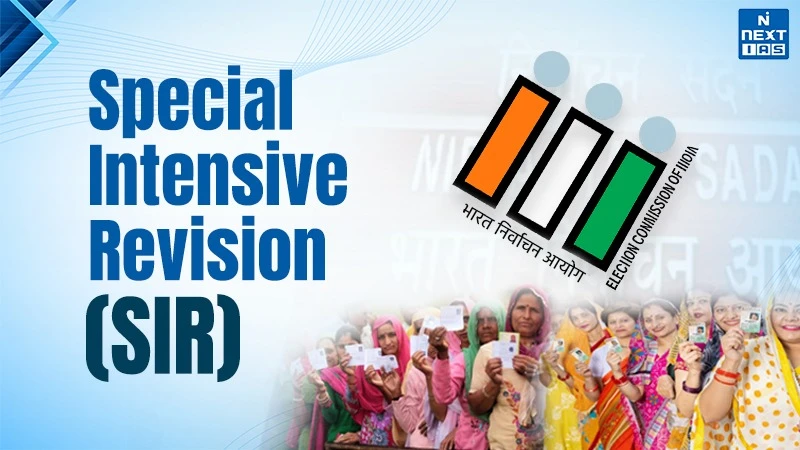
SIR full form is Special Intensive Revision. It is the practice of the Election Commission of India to verify voters' information. This process is completed through the appointed Booth Level Officer (BLO) of the specific region. While summary revisions are merely routine annual paperwork, an SIR is nothing but a detailed demographic overhaul of every household. The current nationwide process began at the end of 2025 and reached its 3rd stage by mid-2026.
Need of Special Intensive Revision
- Several reasons like the fast pace of urbanisation,
- Frequent migration and registration of young citizens who can vote,
- The omission of death information and inclusion of names of foreigners illegally residing in India have made it necessary to undertake an intensive revision process to keep the electoral rolls free from any errors and to maintain their integrity.
What is SIR Process of Voters Verification?
Step 1: Door-to-Door Survey (The Enumeration Phase)
The basic step in SIR is physical verification. For this, the ECI uses a large number of field officials to conduct this phase:
Physical Verification: Thousands of Booth Level Officers (BLOs) physically visit each and every household within their designated polling area.
Form Distribution: Rather than asking people to print the form, BLOs issue the pre-printed enumeration forms to citizens to confirm their living status.
Step 2: Validation of Data through Algorithms
When the field data is gathered, then it goes through the process of technical and administrative cross-validation to detect the errors:
De-duplication software: Through the use of algorithms, the data stored in the computer database is searched for any discrepancy, same pictures or same names in other polling booths.
Identifying 'Ghost Voter': The software helps identify any such entry which shows death, double registration, or migration due to urbanization.
Step 3: Public Scrutiny (Claims and Objections Window)
Post compilation of the preliminary field data, the draft electoral roll is made public and a stringent timeline is set for transparency:
Claims of Errors or Registration: Citizens can file claims to remove any mistakes or get themselves registered if missed out. This can be done via prescribed statutory forms:
Form 6: For new registrations.
Form 7: To raise objections to entries or seek deletion.
Form 8: For correction of particulars and residence shift.
Political Collaboration: The political parties have permission to appoint Booth Level Agents (BLAs), who can submit as many as 50 forms in a day from citizens residing locally to help the official machinery of the state.
Step 4: Stringent Legal Safeguards and Hearings
In order to avoid disenfranchisement or removal of names in an arbitrary manner (in the aftermath of several important legal pronouncements), the ECI has to strictly adhere to the following regulatory guidelines:
Notice: No name can be removed from the log unless a proper notice and hearing is granted to the concerned person.
Step 5: Final Release of the Cleaned-up Rolls
After all objections are heard and resolved and the information in the master database has been updated, the ECI puts together the final data. This leads to a highly accurate, up-to-date and legally sound list of voters which represents the true and verified electorate of the area.
FAQs about SIR
What is the full form of SIR?
The full form of SIR is Special Intensive Revision.
What is SIR?
The SIR is an annual or periodic effort by the Election Commission to update the Electoral Rolls, the official list of eligible voters.
