
 80813-00200


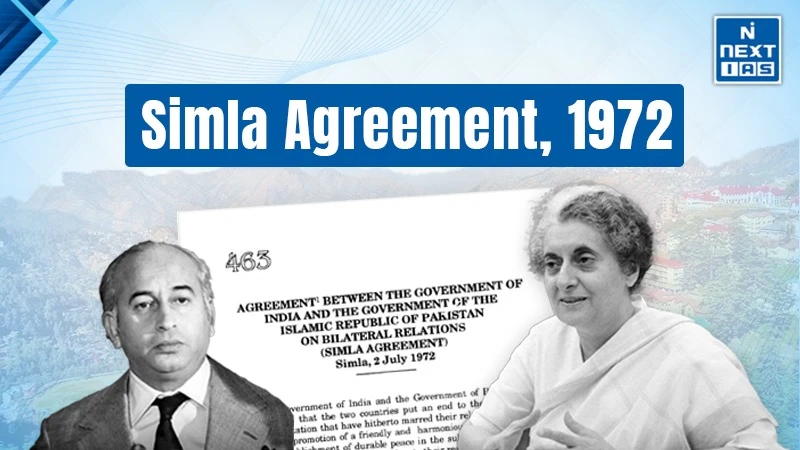
The Simla Agreement was an outcome of the India-Pakistan War 1971 which led to the creation of a new country Bangladesh. The agreement was a historic peace treaty signed between Indian Prime Minister Indira Gandhi and Pakistani President Zulfikar Ali Bhutto on 2nd July 1972 in Simla, Himachal Pradesh.
As per the agreement, all the remaining disputes between India and Pakistan including the Kashmir issue, were to be resolved through direct and peaceful bilateral negotiations without any foreign intervention. Moreover, the ceasefire line was converted into the Line of Control (LoC).
The agreement also includes respecting each other's territorial integrity and return of 90,000 prisoners of war (PoWs) captured in the 1971 Indo-Pak war. India also gave back more than 13,000 square kilometres of land acquired by India to Pakistan. Both the nations restored trade, travel, cultural exchanges and diplomatic relations.
1971 की लड़ाई के बाद, 2 जुलाई 1972 को भारत और पाकिस्तान के बीच शिमला समझौता हुआ। इस समझौते के अनुसार, भारत और पाकिस्तान के बीच सभी मुद्दों को बिना किसी बाहरी दखल के शांतिपूर्ण तरीकों से सुलझाया जाना था।
Important Provisions of Shimla Agreement
The Simla agreement was meant for peaceful relations between India and Pakistan after the 1971 war. The main provisions of the agreement were as follows:
- Bilateral Disputes Resolution: The issues of Jammu & Kashmir would be resolved directly by peaceful negotiations without the third party's intervention or any type of International intervention.
- Recognition of the Line of Control (LoC): The 1971 ceasefire line in Jammu & Kashmir was officially identified as the LoC. Both India and Pakistan committed to officially recognise it without any unilateral modification. They also refrained from the threats or use of any kind of force across the line of control.
- Mutual Respect of Sovereignty: The two countries agreed upon respecting each other's territorial integrity and political sovereignty.
- Return of Captured territories: During the 1971 war, India captured more than 13,000 sq. kms of land in the Sindh region of west pakistan. After the Simla Agreement, India returned the acquired territory back to Pakistan and restored the International border.
- Repatriation of Prisoners of War (POWs): India agreed to return about 90,000 Pakistani POWs which were captured during the 1971 Indo-Pak war. It was one of the largest exercises to return war prisoners in modern history.
- Withdrawal of Forces: The armed forces were asked to withdraw their forces on either sides of the Line of Control and international border to minimize tensions between both the nations.
- Non-use of Force: Both India and Pakistan pledged not to utilize force against each other and reaffirmed the peaceful coexistence.
Contemporary Issues of Simla Samjhota
India suspended the Indus Waters Treaty after the Pahalgam terror attack. In retaliation, Pakistan suspended the Simla Agreement in April 2025. The following are the contemporary issues related to the Simla Agreement:
| S.No. | Issues | Details |
|---|---|---|
| 1 | Dilution of Bilateralism | The suspension of the Simla agreement worsened the idea of solving problems by direct negotiations. |
| 2 | Increase in Cross Border Security Violations | The state sponsored infiltration, continuous cease fire violations and proxy wars have increased without an effective peace plan. |
| 3 | Nuclearization of South Asia | The growing nuclear capabilities led to pose a risk to the regional stability in south asian regions. |
| 4 | Strategic Leverage to India | It can enable India to get tougher on terrorism and review its policy over Pakistan occupied Kashmir (PoK) and bilateral relations with Pakistan. |
| 5 | Effect on Regional Cooperation | Regional institutions such as SAARC may not achieve their goals and thus, there will be a lack of cooperation in matters of trade and security. |
Limitations of the Simla Agreement
The agreement was meant for a peaceful co-existence of neighbouring countries of India and Pakistan. However, many historians and defence experts have found few limitations in the agreement which are as follows:
- Lack of a binding mechanism: The treaty lacked robust enforcement mechanisms and deadlines for resolving bilateral issues such as the pending resolution of the Kashmir issue.
- Cross Border terrorism: The agreement lacked the permanent provision on the issues such as the proxy wars and other intrusion.
- Siachen Issue: The agreement lacked a precise demarcation at the Siachen glacier regions which led to the Operation Meghdoot in 1984.
- Repeated Ceasefire Violations: The incidents of Siachen in 1984, Kargil in 1999, and constant violations of ceasefires undermined the credibility of simla agreement.
- Civil-Military Politics in Pakistan: The simla agreement was signed between the Prime Ministers of both the countries. But the Pakistani military leadership never respected the agreement that led to the Kargil war of 1999. This was the time when the Indian Airforce launched Operation Safed Sagar to support the Indian Army to reach and acquire the high mountain peaks in Kargil.
- Poor Engagement: Trade and cultural exchange was constantly shattered with the political tensions and the historical anger among people.
Way Forward
- Strengthen Bilateral Interaction: Both the nations must keep up direct talk in the same spirit of the agreement.
- Empower Border Management: The deployment of modern technologies such as drones, satellite surveillance, and smart fencing should be increased to ensure effective management at the border regions.
- Enhance Institutional Co-ordination: More effective coordination should be enhanced between security agencies and renewed standard procedures.
- Mobilise Global Support: India must seek the cooperation of its international allies and position itself as a responsible nation partner.
- Support Humanitarian Ideals: The processes like human treatment and re-patriation of inmates must be sustained to strengthen the morality of India.
FAQs about Simla Pact
What is the Simla agreement?
The Simla Agreement is a bilateral peace agreement signed by India and Pakistan in 1972.
When was the Simla Agreement signed?
The Simla Agreement was signed on 2nd July 1972.
Which countries signed the Simla Agreement?
The Simla Agreement was signed between India and Pakistan.
