
 80813-00200


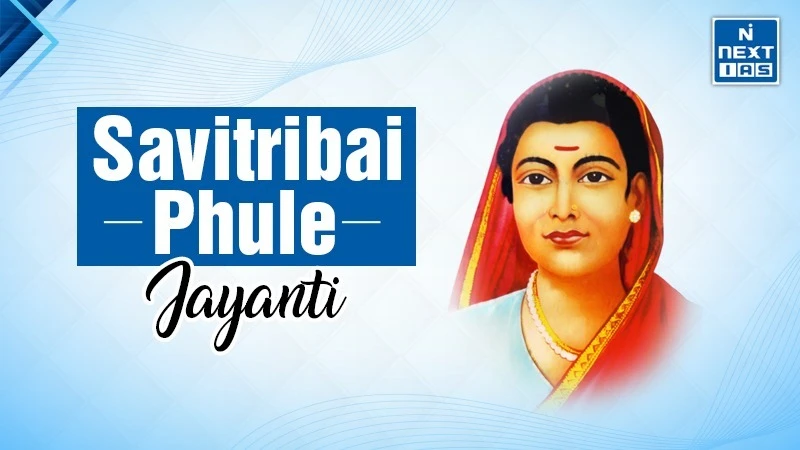
Savitribai Phule Jayanti is observed on 3rd January every year. It marks the birthday of Savitribai Phule who was India's 1st feminist, 1st female teacher and a great social reformer. Savitribai Phule was born on 3rd January 1831 in Naigaon in Satara district in present day Maharashtra. She belongs to the Mali caste and lived at the time when the domination of brahminism or upper caste denied education to people and particularly to women belonging to the lower caste. On the contrary, she adopted a brahmin child and named him Yashwantrao.
She fought for the rights of women and castes along with her husband Jyotirao Phule. Savitribai Phule faced numerous hardships in her journey of social reforms. For example, she was pelted with stones at the time of establishing the first school for girls at Bhide Wada in Pune in 1848. She has always been an inspiration to many people around the world.
She opened up a clinic at the time of plague of 1897. She used to serve the patients herself until she also fell ill and eventually died on 10th march 1897 at the age of 66 years.
सावित्रीबाई फुले एक समाज सुधारक, शिक्षाविद और कवयित्री थीं। उन्हें आधुनिक भारत की पहली महिला शिक्षिका के रूप में जाना जाता है। अपने पति ज्योतिराव फुले के साथ मिलकर, उन्होंने महिलाओं के अधिकारों के लिए काम किया और 1848 में पुणे के भिड़े वाडा में भारत में किसी भारतीय द्वारा लड़कियों के लिए पहला स्कूल शुरू किया।
Historical Context
- The Savitribai Phule Jayanti is celebrated as 'Balika Din' or girl child day and includes school events, speeches on women rights, and cultural processions in schools and educational institutions. The event is often organized by higher educational institutions such as the Savitribai Phule Pune University which was previously regarded as the Fergusson College.
- The Savitribai phule jayanti was transformed into a tool which gave political and social resistance during the social justice movement in Maharashtra during the 1990s.
- Additionally, monuments in honour of her name were established in Maharashtra such as 'Savitribai Phule statue' in Nashik and 'Mahatma Phule Wada' which is a historic residence and workplace of Savitribai and her husband Jyotiba Phule.
- In the contemporary period, the issue of gender based violence is on its rise, and the savitribai phule Jayanti focusses on her poem 'Go, Get Education'. Her poem sensitizes society and appeals to the oppressed groups of people and women to acquire knowledge through education.
Major Contributions of Savitribai Phule
- The contributions made by Savitribai Phule revolutionized Indian society through education, anti-caste movements, and women empowerment.
- After opening a girl's school in 1848 in Pune, she established 18 more schools by the year 1851. After one year, Savitribai Phule with her husband Jyotirao Phule established the Mahila Seva Mandal in 1852 to fight against the women's suicides and child marriages.
- Although she was not an advocate but provided free legal assistance to marginalized groups and women in her own capacity. She also imparted skills training to the needy people.
- Savitribai Phule inaugurated a public well for dalit people in 1868 during her anti-untouchability campaigns. After a few years, she founded about 52 orphanages at the time of famine from 1876 to 1878 which ultimately supported the feeding of thousands of children.
- Her book titled 'kavya phule' was written in 1854. It opposed patriarchy and advocated widow re-marriage through her editorials which used to be published in the deenbandhu journal.
- The historic events and work led by Savitribai Phule motivated other later social reformers such as Periyar and Ambedkar.
Significance
- The Savitribai Phule Jayanti is very important because it denotes gender and caste equality in modern India. She was the founder of literacy for women whose work has motivated modern leaders to introduce schemes such as 'Beti Bachao Beti Padhao'.
- The day is marked with events such as seminars based on women rights in school, colleges and universities. The jayanti emphasizes on the issues such as female foeticide, school dropouts particularly girl child, and caste based crimes.
- The life history of Savitribai Phule is included in the school syllabus so that lakhs of students get inspiration and lessons from her journey.
Social Reforms by Shri Savitribai Phule
- Savitribai Phule initiated reforms by addressing the social evils of caste and gender discrimination during the 19th century in India. Her struggle for the rights of widow re-marriage helped abolish practices associated with sati and provided shelter with necessary counseling to women.
- She advocated for cleanliness and hygiene which was an uncommon phenomenon during those days through distribution of sarees and books. She displayed her bravery during the plague which became an example of public health reform.
- She established the relation between caste and slavery in line with the philosophy and a seminal work of her husband Jyotirao named as 'Gulamgiri'.
- Savitribai also educated women in crafts for self-reliance and thus increasing their decision making role in their family and society.
FAQs about Mata Savitribai Phule
On which day is the Savitribai Phule Jayanti celebrated?
It is celebrated every year on January 3, as she was born on this day in 1831.
Which was the greatest contribution of Savitribai Phule?
Establishing the first girls' school of India in Pune in 1848.
How did Savitribai Phule pass away?
She died from bubonic plague while attending to the sick at her dispensary in 1897.
Who were the founders of Satyashodhak Samaj?
Jyotirao Phule established the satya shodhak samaj on 24 September 1873 to promote caste equality and rational worship.
