
 80813-00200


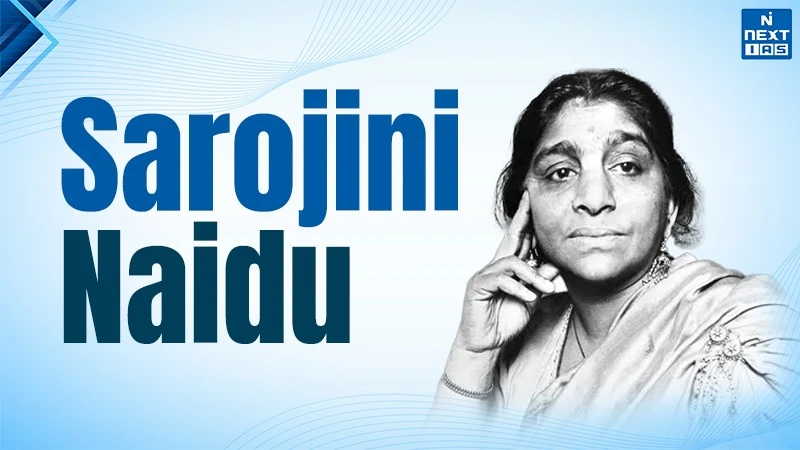
Sarojini Naidu (1879 to 1949) also known as the 'Nightingale of India' by Mahatma Gandhi. She was a poet, orator and freedom fighter. She wrote her first 1,300 line poem at the age of just 13 years and published 'The Golden Threshold' in 1905.
She became the 1st Indian woman poet in English. Her poem 'In the Bazars of Hyderabad' became very famous in India. In 1925, she became the first woman President of the Indian National Congress (INC). After Indian Independence, she was appointed as the first woman Governor of an Indian state i,e. United Province which is present day Uttar Pradesh.
Biography of Sarojini Naidu
| S.No. | Year | Events |
|---|---|---|
| 1 | 1879 |
|
| 2 | 1891 |
|
| 3 | 1895 to 1898 |
|
| 4 | 1898 |
|
| 5 | 1904 |
|
| 6 | 1905 |
|
| 7 | 1917 |
|
| 8 | 1925 |
|
| 9 | 1930 |
|
| 10 | 1942 |
|
| 11 | 1947 |
|
| 12 | 1949 |
|
Role in Indian Freedom Struggle
- Active Leadership in Satyagraha: Sarojini Naidu was actively involved in non-violent resistance and led many protests. She was the woman incharge of Dharasana Salt Works raid in 1930 after the arrest of Mahatma Gandhi.
- First Indian Women INC President: She became the president of the Kanpur session of Indian National Congress (INC). In such capacity, she was involved in crafting the national political planning and mass mobilization.
- Mass Mobilization and Oratorship: She visited various places in India and influenced people by her powerful voice to unite people of different faiths and inspire youth.
- Representing India abroad: She represented India on global platforms such as the 2nd round table conference at London in 1931. She always urged for the Indian self rule by Indian people.
- Imprisoned for Nation: Sariojini Naidu was arrested many times in the Indian Freedom movement such as Non Cooperation movement, Civil Disobedience movement, and Quit India Movements.
Contributions in Women's Movement
- Foundation of Women Organizations: Sarojini Naidu was one of the founders of the Women's Indian Association (WIC) in 1917. She helped in establishing the All India women's Conference (AIWC) in 1927.
- Voting Rights: She led a delegation of women to London in 1917 to demand equal rights for Indian women under British rule.
- Promotion of Female Literacy: She campaigned for Universal girls child education and woked to eliminate the social evils such as child marriage, purdah system, and dowry.
- Political Empowerment: Sarojini Naidu motivated Indian women to join the national freedom movement and public governance.
- Encouraged Gender Equality: She raised her voice for the constitutional guarantees of gender equality and legal rights for women in independent India within the Constituent Assembly.
1st Female Governor of India
- Appointment as Governor: She was appointed as the governor of United Province which is present day Uttar Pradesh on 15th august 1947. She became the 1st female governor of Independent India.
- Symbol of Women Empowerment: Her appointment as the governor of a state set an example for all women that could hold constitutional executive offices in the new republic.
- Selfless Service in lifetime: She worked with dedication at her office until her passing away on 2nd March 1949. She set an example for constitutional governance.
FAQs about Sarojini Naidu
Who is the first lady governor of India?
Sarojini Naidu was the 1st lady governor of India and served in the United Province (Uttar Pradesh).
When Sarojini Naidu died?
Sarojini Naidu died on 2nd March 1949.
