
 80813-00200


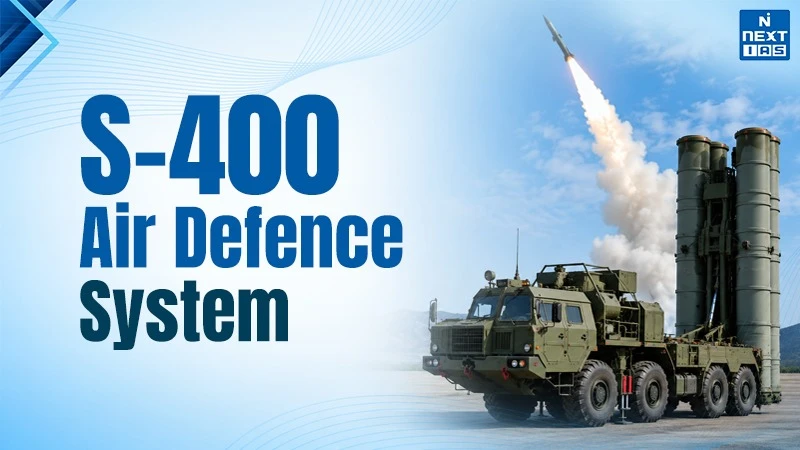
S-400 Defence System, which is alternatively called Sudarshan Chakra in the defence nomenclature of India. It is one of the most advanced long-range air defence systems that India has bought from Russia. India has entered into a deal worth $5.43 billion in October 2018 for buying five squadrons of S-400.
This is mobile surface-to-air missile system developed by the Russian firm Almaz-Antey . It has the ability to detect, track and destroy multiple targets like aircraft, drones, cruise missiles, and some types of ballistic missiles. The engagement range of this air defense system depends upon the type of missiles and the targets and can be around 40km to 400km.
About The S-400 Missile Defence System
- The S-400, developed by Russia, is widely regarded as one of the most advanced long-range surface-to-air missile (SAM) systems in the world.
- In 2018, India signed a 5 billion dollar contract with Russia to purchase five units of the S-400 air defence missile systems that have three parts- Missile launchers, a powerful radar and a command centre.
- The main goal of the S-400 is to offer a long-range umbrella which will be able to detect and destroy incoming strategic bombers, stealth fighters, spy aircraft, and ballistic/cruise missiles.
- With the implementation of this system, India has been able to shift the capabilities of a point defense (protecting individual targets) into regional Defense (protecting regions).
Key Features of the S-400 Missile Defence System
Key Points
- Range: Up to 400 km
- Target tracking: 600 km and above.
- Multi-target engagement capability
- Great mobility and fast deployment.
Performance Metrics:
- Target Engagement: It has the capability of engaging 36 targets at once.
- Speed: The missiles have the capability of traveling at a speed above 14 Mach.
- Altitude: It has the capability of countering targets between 10 meters and 30 km.
- Deployment Time: The system can be combat-ready in 5 to 10 minutes of stop.
There are three major components of the system:
- Missile Launchers
- Advanced Radar Systems
- The Command and Control Unit.
- These elements operate in liaison to form a coherent air defence network that can be used to counter various threats at the same time.
Technical Architecture of the S-400
- The S-400 is a very advanced system that is constructed on a layered architecture, including -.
- Radar Systems: The system utilises the use of a number of radars to carry out surveillance, tracking, and engagement. These radars are capable of tracking hundreds of targets at the same time and also stealth aircrafts.
-
Missile Variants: The S-400 has one of the most unusual
features: it can employ various missile types with different ranges:
- Short-range: ~120 km
- Medium-range: ~200--250 km
-
Long-range: ~380--400 km
- This multi-layered missile structure enables the system to reach threats at different ranges and altitudes.
- Command and Control System: The command centre combines the information provided by radars and prepares missiles launching. It may be used as an independent system or as a component of a bigger air defence system.
- Mobility: The S-400 is placed on mobile launch vehicles, which gives it the capacity to be moved and repositioned in a short period. This improves survivability and flexibility in operations.
Deployment and Operational Status in India
-
The use of S-400 in India has been conducted in strategically
sensitive areas:
- Punjab-Jammu (north-western front) sector.
- Sikkim sector (north- eastern front)
- Rajasthan--Gujarat sector (western front)
- The system is also linked to the India Integrated Air Command and Control System (IACCS), and this allows real-time coordination and response.
- The S-400 defence system also known as the Sudarshan Chakra in Indian service, which meant for its protective and protective purpose.
Capabilities and Advantages
- Long-range Engagement: The S-400 is able to counter threats at a range of up to 400 km and therefore India is able to intercept enemy aircraft even before reaching their air space.
- Multi-Target Capability: The system is able to monitor and attack several targets at the same time which is very effective in countering coordinated attacks.
- Varyability: It is able to intercept - Fighter jets, Cruise missiles, Ballistic missiles and Drones etc.
- High Accuracy: State-of-the-art radar and guidance means that the probability of interception is high.
- Deterrence Value: The existence of the S-400 serves as a psychological deterrent and it prevents enemies to engage in air attacks.
Comparison Among World's Most Advanced Defence System
| System | Country | Type / Role | Range | Key Features |
|---|---|---|---|---|
| S-400 Triumf | Russia (used by India) | Long-range, multi-layered air defence | Up to 400 km | Can intercept aircraft, cruise missiles, ballistic missiles; multi-target tracking; highly versatile |
| THAAD | USA | Ballistic Missile Defence (BMD) | ~200 km (interception) | Exo-atmospheric interception; hit-to-kill technology; focuses only on ballistic missiles |
| Iron Dome | Israel | Short-range rocket defence | ~70 km | Designed for rockets/artillery; high success rate; quick response system |
| HQ-9 | China | Long-range SAM system | ~200--300 km | Based on S-300 technology; comparatively less advanced than S-400 |
| Aegis BMD | USA | Naval ballistic missile defence | ~300+ km | Sea-based system; uses SM-3 missiles; integrated with warships |
Strategic Significance for India
- Enhancing National Security: The S-400 would greatly help in strengthening the air defence capabilities of India making it less susceptible to aerial attacks.
-
Countering Regional Threats :
- Against Pakistan: Disarms fighter jets and missile systems.
- Against China: Covers the Line of Actual Control.
- Multiplier of force: The S-400 is a force multiplier, where it can be combined with other defence systems like fighter aircrafts and localized missiles to increase their performance.
- Integration with Defence Network: The system is linked into the wider air defence system of India including radar systems, satellites and other missile systems.
Challenges and Concerns
- Russian dependency: Indian dependency on Russian defence equipment dependency.has caused issues of vulnerability to supply chain and technological
- CAATSA Sanctions: India is facing the threat of sanctions by the United States under the CAATSA (Countering America Adversaries through Sanctions Act) over the purchase of S-400.
- High Cost: It is a costly system with the deal worth more than 40,000 crore.
- Integration Issues: The introduction of S-400 into other Indian systems needs high-level coordination and infrastructure.
- Delays in Delivery: Geopolitics including the Russia-Ukraine conflict have influenced schedules of delivery.
Way Forward
-
Indigenisation: Fast track projects such as Project Kusha to
ensure that they do not rely on foreign systems.
- Project Kusha: It is the native Long-range Surface-to-Air Missile (LRSAM) program of India that is under development by DRDO.
- Multi-layered Defence: Combine S-400 with other systems such as Akash, BMD and IACCS to provide all-round coverage.
- Network-Centric Warfare: Rely on AI, real-time information exchange, and secure communications to make decisions faster.
- Preparedness to Future Threat: Investment in drone countermeasures, stealth aircraft and hypersonic missiles.
- Cost Efficiency: encourage Make in India and domestic maintenance to save on the long-term expenses.
FAQs
What is the S-400 Defence System?
S-400 Triumf is a Russian-made long-range surface-to-air missile system that detects and shoots down various aerial threats such as fighter jets, drones, cruise and some ballistic missiles.
Which nation developed the S-400 missile system?
Russia's defence firm Almaz-Antey developed the S-400 missile system that is being operated by the Russian Armed Forces since 2007.
When did India make a deal on the S-400 missile system with Russia?
India made a deal with Russia regarding purchase of the S-400 missile systems on 5 October 2018. This deal would improve India's long-range air defence capability.
Mention the range of the S-400 Missile System.
The S-400 Missile System has a range of 400 kilometers depending on the type of missile employed.
Why is S-400 important to Indian defence?
It helps India defend its strategically important regions from aerial attacks from enemy fighter jets and other aerial missiles.
